
By Benny Mwaipaja, Durban
Southern Africa has set out an ambitious blueprint to transform itself from a supplier of raw commodities into a globally competitive manufacturing hub, with governments, financiers and businesses agreeing that the region’s future prosperity will depend on processing its own resources rather than exporting them in their raw form.
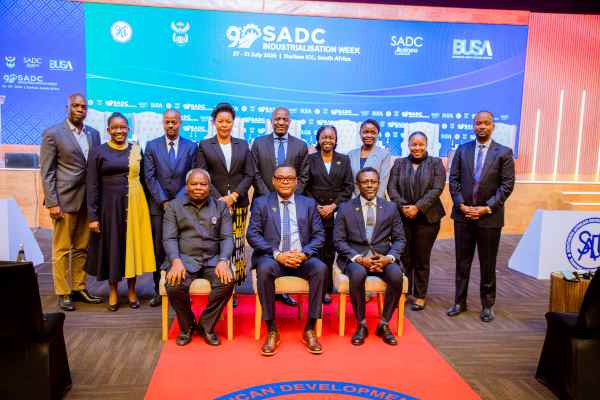
That was the overriding message from the 9th SADC Industrialisation Week (SIW 2026), which concluded in Durban, South Africa, with a strong call for accelerated industrial transformation through deeper regional integration, expanded investment and stronger public-private partnerships.
The gathering, which preceded the 46th SADC Summit of Heads of State and Government, produced what participants described as a renewed commitment to industrial development centred on regional value chains, digital innovation and green manufacturing.
From resource wealth to industrial wealth
For decades, Southern Africa has exported minerals, agricultural commodities and other natural resources while importing higher-value manufactured products.
Delegates in Durban argued that this model has limited economic transformation despite the region possessing abundant natural resources, expanding consumer markets and a growing entrepreneurial base.
Chief Executive Officer of the SADC Finance and Investment Centre, Zwelibanzi Sapula, said discussions throughout the conference pointed to a clear conclusion: Southern Africa has the ingredients needed for industrial success, but has yet to convert its resource wealth into competitive manufacturing industries.
The region’s industrial strategy, he said, must now focus on strengthening regional production networks capable of adding value before products leave African borders.
Building regional value chains
Rather than competing individually, SADC countries are increasingly looking to integrate their industries across borders.
Conference delegates identified agriculture, mining, pharmaceuticals, automotive manufacturing, textiles and chemicals as strategic sectors capable of driving regional industrialisation if supported through coordinated investment and policy harmonisation.

The approach reflects a growing recognition that no single country possesses every component required to build globally competitive industries, but together the region can create integrated value chains that increase production efficiency, attract investment and expand exports.
For countries such as Tanzania, Zambia and the Democratic Republic of Congo, whose economies are rich in minerals and agricultural resources, regional value chains offer an opportunity to retain more economic value domestically through processing and manufacturing.
Critical minerals reshape the agenda
One of the conference’s strongest messages concerned the region’s vast reserves of critical minerals, which are becoming increasingly important in the global transition towards clean energy and advanced manufacturing.
Rather than continuing to export unprocessed ores, delegates argued that Southern Africa should invest in refining, mineral processing and downstream manufacturing.
The strategy would position the region as a supplier of higher-value industrial products rather than simply a source of raw materials.
As global demand rises for minerals used in electric vehicles, battery technologies and renewable energy systems, SADC policymakers see industrial beneficiation as a strategic opportunity to capture a larger share of global value chains.
Agriculture remains central to industrialisation
Despite growing attention on mining and technology, agriculture continues to occupy a central place in Southern Africa’s industrial ambitions.
Delegates described agro-processing as one of the fastest routes towards industrial expansion, food security, export diversification and employment creation.
Strengthening agricultural value chains – from farm production to food processing, packaging and export – was identified as essential for raising incomes while reducing dependence on imported processed foods.
The conference also highlighted the sector’s importance in creating jobs for women and young people, who represent a significant proportion of the region’s workforce.
Digital transformation
Another defining theme was the rapid emergence of digital technologies as drivers of industrial competitiveness.
Artificial intelligence, advanced manufacturing systems and digital production technologies are reshaping global industry at unprecedented speed.
Delegates warned that Southern Africa risks falling behind unless governments accelerate investment in digital infrastructure, innovation ecosystems, research institutions and technology transfer.
The discussions underscored that future industrial competitiveness will increasingly depend not only on physical infrastructure but also on digital capabilities.
SMEs at the heart of industrial growth
Small and medium-sized enterprises (SMEs) were recognised as the backbone of Southern Africa’s economy and a critical component of future industrialisation.
Participants called for improved access to finance, technology, quality standards, markets and business development services to enable smaller firms to participate more effectively in regional supply chains.
Without stronger SME participation, delegates argued, industrialisation risks benefiting only a limited number of large corporations while failing to generate broad-based economic development.
Development finance takes centre stage
The conference also reinforced the growing role of development finance institutions in supporting industrial transformation.
Delegates agreed that governments alone cannot finance the scale of investment required to modernise industries, build regional infrastructure and expand manufacturing capacity.
Instead, industrialisation will require stronger collaboration between governments, development finance institutions, commercial banks, private investors, universities and international development partners.
This financing model is becoming increasingly important as African governments seek to leverage limited public resources to attract substantially larger volumes of private capital.
What it means for Tanzania
For Tanzania, the Durban agenda closely aligns with the country’s Development Vision 2050 (Dira 2050), which seeks to build a US$1 trillion economy through industrialisation, infrastructure development and value addition.
Recent investments in the Standard Gauge Railway, ports, electricity generation and logistics corridors have laid much of the physical foundation.
The next challenge is attracting manufacturing industries capable of transforming those assets into productive industrial ecosystems.
The emphasis placed in Durban on regional value chains also strengthens Tanzania’s ambition to become both an industrial production centre and a logistics gateway connecting Southern, Eastern and Central Africa.
Turning declarations into delivery
Like many regional policy declarations before it, the Durban meeting produced an ambitious vision.
Its success, however, will ultimately depend on implementation.
Delegates acknowledged that industrial transformation requires more than conference resolutions. It demands coordinated policy reforms, sustained investment, regulatory certainty and long-term collaboration between governments and the private sector.
The conference concluded with a shared commitment to translate the partnerships, proposals and investment discussions initiated in Durban into concrete projects capable of delivering measurable economic outcomes. For Southern Africa, the message was unmistakable: the era of exporting raw materials as the foundation of economic growth is drawing to a close. The region’s next chapter will be defined by its ability to manufacture, innovate and compete – not as individual economies, but as an integrated industrial bloc.