

By Business Insider Reporter
Tanzania is stepping up efforts to position itself as a manufacturing and export base, offering investors different entry routes depending on whether they intend to serve the domestic market or use the country as a platform for regional and international trade.
Through the Tanzania Investment and Special Economic Zones Authority (TISEZA), businesses seeking to establish factories, process locally available raw materials or expand existing production can access investment facilitation and incentive schemes tailored to their target markets.
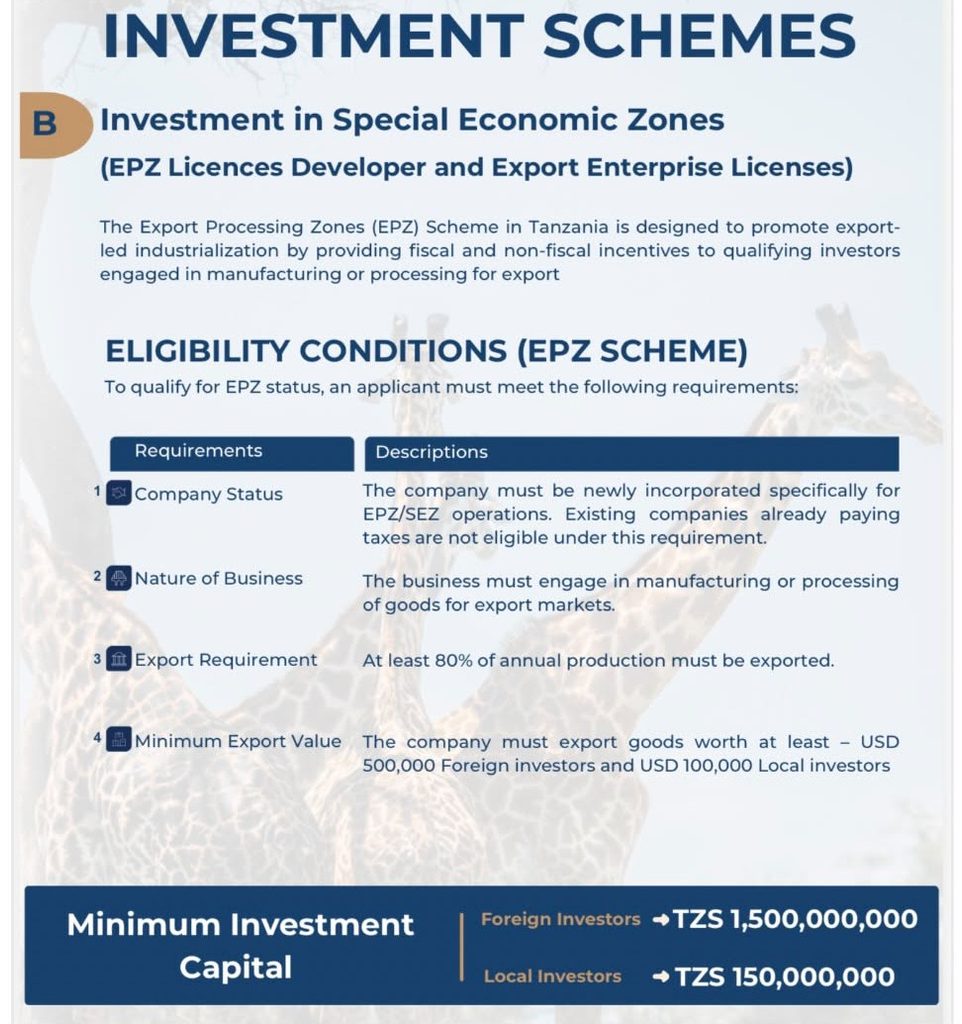
At the centre of the export push is the Export Processing Zones (EPZ) Scheme, which provides qualifying manufacturers with access to Special Economic Zones and a package of fiscal and non-fiscal incentives aimed at reducing investment and production barriers.
Under the scheme, businesses must export at least 80 percent of their annual production, making it primarily suitable for companies seeking to manufacture in Tanzania while targeting markets outside the country.
Foreign investors must generate annual exports of at least US$500,000, compared with US$100,000 for Tanzanian investors.
Minimum investment capital has been set at TSh1.5 billion for foreign investors and TSh150 million for local investors, creating different thresholds for domestic and international businesses seeking to operate under the export-processing framework.
The model is intended to encourage companies to locate manufacturing and processing operations in Tanzania rather than exporting the country’s raw materials for value addition elsewhere.
Domestic market offers another route
Export-oriented manufacturing is not the only option.
Businesses whose primary market is Tanzania can invest through the General Investment Scheme and apply for a Certificate of Incentives, providing a separate route for companies seeking to tap into domestic demand.
The two-track approach allows an investor to choose a structure according to the underlying business model – whether building an export platform or establishing operations primarily to supply the Tanzanian market.
For policymakers, attracting both types of investment is important as Tanzania seeks to deepen industrialisation, create jobs and increase the contribution of locally manufactured products to domestic consumption and exports.
The investment proposition is particularly relevant to industries capable of processing Tanzania’s agricultural, mineral and other natural resources domestically.
Expanding value addition could allow the country to capture a larger share of export earnings while creating demand for logistics, packaging, transport, financial services, technology and skilled labour.
Beyond tax incentives
TISEZA is also seeking to make investment facilitation itself part of Tanzania’s competitive proposition.
Rather than focusing solely on incentives offered at the point of establishment, the authority says investors can receive support throughout the investment cycle – from setting up and obtaining necessary facilitation to project implementation, aftercare, retention and subsequent expansion.
That approach recognises that investment decisions are influenced by more than tax concessions.
For manufacturers, factors such as access to serviced industrial land, electricity, water, transport infrastructure, permits, logistics and efficient regulatory processes can have a significant bearing on production costs and competitiveness.
The country’s Special Economic Zones are consequently expected to play a larger role in bringing some of those requirements together in designated industrial locations.
Building an export platform
Tanzania’s geographical position also provides a potential advantage for manufacturers seeking access beyond the domestic market.
The country’s Indian Ocean ports connect producers with international shipping routes, while road and railway corridors provide access to several landlocked neighbouring economies.
The opportunity, however, will ultimately depend on whether investors can manufacture competitively enough to take advantage of those connections.
For Tanzania, the bigger economic prize is therefore not simply attracting investment capital, but securing projects that build factories, process domestic resources, transfer technology, create jobs and generate exports.
The EPZ and General Investment schemes provide two routes towards that objective. The next test is converting Tanzania’s investment proposition into operating production lines – and turning more of what the country produces into goods manufactured and processed at home.