
East Africa’s exports grew faster than imports in the second quarter of 2026, pushing the region into a $300 million trade surplus. But the numbers also expose two structural challenges: minerals increasingly dominate exports, while intra-EAC trade is growing more slowly than sales to markets outside the bloc.
By Business Insider Reporter, Arusha
East Africa’s trade with the world surged 37 per cent to US$52.3 billion in the second quarter of 2026, driven by a sharp increase in exports that helped the region overturn a nearly $1 billion trade deficit recorded a year earlier.
The latest East African Community Quarterly Statistics Bulletin shows exports climbed 41.3 per cent to US$26.3 billion during April–June, outpacing imports, which rose 32.9 percent to US$26 billion.
The result was a modest US$300 million trade surplus, compared with a deficit of US$945.3 million during the corresponding quarter of 2025.
The figures point to strengthening external trade across the EAC at a time when the eight-member bloc is seeking to use its combined market, regional infrastructure and trade agreements to accelerate industrialisation and attract investment.
But beneath the headline growth lies a more complicated picture.
The region’s export boom remains heavily dependent on minerals and precious metals, while trade among EAC countries, despite growing strongly, is accounting for a slightly smaller proportion of overall exports.
African markets gain importance
Africa continued to provide an important market for East African products.
EAC exports to other African countries increased 44.3 percent to US$7.2 billion, equivalent to 27.5 percent of the region’s total exports.
Exports to the Southern African Development Community (SADC) jumped 50.8 percent to US$5.1 billion, while exports to the Common Market for Eastern and Southern Africa (COMESA) increased 48.3 per cent to US$3.1 billion.
The performance highlights the commercial importance of neighbouring African markets as the continent moves towards deeper integration under the African Continental Free Trade Area.
Trade within the EAC itself also expanded. Intra-regional exports increased 33.2 percent to US$3.2 billion.
However, their share of total EAC exports slipped from 12.8 percent in the second quarter of 2025 to 12.1 percent in 2026.
That does not mean trade among Partner States contracted. Rather, exports to markets outside the EAC expanded even faster.
For regional policymakers, however, the relatively modest intra-EAC share remains significant because one of the central objectives of integration is to create a large internal market in which companies can manufacture in one Partner State and sell relatively easily across the bloc.
China trade surges
China emerged as an increasingly important force behind the region’s export growth.
EAC exports to China nearly doubled from US$5.7 billion to $10.7 billion between the second quarters of 2025 and 2026, largely reflecting mineral commodities and other raw materials.
Imports from China also increased substantially, from US$4.7 billion to US$7.1 billion.
The United Arab Emirates and South Africa were among the other major destinations for EAC exports, while India, the UAE, Saudi Arabia, the United States and Japan remained important sources of imported goods.
The numbers underline the region’s growing integration into global trade, but also raise a familiar question over what East Africa is selling.
Copper and precious metals accounted for 61.9 percent of total exports, up from 58.7 percent a year earlier.
Coffee, tea and spices remained important agricultural exports, while petroleum products were the largest import category alongside machinery, transport equipment and industrial supplies.
The growing dominance of minerals means the trade surplus cannot be viewed solely as evidence of broad-based industrial competitiveness. Commodity prices and mineral demand can change rapidly, leaving economies heavily dependent on them exposed to external shocks.
The longer-term opportunity is therefore to translate rising trade into greater domestic processing and manufacturing.
Inflation falls sharply
Trade growth coincided with a significant moderation in regional inflation.
Annual headline inflation, measured by the EAC Harmonised Consumer Price Index, fell from 11.1 percent in April to 10.7 percent in May and 7.8 percent in June.
The June figure was dramatically below the 22.7 percent recorded a year earlier.
Tanzania recorded one of the lowest headline inflation rates among the Partner States covered by the index, at 4 percent in June, compared with 3.7 per cent in Uganda and 6.5 per cent in Kenya.
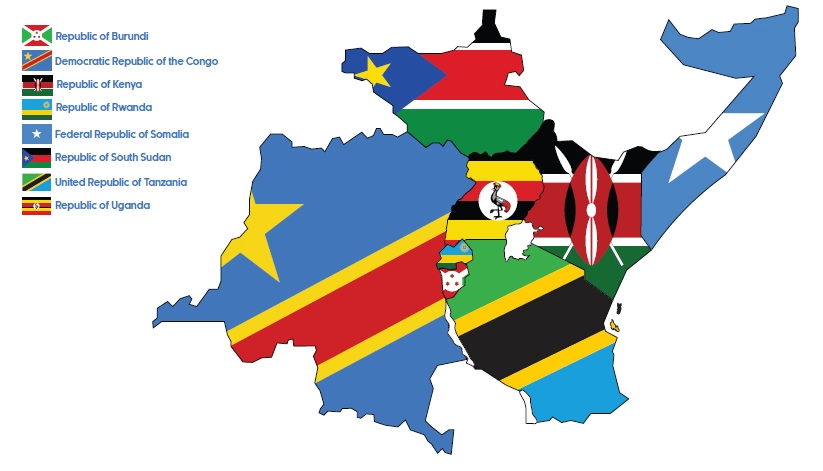
Rwanda and South Sudan both recorded 13 per cent, while Burundi stood at 8 percent.
Food prices nevertheless remained a source of pressure. Regional food inflation increased from 9.5 per cent in May to 10.1 percent in June, although this was far below the 37.5 per cent recorded in June 2025.
Energy, fuel and utilities inflation eased from 14.2 percent to 11.1 percent, but remained above the 6.3 per cent recorded a year earlier.
Underlying inflation also deserves attention. Core inflation increased from 6.2 percent in April to 7 percent in June, suggesting that some price pressures persisted despite the substantial improvement in headline inflation.
Private-sector credit reaches US$75.9bn
The quarter also saw continued expansion of credit across the regional economy.
EAC private-sector credit increased 15 percent year-on-year to US$75.9 billion, helping push broad money supply to US$107.7 billion.
The distribution of new credit, however, provides another indication of where economic activity is expanding fastest.
Lending to wholesale and retail trade increased 29.1 percent, while agricultural lending grew 25.6 per cent and construction credit increased 22.9 percent.
Manufacturing credit grew by only 0.9 percent.
Households remained the largest borrowers, accounting for US$17.6 billion in outstanding loans, followed by wholesale and retail businesses with US$11.6 billion.
The relatively weak expansion of manufacturing credit contrasts sharply with the region’s export ambitions.
If East Africa wants to reduce its dependence on raw mineral and agricultural exports, manufacturers will require substantially greater access to long-term capital for factories, machinery, technology, processing and expansion.
Tanzania’s short-term rates fall
Interest-rate movements differed considerably across the region.
Tanzania recorded the largest quarterly decline in the 91-day Treasury bill rate, falling 60 basis points to 3.6 percent.
Kenya’s rate increased 120 basis points to 8.7 per cent, while Uganda recorded the highest among reporting countries at 10.2 per cent.
Commercial lending rates, meanwhile, increased in Tanzania, Burundi and Rwanda but declined in Kenya, Uganda and South Sudan.
These differences matter for businesses operating across the regional market because financing costs can significantly influence where companies invest, manufacture and expand.
A bigger market, but a value-addition challenge
The US$52.3 billion quarterly trade figure demonstrates the increasing scale of East Africa’s commercial links with the rest of the world.
Exports are expanding rapidly, African markets are buying more East African goods and the region has moved from deficit into surplus.
Yet the composition of that growth presents policymakers with a bigger challenge.
With copper and precious metals accounting for nearly two-thirds of exports, East Africa’s next phase of trade growth will depend partly on whether it can move further along the value chain – processing more minerals, agricultural commodities and other raw materials before exporting them.
At the same time, intra-EAC exports need to grow fast enough to turn the Community’s expanding population and combined market into a stronger commercial advantage for regional businesses. The second-quarter numbers therefore tell two stories: East Africa is trading considerably more, but transforming that growth into deeper regional integration and a stronger manufacturing economy remains unfinished business.