
By Business Insider Reporter
Tanzania’s insurance industry is positioning itself for a pivotal shift, as stakeholders move to transform the annual Insurance Day from a ceremonial gathering into a platform for tangible policy reform and sectoral growth.
For years, the event largely served as a networking forum – bringing together players for presentations and discussions that rarely translated into concrete outcomes.
But that narrative is shifting. The Insurance Institute Tanzania (IIT), the event’s organizer, says that beginning with this year’s edition, the focus will pivot to action – prioritizing the resolution of long-standing structural bottlenecks that have constrained the sector’s growth.
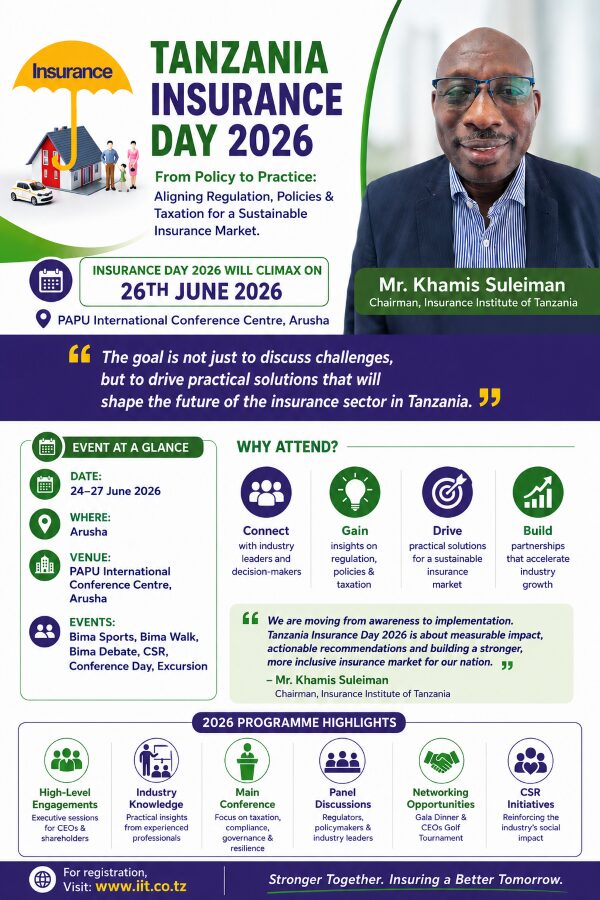
Held under the theme, “From Policy to Practice: Aligning Regulation, Policies and Taxation for a Sustainable Insurance Market,” this year’s edition will culminate on 26 June 2026 with a high-level stakeholders’ conference at the PAPU International Conference Centre, before concluding with a tourism excursion across Tanzania’s Northern Circuit.
“We realised that many of the issues we face in insurance are not moving us forward – they are holding us back,” said Khamis Suleiman (pictured), Chairman of the Organising Committee for Tanzania Insurance Day 2026. “In the past, it was more like a social event – people meet, present papers, and leave without clear resolutions. This time, we want to confront the real challenges and come out with solutions.”
At the heart of those challenges lies taxation, widely seen as the most pressing constraint. Insurance companies in Tanzania face multiple and often unresolved tax disputes, particularly with the Tanzania Revenue Authority (TRA). According to industry players, these disputes can linger for years, creating uncertainty and, in some cases, threatening the survival of firms.
“Every insurance company board has several tax issues – sometimes five, six, or even more,” Mr. Suleiman noted. “Some take too long to resolve, and if they remain unresolved, they can seriously affect the company’s operations. There is still a gap in understanding how the insurance business works.”
Beyond taxation, regulatory misalignment is also weighing on the sector. Insurance is inherently a global business, with companies relying on international reinsurance arrangements and service providers. However, recent directives requiring transactions to be conducted in Tanzanian shillings have created a mismatch, as many obligations – particularly to foreign partners – must be settled in US dollars.
This has introduced significant foreign exchange risk. Insurers collect premiums in shillings but must later source dollars, often at higher and fluctuating rates, to meet external obligations.
The challenge becomes even more pronounced in claims settlement. For instance, a manufacturer whose factory has been destroyed may need compensation in foreign currency to import replacement machinery.

“Previously, if a client paid in dollars, we would compensate them in dollars. But now we are required to transact in shillings, while some of our obligations remain in foreign currency,” Mr. Suleiman explained. “This creates a mismatch that affects our ability to operate efficiently.”
While such policies are partly aimed at stabilizing the local currency and managing foreign exchange pressures, industry stakeholders argue that they have unintended consequences for business operations – highlighting the delicate balance between macroeconomic management and sectoral efficiency.
Profitability, meanwhile, has emerged as a central theme in the industry’s reform agenda. Stronger profits are seen not only as a measure of corporate performance but also as a catalyst for broader economic impact. Insurance companies rely on retained earnings to build reserves, enabling them to underwrite larger risks and reduce dependence on foreign reinsurers.
“If we improve profitability, we increase our capacity to retain business locally,” said Mr. Suleiman. “That means less capital flowing out of the country and more funds circulating within our economy.”
Currently, Tanzania retains only about 50 percent to 54 percent of its insurance premiums, with the rest ceded abroad. By comparison, regional peers such as Kenya have historically achieved higher retention rates, supporting the growth of stronger domestic insurance firms.
Tax policy has also played a role in shaping market dynamics. The introduction of an 18 percent Value Added Tax (VAT) on insurance products has increased the cost of coverage, dampened demand and affecting industry growth. For many consumers, the additional cost has made insurance less accessible.
“The VAT has made insurance more expensive, and this has reduced uptake,” Mr. Suleiman said. “We believe there is a need to review this approach – perhaps by introducing a more suitable sales tax model or targeted incentives, especially for life insurance.”
Life insurance, in particular, remains underdeveloped in Tanzania, partly due to the absence of meaningful tax incentives. In contrast, countries like India and Kenya have implemented tax relief measures to encourage uptake, recognising the role of life insurance in promoting financial security and long-term savings.
Against this backdrop, the 2026 Insurance Day is expected to bring together a broad coalition of stakeholders – including regulators, the Ministry of Finance, TRA, and financial institutions – to chart a way forward. IIT says the goal is to move beyond dialogue and establish actionable commitments, potentially through a joint task force to address systemic issues.
The event will also feature a pre-conference forum for insurance company CEOs, shareholders, and directors, aimed at examining internal industry challenges such as governance, operational efficiency, and the causes of business failure. Input from audit professionals is expected to provide an external perspective on these issues.
Complementary initiatives – including youth debates, sports activities, and corporate social responsibility programmes – will further broaden the event’s impact, targeting awareness and engagement beyond the industry itself.
Taken together, these efforts reflect an industry at an inflection point. Faced with regulatory, fiscal, and structural constraints, Tanzania’s insurance sector is increasingly advocating for reforms that align policy with operational realities.
The message from industry leaders is clear: with the right policy environment and collaborative approach, insurance can play a far greater role in supporting economic resilience, mobilising domestic capital, and protecting businesses and households alike. As Mr. Suleiman put it, “This is about more than just insurance – it’s about strengthening a key pillar of our economy. And that requires all of us to act.”