
By Business Insider Reporter
The global sustainability agenda is entering a more commercially driven phase, with chief sustainability officers increasingly under pressure to demonstrate how environmental action can strengthen growth, resilience and competitiveness rather than remain primarily a compliance exercise.
That is the central message of the World Economic Forum’s inaugural Chief Sustainability Officers’ Outlook, published on September 15, which draws on responses from 103 sustainability leaders across five continents.
The survey finds that 63 percent expect global sustainability progress to hold steady or accelerate over the next 12 months, while three in four expect companies’ transition-related investment to do the same.
The business case is emerging as the strongest driver. Some 64 percent of respondents identify a stronger economic case for sustainability as a key accelerator, followed by increasingly applicable technologies at 56 percent. At the same time, 78 percent expect geopolitical and macroeconomic headwinds to weigh on progress, creating what the Forum calls a “green divergence”, with countries and sectors moving at different speeds.
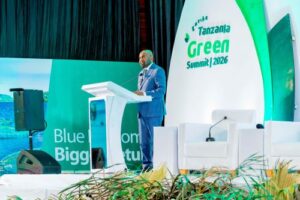
For Tanzania, the findings come at an important moment as implementation of Dira 2050 begins in the 2026/27 financial year. The report’s message has direct implications for an economy seeking to mobilise substantial private capital, accelerate industrialisation and build competitiveness.
The report suggests that sustainability should increasingly be viewed through the investment decisions that will shape Tanzania’s next phase of economic development – from energy and manufacturing to agriculture, infrastructure, mining, tourism and financial services.
This means the sustainability question is not simply whether businesses are meeting environmental requirements. It is whether investments can improve productivity, reduce resource costs, strengthen supply chains and protect companies against future climate and market risks.
Adaptation is particularly relevant. Eighty-five percent of the sustainability leaders surveyed expect adaptation to become a bigger global priority over the next three years, while 77 percent say private-sector investment will be decisive in scaling it. Yet 62 percent cite uncertainty over the costs and benefits of adaptation as a major barrier to investment.
For Tanzania, where agriculture, water, coastal infrastructure, transport, energy and tourism face climate-related risks, this points to a growing need to make resilience financially investable. Better risk modelling, credible business cases and financing structures that capture the value of avoided losses could help turn adaptation from a development requirement into an investment opportunity.
Technology presents another opportunity – and a warning. Seventy-three percent of CSOs expect AI to accelerate sustainability progress, particularly through measurement, reporting, efficiency and risk modelling. But 77 pecent identify the energy and resource intensity of AI infrastructure as its biggest negative sustainability impact.
For Tanzania, the implication is that digitalisation and sustainability should increasingly be pursued together. AI, data and digital systems can improve resource efficiency and climate-risk management, but their expanding infrastructure will also require reliable, affordable and increasingly sustainable energy. Ultimately, the WEF outlook points to a shift from sustainability as an obligation to sustainability as an economic strategy. For Tanzanian companies and investors, that means the next question should not simply be how much sustainability costs, but how it can create value, reduce risk and strengthen the competitiveness of the economy envisioned under Dira 2050.