
By Business Insider Correspondent
Tanzania is seeking to turn the mounting pressures of climate change into a new source of investment, jobs and entrepreneurship, with the government calling on young people and financiers to take a bigger stake in the country’s emerging green economy.
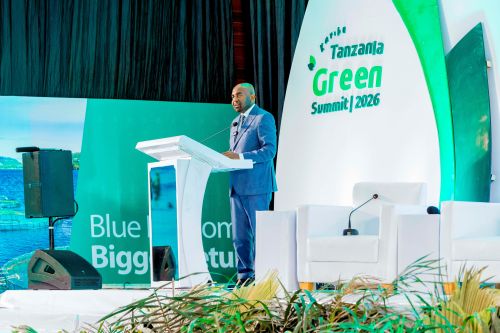
Minister of State in the Vice-President’s Office responsible for Union and Environment, Hamad Yussuf Masauni, said climate change should no longer be viewed solely as an environmental challenge, arguing that the transition to a low-carbon and climate-resilient economy could open significant commercial opportunities.
Speaking at the opening of the Tanzania Green Summit 2026 at the Mlimani City Conference Centre in Dar es Salaam, Masauni identified renewable energy, clean cooking, sustainable agriculture, waste management and the circular economy among sectors with strong investment potential.
Other opportunities lie in sustainable tourism, the blue economy and nature-based solutions.
“Tanzania has significant opportunities in renewable energy, clean cooking, sustainable agriculture, waste management, the circular economy, sustainable tourism, the blue economy and nature-based solutions,” Mr. Masauni said.
The summit’s theme, “Turning Climate Action into Opportunity,” reflects a broader shift in Tanzania’s climate agenda towards linking environmental action with investment, technology, employment and economic transformation.
Masauni said the approach was aligned with the country’s National Development Vision 2050, which places greater emphasis on building a competitive and sustainable economy.

Youth as green entrepreneurs
Central to that transition, the minister said, will be Tanzania’s young population.
Rather than treating young people merely as beneficiaries of climate programmes, Masauni said they should increasingly be positioned as entrepreneurs, innovators, researchers and leaders of the green economy.
That will require improved access to skills, technology, capital and markets.
The approach could create opportunities for a new generation of businesses ranging from renewable-energy installations and climate-smart agriculture to recycling, clean cooking technologies, waste processing and environmentally sustainable tourism.
For Tanzania, the challenge will be turning the growing number of climate initiatives into commercially viable enterprises capable of creating jobs at scale.
Masauni said the country had already taken steps to strengthen its position in the international climate architecture, including its selection to host the African Youth Climate Change Training Centre and a regional office of the Santiago Network on Loss and Damage.
The initiatives are intended to strengthen the capacity of developing countries to respond to climate-related impacts.
Climate finance opportunity
Permanent Secretary in the Vice-President’s Office Dr Richard Muyungi said Tanzania was also seeking to make greater use of international environment and climate funds.
He pointed to carbon trading projects coordinated through the National Carbon Monitoring Centre (NCMC) as another emerging opportunity.

But the economic benefits of such investments, he said, should extend beyond attracting climate capital.
Projects should support environmental conservation while encouraging domestic value addition, technology transfer and job creation for Tanzanians.
That is particularly important as developing countries seek a larger share of the economic value generated by the global transition towards cleaner energy and production systems.
Banks and investors urged to step up
The government also wants financial institutions and investors to play a more prominent role.
Banks and other financiers were encouraged to develop innovative financing mechanisms capable of supporting green businesses and climate-resilient projects, addressing one of the major obstacles facing emerging environmental enterprises: access to affordable capital.
The message potentially expands the climate conversation beyond government agencies and environmental organisations to banks, insurers, investors, technology companies and entrepreneurs.
Investors were also urged to stop viewing environmental sustainability merely as a regulatory compliance requirement and instead consider it a source of long-term economic value.
For businesses, that shift could become increasingly important as capital markets, lenders, consumers and international supply chains place greater emphasis on environmental performance.
The government’s proposition is therefore broader than environmental protection. Tanzania wants climate action to generate businesses, mobilise investment and create employment. Whether that ambition translates into a sizeable green economy will depend on the country’s ability to connect policy with finance, technology with entrepreneurs and climate projects with commercially sustainable markets.