

By Business Insider Reporter
Global travel and tourism development conditions have strengthened to their highest level since 2019, but destinations face a growing challenge of converting rising visitor demand into sustainable economic and social value, according to the World Economic Forum’s (WEF) Travel & Tourism Development Index (TTDI) 2026.
The 10th edition of the index, released in Geneva on September 25, found that 101 of the 110 economies assessed – 92 percent – improved their scores between 2024 and 2026. The average score increased by 2.1 percent, marking the fastest pace of improvement since 2019.
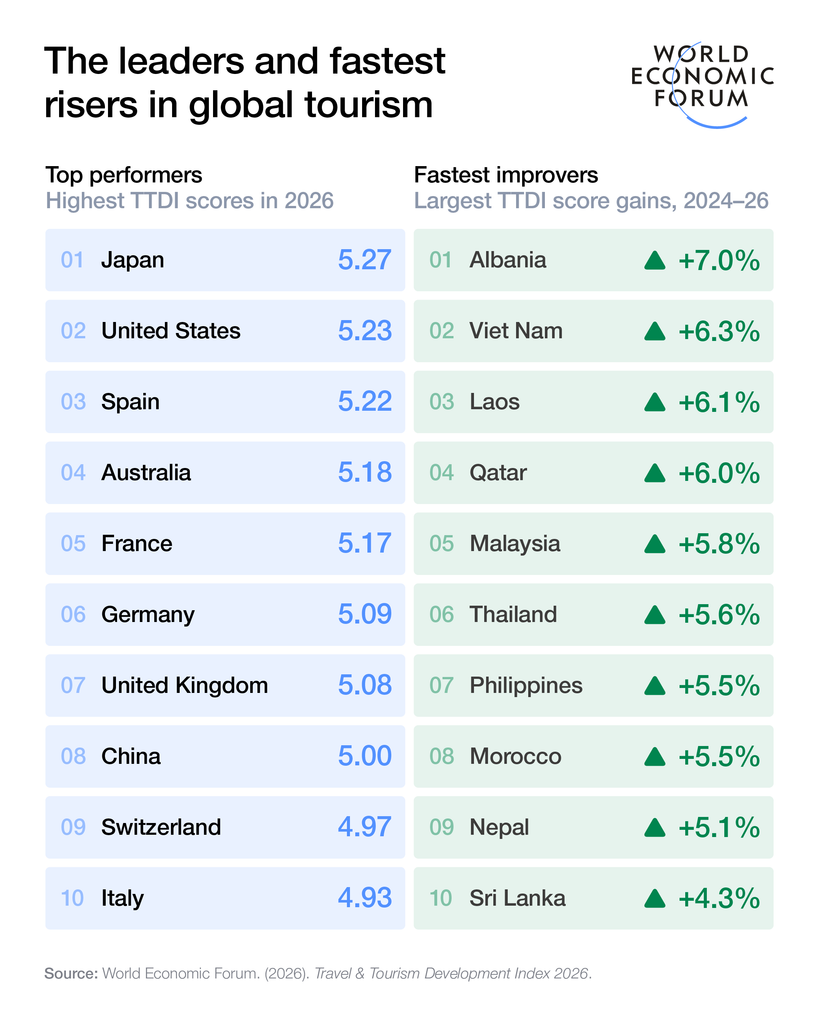
Japan ranked first globally, followed by the United States, Spain, Australia and France. Advanced economies occupied nine of the top 10 positions, underscoring the continuing importance of strong infrastructure, connectivity, business environments and tourism services in determining destination competitiveness.
Tanzania ranks 74th globally, making it the highest-ranked country in the East African Community (EAC) and placing it fifth in Africa, behind Mauritius (59th), South Africa (61st), Egypt (63rd) and Morocco (70th).
Regional performance
“Overall T&T development conditions improved across every region between 2024 and 2026, but the pace of progress varied considerably,” reads the report.
“Asia-Pacific and the Middle East and North Africa (MENA) recorded the strongest gains, with average scores increasing by 3.6 percent and 2.5 percent respectively. Growth was more modest in Europe and Eurasia (+1.8 percent) and the Americas (+1.6percent), while sub-Saharan Africa recorded the slowest improvement at 1.1 percent,” it adds.
The index, produced by the WEF in collaboration with Zurich Insurance Group, measures the conditions that enable travel and tourism to develop sustainably and resiliently. It does not directly measure tourism performance through indicators such as visitor arrivals, tourism receipts or spending.
Instead, its framework assesses 17 pillars and 102 indicators, covering areas including business conditions, safety and security, health and hygiene, human resources, ICT readiness, tourism policy, price competitiveness, air and ground infrastructure, tourist services, natural and cultural resources and sustainability.
The latest findings point to a tourism sector that has largely moved beyond post-pandemic recovery but is entering a more demanding phase.
“Japan’s rise to the top of this year’s rankings reflects more than visitor appeal.
It demonstrates how strong foundations and effective destination management can turn travel and tourism activity into long-term advantage,” said Cara Morton, CEO, Global Businesses and Operations, Zurich Insurance Group.

According to her, the choices made by governments, industry and investors will determine whether the next phase of tourism growth is better balanced and better managed than the last.
Between 2024 and 2026, three out of four economies became less affordable for travellers, while tourism investment failed to keep pace with growing demand. Labour shortages are also emerging as a significant constraint, potentially limiting the ability of destinations and tourism businesses to expand.
“Travel activity and visitor spending have reached record highs, with an estimated 1.52 billion international tourists travelling globally in 2025, according to data from the UN Tourism World Tourism Barometer,” noted Kiva Allgood, Managing Director, World Economic Forum.
“In 2025, travel and tourism’s total contribution to the global economy reached US$11.6 trillion, while domestic visitor spending reached US$5.63 trillion and
international visitor spending totalled US$2.02 trillion. The travel and tourism sector also supported a record 366 million jobs worldwide in 2025,
representing about one in every nine jobs globally,” she added.
The WEF also warns that stronger visitor numbers do not automatically translate into better livelihoods or higher-quality employment. Benefits reaching local communities weakened in the latest assessment, particularly in destinations where tourism remains highly seasonal.
At the same time, emerging tourism economies are gaining ground. Since 2019, the largest emerging economies have improved their TTDI scores more than twice as fast as the Top 20 economies, with Asia-Pacific accounting for seven of the 10 fastest-improving performers. Albania recorded the largest overall improvement between 2024 and 2026.
For the wider industry, the findings point to a shift in priorities – from simply attracting more visitors towards strengthening the capacity of destinations to manage growth.
Investment in infrastructure, workforce skills, technology, connectivity and resilient tourism systems will increasingly determine whether rising demand translates into durable economic value.
The WEF says stronger collaboration between governments and businesses will be critical to achieving that transition.
The findings were unveiled at the inaugural Beyond Tourism Day in Geneva under the theme “Resilient Growth. Renewed Impact”, bringing together business, government and civil-society leaders to examine how tourism can strengthen economic resilience, create quality jobs and deliver greater value to communities and destinations. With global tourism conditions improving, the central challenge is no longer simply recovery. It is whether destinations can build the infrastructure, skills, investment and partnerships needed to make tourism growth more resilient—and ensure its benefits are more widely shared.