
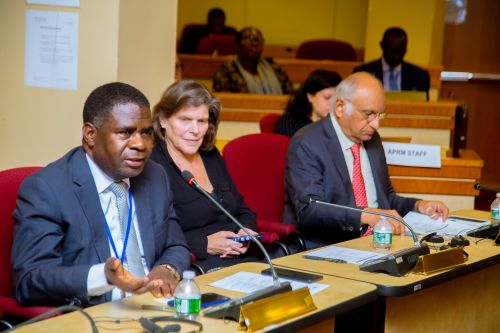
AfCRA is being structured as a commercially run, financially independent institution, with its credibility expected to hinge on professional independence, transparency and protection of rating decisions from political influence.
By Correspondent Scola Malinga, New York
Africa is preparing to launch its own credit rating agency on October 7, 2026, in Port Louis, Mauritius, as the continent moves to establish an African-owned institution operating on commercial principles within the credit-rating industry.
Tanzania’s Deputy Minister for Finance, Engineer Mshamu Ali Munde (MP), participated in discussions in New York on the status and direction of the Africa Credit Rating Agency (AfCRA), an African Union initiative designed to establish a credit rating institution owned and operated on private-sector principles.
Unlike conventional AU institutions, AfCRA is being structured as a commercially oriented entity expected to finance its own operations and remain financially independent.
The African Peer Review Mechanism (APRM) has been tasked with leading the process of establishing the agency.
The discussions emphasised that AfCRA should be understood as a commercial institution enjoying political support from the African Union, rather than an agency whose credit-rating decisions are directed by governments.
That distinction is expected to be critical to the institution’s ability to establish credibility among investors and financial markets.
Credibility will be the test
Participants stressed the importance of professional independence, transparent operating systems and safeguards to ensure that credit-rating decisions are not influenced by political considerations.
These principles will be particularly important as AfCRA seeks to establish itself as a credible African-owned participant in a global industry where ratings can influence perceptions of sovereign and corporate credit risk.
The meeting reiterated support for the establishment of an African-owned credit rating institution, while identifying credibility, transparency, institutional independence and financial sustainability as central pillars of its operations.
It was also proposed that participation by African Union member states should remain voluntary.
Governments’ role, according to the discussions, should focus on helping establish an institution founded on accountability, professionalism and credibility in the rating process rather than influencing individual ratings.
Commercial model
AfCRA’s proposed structure represents an important feature of the initiative.
Rather than operating as a traditional AU institution dependent on member-state financing, the agency is intended to function as a self-sustaining commercial organisation.
The approach is designed to provide a degree of separation between the political institutions supporting its establishment and the professional processes through which credit assessments are ultimately made.
The agency’s formal launch is scheduled for October 7 in Port Louis, Mauritius.
For AfCRA, however, the launch will mark the beginning rather than the completion of the process of building confidence in the institution.
Its standing in financial markets will ultimately depend on the transparency of its methodologies, the quality and independence of its assessments and its ability to demonstrate that ratings are determined by professional considerations.
Tanzania joins discussions
Munde’s participation places Tanzania among countries engaging in discussions over the emerging institution and its future role in African financial markets.
The meeting maintained that member states’ participation in the AfCRA initiative should be voluntary, while governments should support conditions that allow the institution to operate with accountability and professional independence.

(Photos by the Government Communication Unit, Ministry of Finance, New York, United States)
The discussions took place on the sidelines of a high-level meeting of the Private Climate Finance Community at the United Nations headquarters in New York.
The meeting was coordinated by the World Economic Forum as part of the Sustainable Development Impact Meetings 2026 (SDIM26).
As AfCRA approaches its October launch, its challenge will be to turn the continent’s political support for an African-owned credit rating institution into a commercially sustainable organisation capable of establishing trust among governments, businesses, investors and financial markets. That will make independence more than an institutional principle: it will be central to whether AfCRA can build the credibility required to operate effectively in the credit-rating business.