By Anatoli Rugaimukamu
Tanzania’s governance framework reflects a sustained struggle to reconcile the normative promises of the Law with lived realities, particularly where public interest comes into tension with state interest. The Constitution of the United Republic of Tanzania, anchored in principles of popular sovereignty, the rule of law, and social justice, articulates a clear normative commitment to serving and protecting the public interest.
Grounded in constitutional principles, Tanzania’s legal architecture advances a broadly liberal democratic premise in which information held by public institutions is presumed to be a public good, subject only to narrowly circumscribed and proportionate grounds for non-disclosure. This aligns with global transparency norms advanced by institutions such as the United Nations and the World Bank, where openness is treated as foundational to accountability (United Nations 2020; World Bank 2017).
However, Tanzanian scholarship and recent political developments indicate that the divergence between legal intent and lived practice is not merely incidental, but a structural condition actively produced and maintained through human agency, governance choices, and uneven power relations. The events surrounding the Presidential Commission of Inquiry into the violence of 29 October 2025, chaired by Mohamed Chande Othman, offer a contemporary and revealing illustration of this dynamic. Established by presidential authority and financed through public resources, the Commission undertook a nationwide inquiry, collecting testimony from citizens, institutions, and experts before submitting its findings in April 2026.
The report addressed a matter of profound public concern, post-election violence that claimed hundreds of lives and inflicted widespread social harm, yet the handling of its findings underscores how human decisions and institutional practices can mediate, constrain, or redirect the realization of legal and constitutional commitments.
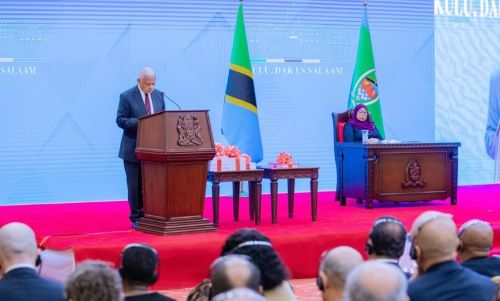
At this juncture, my reflection focuses on the framing of the report at the point of its reception, a framing that reflects conscious human and institutional decisions and foregrounds a critical issue of governance. In her official address, President Samia Suluhu Hassan emphasized the Commission as an instrument constituted under presidential authority and situated within executive processes, reaffirming a long-standing practice in which such commissions report to the Head of State.
While this positioning is legally defensible within Tanzania’s constitutional tradition, it exposes a deeper, humanly constructed tension: when a public inquiry funded by taxpayers and rooted in citizen testimony is framed and administered as a “presidential report,” how is its character as a public good reshaped or narrowed through executive authority and entrenched political conventions?
Here, the tension between public interest and state interest materializes, moving beyond theory into concrete governance practice. From one perspective, the state – acting through the President, is the lawful recipient and custodian of such reports, a status grounded in constitutional authority and established institutional practice.
From another perspective, however, the substance of the report, its evidence, findings, and broader implications, derives its legitimacy from the public itself.
As a result, the report constitutes a public good, one that ought to invite wider citizen participation through access, scrutiny, and use as a collective reference point. Such engagement is essential for addressing the social, governance, and administrative failures that created the conditions under which the unforgettable national experience of 29 October unfolded.
In this sense, the report carries an intrinsic public ownership that extends beyond its formal submission channel.
Tanzanian governance scholarship helps illuminate this contradiction. Studies on access to information and accountability show that where the state retains dominant interpretive control over publicly generated knowledge, transparency becomes conditional rather than inherent.
The Chande Commission episode reflects precisely this dynamic: the coexistence of public participation in knowledge production with centralized authority over its classification, framing, and dissemination.
Philosophically, this raises a fundamental question about the autonomy of public interest.
In democratic theory, public interest is meant to function as an external normative standard, one that constrains power. Yet in practice, the Tanzanian case suggests a gradual inversion where the state does not merely implement public interest but increasingly defines it. By asserting interpretive primacy over a report generated through public means, the state effectively positions itself as both the source and the arbiter of what counts as public truth.
The implications are subtle but significant. When a commission of national importance, investigating events as consequential as the 29 October 2025 violence, is framed primarily within the authority of the presidency, the boundary between state interest and public interest becomes blurred.
Accountability risks becoming internalized within the executive, rather than externalized through public scrutiny. Transparency shifts from being a right to being a matter of release.
This is not to suggest illegality, but rather to highlight a structural imbalance. The issue is not whether the President has the authority to receive or manage such a report – clearly, she does. The deeper issue is whether that authority should extend to defining the report’s public character, given its origin in taxpayer funding and citizen participation. In mature democratic systems, commissions of inquiry, especially those dealing with national crises, are often understood as belonging to the public domain, even when formally submitted to the executive.
Thus, the Chande Commission moment crystallizes the broader dilemma within Tanzania’s governance system. It demonstrates how public interest, while formally recognized, can be operationally absorbed into state interest through control of interpretation, classification, and disclosure. The question, therefore, is no longer abstract. When a report is produced by the people, funded by the people, and concerns the fate of the people, but is ultimately defined as belonging to the state, who, in practice, owns the truth?