By Benny Mwaipaja
The Ministry of Finance has tabled a TSh21.3 trillion budget for the Ministry and its affiliated institutions for the 2026/27 financial year, signalling a renewed focus on economic expansion, fiscal discipline and domestic revenue mobilisation as the country pursues ambitious development goals under Dira 2050.
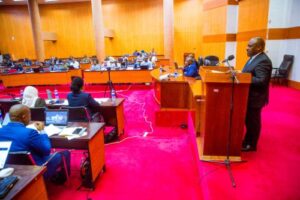
Presenting the ministry’s budget proposals to Parliament in Dodoma, Finance Minister Ambassador Khamis Mussa Omar (pictured) said the allocation would finance both recurrent expenditure and development programmes across eight institutions under the ministry’s portfolio.
Of the total allocation, TSh19.4 trillion has been earmarked for recurrent expenditure, while TSh1.8 trillion will be directed towards development projects aimed at strengthening public financial management and supporting broader economic transformation.
The proposed budget comes at a time when Tanzania continues to position itself among Africa’s fastest-growing economies, supported by strategic infrastructure investments, expanding private sector activity and ongoing reforms designed to improve the business environment.
Growth target raised to 6.3 percent
The government expects the economy to expand by 6.3 percent in 2026, up from an estimated 5.9 percent growth recorded in 2025.
According to the minister, the growth target will be supported by prudent macroeconomic management, increased investment, stronger domestic revenue performance and continued implementation of strategic national projects.
At the same time, authorities aim to maintain inflation within a stable range of between three and five percent, a target considered critical for preserving purchasing power and maintaining investor confidence.
“We will continue managing the economy professionally while strengthening public expenditure discipline and improving domestic revenue collection efficiency,” Ambassador Omar told Parliament.
The government’s economic outlook reflects confidence in the resilience of key sectors including agriculture, mining, construction, transport and financial services, all of which have played a significant role in supporting recent growth.
Revenue collection remains central
A major pillar of the 2026/27 fiscal strategy is increased domestic revenue mobilisation.
The Ministry of Finance projects total government revenue and financing sources of TSh55.2 trillion during the financial year, with the Tanzania Revenue Authority (TRA) expected to contribute more than TSh39 trillion.
The revenue target underscores the government’s determination to reduce dependence on external financing while creating additional fiscal space for development spending.
For businesses and investors, stronger domestic revenue performance remains crucial as it provides government with the resources needed to expand infrastructure, improve service delivery and support economic competitiveness without placing excessive pressure on borrowing.
TSh100 billion monthly for arrears settlement
In a move likely to be welcomed by contractors, suppliers and service providers, the government has committed to allocating Sh100 billion every month to settle outstanding obligations owed to public servants, contractors, suppliers and service providers.
The initiative is expected to ease liquidity pressures facing businesses that depend on government contracts and improve confidence in public sector payment systems.
Settlement of arrears has long been viewed by the private sector as a critical component of improving cash flow and stimulating broader economic activity.
Strong debt management performance
The budget presentation also highlighted Tanzania’s progress in debt management, an area increasingly scrutinised by investors and international financial institutions.
Between July 2025 and April 2026, the government spent TSh9.74 trillion servicing public debt. Of this amount, TSh4.45 trillion was directed towards external debt obligations while TSh5.29 trillion serviced domestic debt.
The minister said timely debt servicing has continued to strengthen Tanzania’s credibility in regional and international financial markets.
That performance has earned international recognition, with Tanzania winning the overall Commonwealth Public Debt Management Award as well as the award for Best Government Debt Management Office in Africa.
The accolades reinforce Tanzania’s growing reputation for prudent fiscal management at a time when many developing economies continue to face debt sustainability pressures.
Budget execution remains strong
The Ministry of Finance also reported strong implementation performance for the current financial year.
The ministry initially received approval for a TSh20.18 trillion budget in 2025/26, covering both recurrent and development expenditure.
Following a mid-year review, the budget was revised to Sh19.94 trillion.
As of April 2026, the ministry had received Sh14.08 trillion, representing 70.6 percent of the revised allocation. Actual expenditure reached TSh14.05 trillion, equivalent to 99.8 percent of funds received.
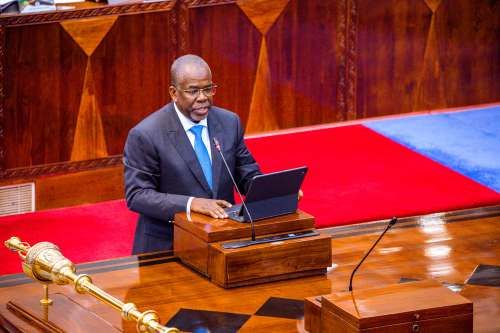
(Photo by the Government Communications Unit, Ministry of Finance, Dodoma)
The high absorption rate reflects improved budget execution and spending efficiency within the ministry and its institutions.
Foreign reserves and inflation remain stable
Macroeconomic indicators presented to Parliament suggest that Tanzania continues to maintain a stable economic environment despite ongoing global uncertainties.
Average inflation remained at 3.4 percent during 2025, comfortably within the government’s target range.
Meanwhile, foreign exchange reserves reached US$5.72 billion, sufficient to cover more than 4.4 months of imports of goods and services.
The reserves position provides an important buffer against external shocks and supports exchange rate stability, both of which are key considerations for investors and businesses engaged in international trade.
Dira 2050 framework
The 2026/27 budget has been aligned with Tanzania’s Vision 2050, the Fourth National Five-Year Development Plan and the ruling CCM Party’s 2025 election manifesto.
The framework places emphasis on industrialisation, economic diversification, infrastructure development, private sector growth and improved competitiveness.
For the business community, the proposed budget signals continuity in the government’s broader economic strategy while reinforcing efforts to strengthen fiscal sustainability, improve debt management and accelerate long-term growth. As Parliament begins deliberations on the proposals, investors and economic stakeholders will be watching closely to assess how effectively the planned expenditure, revenue measures and development priorities translate into stronger economic performance in the coming year.