
By Business Insider Reporter
Tanzania’s petroleum regulator, the Petroleum Upstream Regulatory Authority (PURA), recovered TSh8.86 billion through audits of oil and gas companies, while overseeing increased natural gas production, new discoveries and growing local participation in the sector during the 2025/26 financial year.
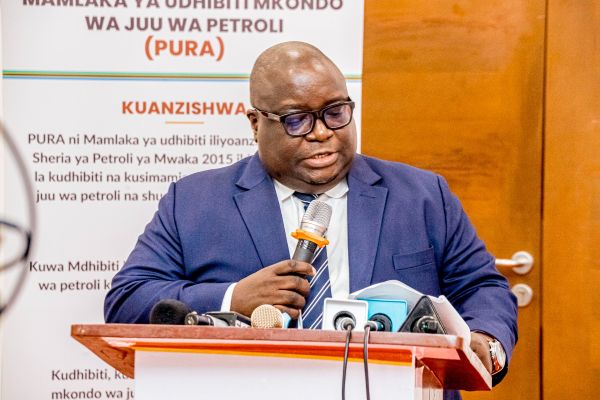
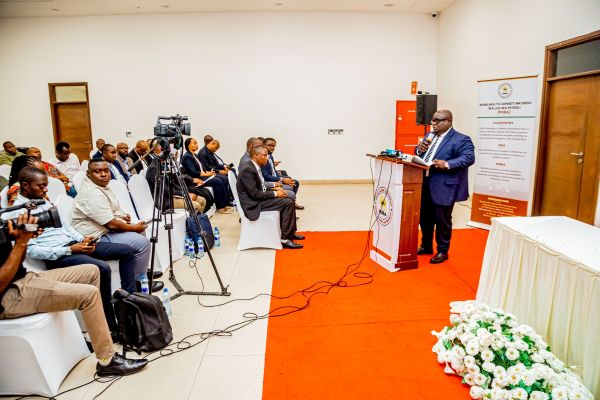
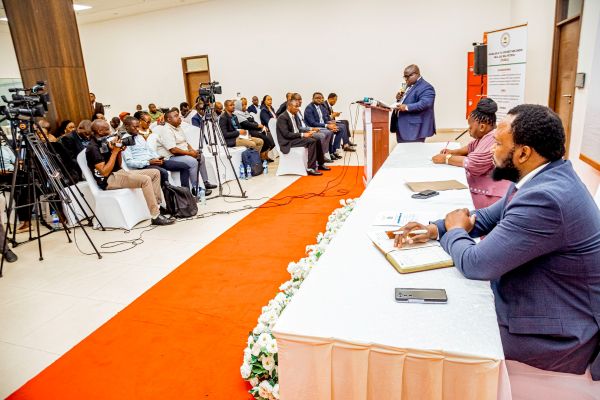
Presenting the authority’s performance to editors from the Tanzania Editors Forum (TEF) at a meeting coordinated by the Office of the Treasury Registrar, PURA Director General, Eng. Charles Sangweni (pictured above), said the authority had strengthened regulation, financial oversight and supervision of upstream petroleum activities.
The US$3.3 million recovered through audits of Production Sharing Agreements (PSAs) represents one of the year’s notable achievements.
Sangweni explained that companies investing in exploration and development are entitled to recover eligible expenditure from petroleum production before profits are shared with the government. PURA audits these costs to ensure that companies do not claim expenses that are not legally recoverable.
The audits covered Songosongo for 2023/24, Block 14 for 2023 and 2024, and the Ruvuma Block for 2024. Further audits covering Songosongo for 2025 and Block 2 for 2023 also commenced.
Removing ineligible expenditure from cost recovery increases the revenue available for sharing between investors and the government, he said.
Gas production and new discoveries
Tanzania’s natural gas production increased to 65.4 billion cubic feet in 2025/26, from 62.6 billion cubic feet in the previous financial year. Sangweni attributed the growth partly to rising demand from industries and increased use of compressed natural gas (CNG) in vehicles.
He said CNG offered motorists substantial savings compared with petrol. A vehicle that uses one litre of petrol to travel 10 kilometres could cover approximately 15 kilometres using one kilogramme of natural gas. With petrol costing around Sh4,000 per litre against Sh1,550 for a kilogramme of gas, the economic incentive for switching to CNG is considerable.
During the year, PURA supervised drilling of three wells in the Mnazi Bay area. Two development wells, MB5 and MS2, were completed and brought into production, with combined capacity of 90 million cubic feet daily.
The third well, Kasa 1X, was drilled for exploration and resulted in an estimated discovery of 223 billion cubic feet of natural gas. Eng. Sangweni said the well started production on November 20, 2026, producing approximately 49 million cubic feet daily.
In the Tanga Block, fresh interpretation of three-dimensional seismic data identified three potential hydrocarbon prospects. Preparations for an exploration well are under way, with drilling expected in 2027.
PURA also supervised preparations for further development in the Ruvuma Block, including drilling of Chikumbi-1, rehabilitation of Ntorya-1 and production testing at Ntorya-2.
Meanwhile, seismic data collection in the Mbele area reached 99 per cent completion by June 30, 2026, covering 772 kilometres against a target of 779 kilometres. In Lindi-Mtwara, three-dimensional seismic surveys covered 257.96 square kilometres, representing 35 per cent of the planned area.
Local businesses gain ground
Increasing Tanzanian participation in petroleum activities was another priority. Sangweni said the value of goods and services supplied by local companies rose to more than US$30 million in 2026, compared with US$14 million in 2025.
PURA also supervised corporate social responsibility projects undertaken by petroleum companies, including construction of Likomo Primary School in Lindi Municipal Council and installation of modern LPG cooking facilities in four schools in Msimbazi Ward, Mkuranga District.
The authority further encouraged companies involved in preparations for the proposed liquefied natural gas (LNG) project to support vocational training for young Tanzanians.
Skills such as welding, machinery operation and other technical trades will be essential during construction and operation of major petroleum infrastructure.
Digital audits and stronger regulation
PURA has also completed preparations for a Cost Recovery Management System, a digital platform through which petroleum companies will submit financial records for regulatory review.
Previously, auditors frequently visited company offices to collect and examine expenditure records. The new system will allow initial assessments to be conducted remotely, reducing administrative work and speeding up audits.
On regulatory reforms, PURA reviewed the Petroleum (Reconnaissance and Tendering) Regulations and Petroleum (Natural Gas Pricing) Regulations, published in the Government Gazette in August 2025. It also prepared Petroleum Commissioning Regulations and Petroleum Corporate Social Responsibility Regulations, which were undergoing further processing at ministerial level.
The commissioning regulations will require operators to restore sites affected by petroleum activities after completing their operations. The proposed CSR regulations seek to give communities a greater role in identifying development projects that address their actual needs.
Sangweni said PURA also invested in staff training to strengthen technical expertise in geology, geophysics, geochemistry and engineering, particularly as new technologies and artificial intelligence transform petroleum exploration. He said the authority would continue improving supervision and working with government and private sector partners to increase natural gas availability and ensure petroleum resources contribute more effectively to Tanzania’s economic growth.