


By Business Insider Reporter
Tanzania is stepping up efforts to attract more British tourists through a major television and digital advertising campaign targeting about 500,000 households across the United Kingdom during the Christmas and New Year holiday season.
The United Kingdom is one of Tanzania’s leading long-haul tourism source markets, with considerable potential for further growth.
According to the International Visitors’ Exit Survey, the UK accounted for about 6.4 percent of international visitor arrivals in 2024, ranking fifth among Tanzania’s source markets. Its share stood at six percent in 2025, maintaining its position among the country’s five leading markets.
The UK also ranked third among Zanzibar’s international source markets in 2025, accounting for nearly eight percent of visitors, behind Italy and France.
The London-based African Travel & Tourism Association (ATTA) said the eight-week campaign, scheduled to begin on December 4, 2026, and run into January 2027, represents Tanzania’s biggest-ever digital television marketing initiative in the UK.
According to ATTA, the campaign is being spearheaded by Tanzania Tourism UK as part of an intensified effort to strengthen the country’s visibility, inspire travel demand and translate growing interest in its tourism attractions into bookings.
Running under the creative theme “Live Out Your Wildest Dreams”, the campaign builds on an earlier test initiative conducted in July 2026, whose encouraging results have prompted a substantial increase in marketing investment during what is considered a critical travel-buying period.
The campaign adopts three complementary advertising approaches designed to reach prospective travellers through different television and digital platforms: AdSmart, linear television and online digital television.
The AdSmart component will use sophisticated audience-targeting techniques, including socio-economic profiling, Mosaic targeting and Experian data, to identify approximately 350,000 households considered potential customers for Tanzania’s tourism experiences.
Unlike conventional television advertising, which depends largely on the programmes being watched, AdSmart enables advertisements to reach selected households regardless of the content they are viewing, whether through live television, catch-up services or streaming platforms.
The second component, linear television advertising, will concentrate on programmes and channels whose content naturally connects with Tanzania’s tourism appeal.
Advertisements will feature on channels including Sky Nature, National Geographic Wild and Animal Planet, placing the country’s wildlife and safari experiences before audiences already interested in nature, conservation and wildlife-related content.
The third component, online digital television, will extend the campaign beyond traditional television audiences by reaching viewers accessing Sky-generated content through third-party websites, including The Times, The Independent and the Daily Mail.
Together, the three approaches are expected to deliver extensive and repeated exposure to approximately half a million UK households, increasing the campaign’s potential to influence travel decisions.
Head of Tourism Marketing at Tanzania Tourism UK, Tim Henshall, who also wrote the advertising commercial, described the initiative as a major investment in promoting Tanzania to international travellers.
“This is a massive push for an Africa destination,” he said.
Mr Henshall said the decision to increase investment followed encouraging findings from the July campaign, with research indicating a positive shift in perceptions of Tanzania among people exposed to the advertisement.
According to post-campaign research conducted by Tanzania Tourism UK, the July advertising initiative recorded a nine percent increase in the desirability of African safari destinations among viewers.
More significantly for Tanzania, the country moved from fourth to first position among the African safari destinations considered by those who had watched the advertisement.
The findings suggest that targeted destination marketing can play an important role in shaping travellers’ preferences in an increasingly competitive international tourism market.
“Our audience is telling us the ads made them feel very positive about travel to Tanzania. We now plan to inspire them to book,” Mr Henshall said.
He also encouraged UK-based African tourism specialists to increase their focus on Tanzania and position themselves to benefit from the additional interest expected to be generated by the campaign.
The initiative comes as Tanzania continues to strengthen its position as a leading international tourism destination, supported by attractions ranging from the Serengeti’s renowned wildlife migrations and Mount Kilimanjaro to the beaches and cultural heritage of Zanzibar.
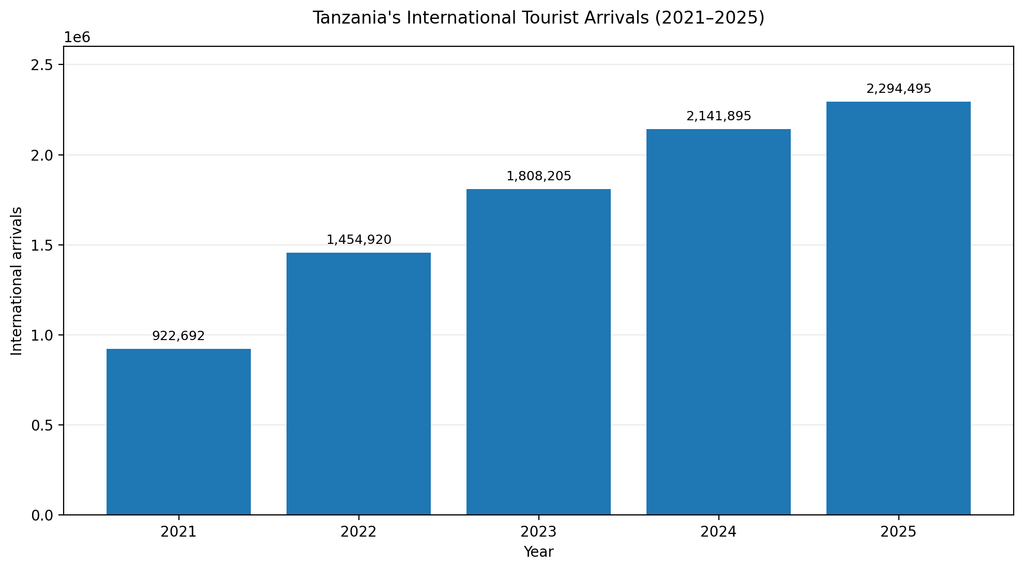
The country’s international tourism market has expanded considerably in recent years, with arrivals rising from 1.45 million in 2022 to 2.29 million in 2025. The UK has maintained a significant position within this growth, accounting for 5.9 percent of international visitors in 2023, 6.4 percent in 2024 and 6.0 percent in 2025. This translates into an estimated 138,000 British visitors in 2025, underlining the market’s importance and potential for further growth.
Beyond generating immediate holiday bookings, the campaign is expected to strengthen Tanzania’s competitiveness in the British market by connecting its tourism offering with audiences whose interests and viewing habits indicate a strong potential for travel.
The emphasis on repeated advertising exposure, audience profiling and platforms associated with wildlife and nature programming reflects a shift towards more targeted tourism promotion, where marketing investment is directed towards audiences most likely to develop an interest in a destination. Travel trade experts say the real test for Tanzania will be its ability to translate the campaign’s increased visibility and positive consumer sentiment into actual bookings and business opportunities for tour operators, travel agents, accommodation providers and other players across the tourism value chain.