
By Tim McDonnell
The COP31 climate summit in Turkey collapsed on Sunday without agreement on a final deal, over deep disagreement over the negotiations’ most basic provision — the first time the talks ended unsuccessfully since calamitous 2009 meetings.
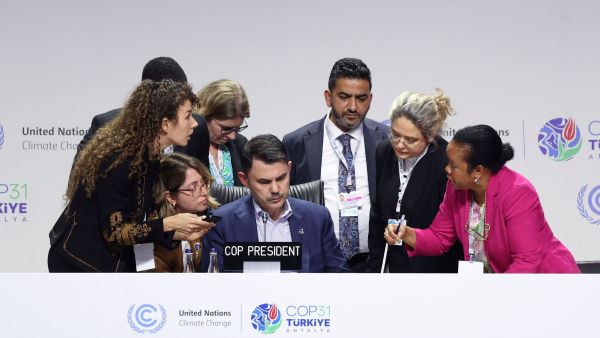
After negotiations stretched to their longest in three decades, Murat Kurum, the summit president, finally acknowledged that a meeting meant to drive forward the “implementation” of countries’ existing carbon-cutting commitments could not even agree on what their overarching goal should be.
“There is no consensus on this document,” he said, marking the first time for COP to conclude without an agreement since the calamitous 2009 summit in Copenhagen. “Therefore, these decisions have not been adopted.”
The breakdown effectively marks the demise of a 2023 consensus, reached in Dubai, on the long-term phaseout of fossil fuels in the global economy. The years since then have been marked by successive global energy crises, including the biggest oil and gas supply disruption in history.
While these crises have driven a faster pivot from fossil fuels in some importing countries, they have reinforced others’ conviction that more, not less, investment is required in the legacy energy system for the sake of security and affordability. COP31 shows that climate action was a casualty of that turmoil.
Overlapping wars and US President Donald Trump’s rambunctious foreign policy have also undermined multilateralism in general, a critical problem for a negotiating process that requires consensus (a requirement that former Vice President Al Gore criticized this week as “insane” for an issue on which some countries’ interests are so diametrically, inherently opposed).
In Dubai, it took an oil executive — Sultan Al Jaber, CEO of ADNOC — to bring fellow exporters onboard for the most pointed critique of their own industry in COP history. But that consensus proved fragile. At last year’s COP in Brazil, the final deal didn’t include the words “fossil fuels” but did encourage countries to take the Dubai consensus “into account” when developing national policies.
By this year, the most delegates could muster was merely “recalling” the consensus, without any indication of what that memory was meant to instigate. Instead, the draft decision included new calls for carbon capture that — while clearly necessary to bend the curve on global emissions — are seen by many negotiating teams as a cover for extending the lifespan of fossil fuels.
Negotiating blocs that supported adopting the draft included the Arab Group, which includes the UAE, as well as China, India, and Japan. But the COP process requires consensus, and the draft was adamantly opposed by the least-developed-countries bloc, as well as the UK and European Union. The US has not been represented at the talks since President Donald Trump returned to office.
While the failure to adopt a conference-wide deal indicates that universal agreement on global energy pathways has become more elusive than ever, smaller groupings did manage to find common ground on the issue. More than two dozen countries (albeit relatively minor carbon emitters) have now adopted some form of policy guidelines for a “transition away from fossil fuels.” And during COP31, nearly 90 countries signed on to pledge to turbocharge the electrification of their economies.
COP, in other words, has not completely imploded — but it has become deeply fragmented. And meanwhile, the real economy doesn’t need a UN-brokered summit to set either the floor or the ceiling for change. “The green economy will not win because a text tells it to,” Juan Carlos Monterrey Gómez, Panama’s former climate envoy, wrote. “It will win because it is cheaper, smarter and creates more jobs. The future will not be negotiated.”