
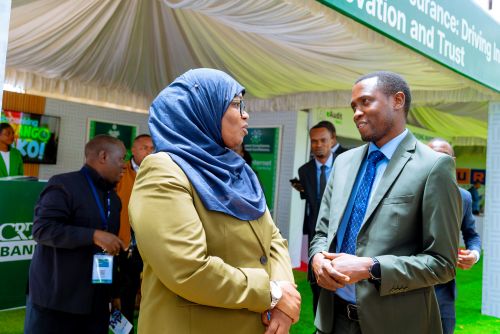
The proposed legislation will clarify the powers and responsibilities of internal auditors, management and audit committees, while reforms to the profession could open internal auditing to engineers, doctors and other specialists.
By Correspondent Asia Singano, Arusha
Tanzania has started the process of introducing a dedicated Internal Audit Act as the government moves to strengthen financial oversight, risk management and accountability across institutions.
Finance Minister Ambassador Khamis Mussa Omar said the proposed legislation would establish a stronger legal and institutional framework for internal auditing and provide greater clarity over the roles of auditors, management and audit committees.
His remarks were delivered on his behalf by Deputy Finance Minister Laurent Deogratius Luswetula at the 19th Annual Internal Audit Conference and 13th Governance Forum at the Arusha International Conference Centre (AICC).
The event was organised by the Institute of Internal Auditors Tanzania.
“A dedicated Internal Audit Act will help clearly define the responsibilities, authority, operational boundaries and working relationships between Internal Audit, management and audit committees,” Luswetula said.
The initiative represents an attempt to give internal audit a clearer statutory foundation at a time when institutions are facing increasingly complex financial, operational and technological risks.
Audit profession set for broader expertise
Alongside the proposed legislation, the Ministry of Finance is reviewing the internal audit cadre’s Scheme of Service to broaden the range of professional expertise available to audit teams.
Under the planned changes, specialists from disciplines such as engineering and medicine could participate in internal audit work where their technical expertise is required.
The current system is predominantly centred on accounting and finance professionals.
According to Luswetula, broadening the professional composition of internal audit would enable institutions to respond more effectively to sector-specific risks and requirements.
The reforms could be particularly significant for institutions managing technically complex operations, where assessing risks may require knowledge beyond conventional accounting and financial controls.
Luswetula said professional development of internal auditors was a shared responsibility involving the Ministry of Finance, institutional leaders and accounting officers.
“I call upon institutional leaders to continue building the capacity of internal auditors and audit committees in order to improve efficiency in resource management and strengthen their contribution towards achieving institutional objectives,” he said.
Focus on value for money
The government is also pushing internal auditors to move beyond compliance and play a stronger role in ensuring that public resources deliver value for money.
Speaking on behalf of Prime Minister Dr. Mwigulu Lameck Nchemba, Minister of State in the President’s Office, State House – Zanzibar, Dr. Saada Mkuya Salum, called on auditors to uphold professionalism and efficiency to strengthen public confidence.
“Internal auditors must continue helping institutions ensure that resources are used efficiently, productively and with due regard to value for money,” Mkuya said.
She said efficient use of resources increases the country’s capacity to improve healthcare, education, agriculture, infrastructure and other essential public services.
The government, she added, would continue strengthening good governance and public financial management while supporting measures aimed at improving accountability in both the public and private sectors.
Technology and risk management
The reforms also place greater emphasis on technology in internal auditing.
Acting Internal Auditor-General at the Ministry of Finance, Engineer Kenneth Nindie, urged internal auditors to make greater use of audit systems to strengthen risk management and safeguard public resources.

“I ask heads of institutions to make use of our internal auditors, but also empower them to use internal audit systems,” Nindie said.
Greater use of audit systems is expected to support a more systematic approach to identifying and managing institutional risks, while strengthening oversight of public funds.
The government’s planned reforms therefore extend beyond establishing a new law. They encompass professional skills, institutional capacity, technology and clearer relationships between auditors, management and oversight committees.
The 19th Annual Internal Audit Conference was held under the theme “Beyond Assurance: Driving Insight, Innovation and Trust.”
Together with the 13th Governance Forum, the gathering brought together internal audit professionals, government leaders, boards and management teams, regulators, private-sector representatives, professional institutions and other stakeholders.
Discussions focused on corporate and public-sector governance, accountability, risk management, integrity and institutional performance. For the government, the proposed Internal Audit Act and changes to the profession are intended to strengthen the infrastructure through which institutions identify risks, safeguard resources and improve accountability—placing internal audit increasingly at the centre of sound financial and institutional management.