
By Business Insider Reporter
African banks are increasingly looking beyond their home markets to capture the expected growth in cross-border transactions while reducing their exposure to risks in individual economies, according to a new Fitch Ratings assessment reported.
Published early this week, the report says banking groups from Kenya, Morocco, Nigeria and South Africa are leading the expansion, with the African Continental Free Trade Area (AfCFTA) expected to provide further impetus because it “has the potential to significantly increase intra-African trade and investment.”
Fitch’s analysis shows that the contribution of foreign assets to the balance sheets of three of Nigeria’s largest banks – Access Bank, United Bank for Africa (UBA) and Zenith Bank – rose sharply between 2021 and 2025, highlighting the growing importance of international operations to some of Africa’s largest banking groups.
The expansion is not uniform across the continent. Fitch notes that Kenya’s developing retail lending market is attracting Nigerian and South African banks, while Kenyan banks are increasingly targeting the Democratic Republic of Congo (DRC) following Kinshasa’s entry into the East African Community in 2022.
The logic is strategic: regional expansion gives banks additional revenue streams while strengthening their credit profiles by reducing their “exposure to weaknesses and shocks in individual countries,” Fitch says.
Tanzania: both host and exporter of banking capital
Tanzania provides an interesting illustration of this two-way movement of banking capital.
The country hosts a sizeable presence of foreign-owned and pan-African banking groups, including Absa, Stanbic, Standard Chartered, KCB, NCBA, Equity Bank, Access Bank, United Bank for Africa (UBA) and others. The Bank of Tanzania’s banking system has historically included banks with ownership and operations linked to South Africa, Kenya, Nigeria, India, China and other international markets.
Some of these groups use Tanzania as part of much larger regional networks. South Africa’s Absa Group, for example, operates in 12 African countries and has banking operations in Tanzania through Absa Bank Tanzania and National Bank of Commerce (NBC). Its wider African footprint includes Botswana, Ghana, Kenya, Mauritius, Mozambique, Seychelles, South Africa, Uganda and Zambia.
Standard Bank Group’s Stanbic operation in Tanzania is similarly part of a wider African network stretching across countries including South Africa, Uganda, Kenya, Nigeria, South Sudan, Zambia and others.
Standard Chartered, meanwhile, remains one of Tanzania’s longest-established international banks, with a presence dating to 1917. Following the transfer of its Wealth and Retail Banking business to Access Bank Tanzania in June 2025, the group has focused its Tanzanian operations on corporate and investment banking, using its international network to support cross-border business.
Tanzanian banks are also crossing borders
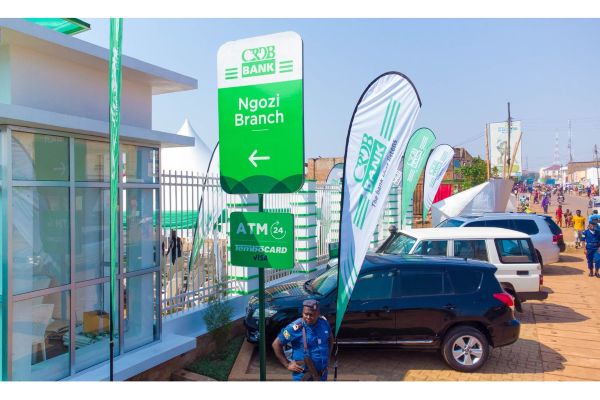
The flow, however, is no longer one-way. CRDB Bank has emerged as Tanzania’s clearest example of a domestic bank pursuing regional expansion. The bank operates subsidiaries in Burundi and the Democratic Republic of Congo, in addition to its Tanzanian operations.
CRDB Bank Burundi was established in 2012, while CRDB Bank Congo was incorporated in 2023 and began operations in Lubumbashi in July that year. CRDB Bank’s current group structure describes its operations in Burundi and the DRC as regional banking operations, giving the Tanzanian lender a presence in three African countries.
The bank has also established a representative office in Dubai’s International Financial Centre, intended to facilitate trade and investment between the GCC and East Africa and connect the group with international corporates, financial institutions, sovereign investors and family offices.

Exim Bank Tanzania provides another example. The Tanzanian-founded lender says it has expanded its operations beyond Tanzania into Comoros, Djibouti and Uganda, while maintaining a representative office in Ethiopia.
The regionalisation of Tanzanian banking is therefore beginning to mirror the wider African trend identified by Fitch: banks are increasingly seeking growth beyond saturated or concentrated domestic markets and positioning themselves along emerging trade and investment corridors.
NMB’s next frontier
The next major Tanzanian lender to potentially join this regional expansion story is NMB Bank.
Under its Agenda 2030 strategy, NMB says it intends to expand its footprint in high-potential regional and domestic markets, alongside deeper investment in retail, SME and wholesale banking. The strategy represents the bank’s next five-year growth cycle and is built around leveraging its scale, balance-sheet strength and digital capabilities.
The lender revealed its regional markets expansion plans during the annual general meeting in Dar es Salaam on June 10, 2026, where it also announced widening of ownership participation through a more accessible share structure.
That ambition would mark an important shift for Tanzania’s largest banking brands: from primarily competing for market share at home to seeking opportunities in neighbouring and other high-potential African markets.
Board chairman David Nchimbi said NMB was assessing markets with economic characteristics similar to Tanzania, mentioning Uganda, Zambia and the Democratic Republic of Congo (DRC) as markets under consideration. He stressed that any expansion would be approached cautiously and on a disciplined basis.
NMB already has a substantial international customer base through its diaspora banking proposition, while its corporate and institutional franchise connects Tanzanian businesses with international markets. Its Agenda 2030 regional ambitions could take that cross-border orientation a step further – from serving Tanzanians and Tanzanian businesses abroad to establishing a direct banking presence in selected foreign markets.
The broader message from Fitch is that such expansion is not simply about size. As African economies integrate and intra-African trade grows, banks with diversified geographic earnings may be better positioned to capture new transaction flows and withstand country-specific shocks. For Tanzania, that creates a two-sided opportunity: to remain an attractive market for international banking groups while developing domestic banks capable of competing for business beyond the country’s borders.