By Business Insider Reporter
Twenty years of tracking gender equality by the World Economic Forum (WEF) show that the world has moved closer to parity, but progress is slowing and, in some of the most important areas, going backwards.
The Global Gender Gap Report 2026, released by WEF on September 16, 2026, finds that 69.2 percent of the global gender gap has now been closed, an improvement of 0.4 percentage points over the past year.
Among the 97 economies tracked continuously since 2006, the gap has narrowed by 5.2 percentage points to 69.4 percent, the highest level recorded. Yet, at the current pace, full gender parity remains 120 years away.
The biggest concern is not whether women are entering workplaces, senior management or government, but whether they are reaching positions where the greatest economic and political decisions are made.
Political empowerment remains one of the two weakest areas globally, with only 22.1 percent of the gap closed, while economic participation and opportunity stands at 61.7 percent.
The report shows that women have made significant gains in political representation over the past two decades. In 2006, there was one woman minister for every 8.1 men. Today, the ratio is one woman for every 4.3 men. Parliamentary representation has also improved, from one woman for every 5.6 men to roughly one for every three men.
But that progress is now under pressure. Political empowerment has fallen below its 2016 level, while the share of economies led by a woman reached 27 percent in 2022 before falling back to 2016 levels.
The same problem is visible in business. Women occupy only 19.1 percent of chief executive officer positions globally and about a quarter of chief financial officer and chief operating officer roles. By contrast, women account for around two-thirds of chief human resources and chief people officer positions, but fewer than one in five chief information officers and fewer than one in 10 chief technology officers.
Government leadership shows a similar pattern. Although the number of ministerial portfolios headed by women has increased by 26 percent since 2008, only one in 10 of those positions is considered high influence – a proportion that has barely changed.
The emerging technology economy presents another major risk. Women represent only 19.3 percent of AI engineers and remain underrepresented in artificial intelligence companies at virtually every level. Their representation among AI firm employees is 36.6 percent at individual-contributor level, compared with 44.8 percent in comparable non-AI firms.
Africa offers a more mixed picture. Sub-Saharan Africa closed 68.8 percent of its gender gap, ranking sixth among the world’s regions. It improved by 1.6 percentage points over the previous year, while showing particularly strong long-term gains in the representation of women among legislators, senior officials and managers.
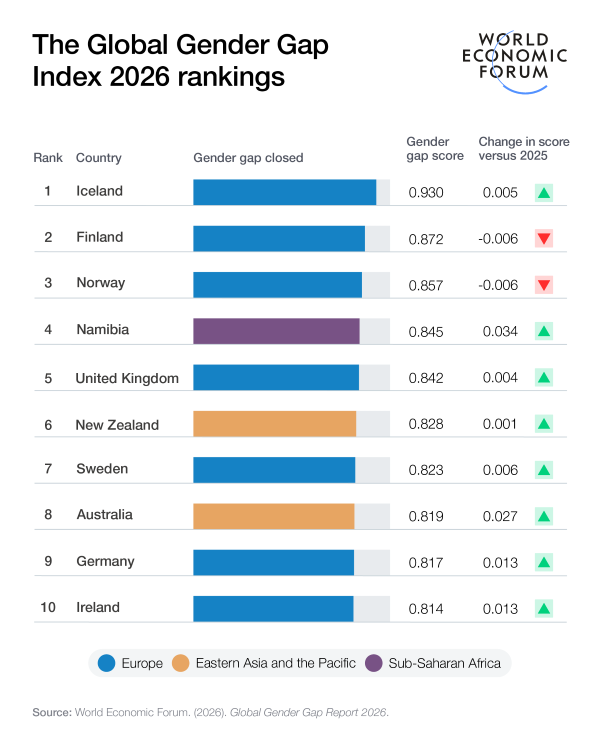
Namibia remains the region’s standout performer, ranking fourth globally after closing 84.5 percent of its gender gap. Other top African performers are:
- Burundi — 26th (globally)
- Rwanda — 28th
- South Africa — 30th
- Zimbabwe — 49th
- Tanzania — 54th
For the WEF, the lesson from two decades of data is clear: gender parity is achievable, but it is not automatic.
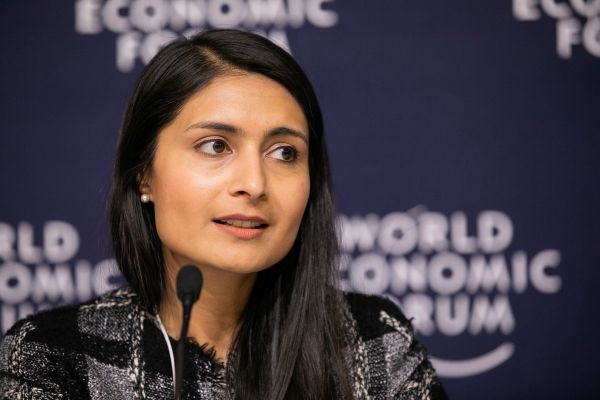
“Parity is a foundation for growth and competitiveness,” WEF Managing Director Saadia Zahidi said, calling for governments and employers to adopt effective policies faster. The 2026 findings therefore shift the question from whether women are progressing to whether they are gaining enough power and influence to shape the economy and society.