
By Peter Nyanje
Tanzania’s external sector demonstrated remarkable resilience in the year ending May 2026, with booming exports of gold, manufactured goods and services cushioning the economy against rising import costs driven by geopolitical tensions.
While the current account deficit widened modestly, the latest Bank of Tanzania (BoT) Monthly Economic Review (MER) suggests the country’s export engine is becoming increasingly diversified and better positioned to support long-term economic growth.
The current account deficit increased to US$2.21 billion from US$2.09 billion recorded a year earlier, reflecting faster growth in imports of goods and services than exports. According to the central bank, higher freight charges and persistently elevated global commodity prices – largely linked to instability in the Middle East and disruptions to maritime shipping – pushed up Tanzania’s import bill.
Despite these pressures, the country’s external position remained fundamentally strong.
One of the clearest indicators was the continued growth in foreign exchange reserves, which rose to US$5.54 billion by the end of May 2026 from US$5.14 billion a year earlier. The reserves were sufficient to finance 4.3 months of projected imports, comfortably above the national adequacy benchmark. BoT attributes this improvement largely to robust export earnings, particularly from gold, alongside the country’s domestic gold purchase programme.
Exports continue to gather momentum
Perhaps the most encouraging development is the rapid expansion of exports.
Total exports of goods and services climbed 17.8 percent to US$19.68 billion, up from US$16.71 billion during the corresponding period in 2025. Goods exports alone surged 20.4 percent to US$11.63 billion, reflecting strong performance across several sectors rather than reliance on a single commodity.

Gold remained Tanzania’s largest foreign exchange earner, with export revenues jumping 46.7 percent to US$5.53 billion, supported by favourable international prices and increased domestic production. At the same time, manufactured exports expanded by 38.3 percent to US$2.01 billion, driven largely by growing regional demand for iron, steel and glass products. Traditional exports also strengthened, with tobacco, coffee and cotton all recording notable gains.
The figures reinforce Tanzania’s broader industrialisation agenda, suggesting that manufactured products are steadily becoming a more important source of export earnings.
Services emerge as a strategic growth pillar
The strongest structural story, however, lies in services.
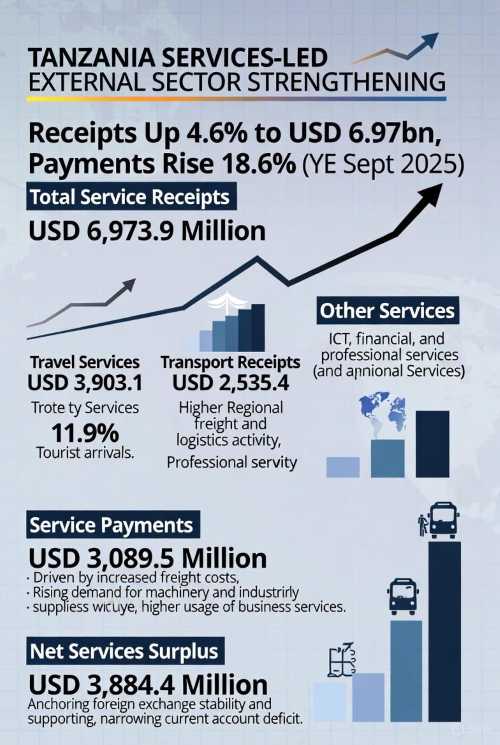
Receipts from services increased 14.2 percent to US$8.05 billion, underlining the growing contribution of tourism and transport to Tanzania’s foreign exchange earnings. Travel receipts rose to US$4.42 billion, supported by a 5.9 percent increase in international tourist arrivals to approximately 2.3 million visitors.
Equally significant was transport.

Transport service earnings climbed 16 percent to US$3.15 billion, reflecting increased freight revenues from transit cargo. The performance highlights the growing importance of Tanzania’s ports, road corridors and railway investments in positioning the country as a regional logistics gateway serving neighbouring landlocked economies.
For policymakers pursuing Dira 2050, these figures provide evidence that investments in transport infrastructure are beginning to generate measurable returns beyond domestic commerce.
Imports signal expanding investment activity
Imports also rose sharply, increasing 17.8 percent to US$20.41 billion. While wider import growth contributed to the larger current account deficit, the composition of imports paints a more positive picture of the economy.
The increase was driven largely by purchases of industrial supplies, machinery, mechanical equipment and intermediate goods needed to support manufacturing and infrastructure development. Imports of refined petroleum products rose nearly 10 percent to US$2.66 billion, largely reflecting higher international oil prices rather than increased consumption alone.
Meanwhile, service payments increased 8.3 percent, mainly because elevated freight charges pushed up transport costs amid continued geopolitical disruptions.
A more resilient external economy
Although the modest widening of the current account deficit may initially appear concerning, the broader picture is considerably more encouraging.
Export growth remains robust, foreign exchange reserves continue to strengthen, tourism is recovering, manufacturing exports are expanding and Tanzania’s logistics sector is becoming an increasingly important regional revenue source. At the same time, much of the increase in imports reflects investment in productive capacity rather than excessive consumer demand. The latest BoT figures therefore suggest that Tanzania’s external sector is not weakening – it is evolving. The economy is becoming more diversified, less dependent on traditional exports alone and increasingly integrated into regional trade and transport networks. If these trends continue, Tanzania will be better positioned to absorb future global shocks while sustaining economic growth through stronger export competitiveness and expanding services.