By Correspondent Jordan Mbwambo, Dodoma
The government has clarified the criteria used to assess and collect property tax through electricity prepaid meters (LUKU), reaffirming its commitment to improving domestic revenue collection while maintaining a simple and predictable tax regime for homeowners.
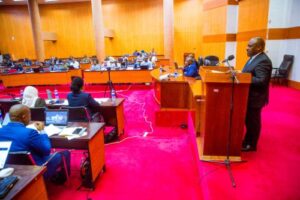
Speaking in Parliament in Dodoma, Deputy Minister for Finance Laurent Luswetula explained that the government currently applies a fixed-rate system when collecting property tax through LUKU meters, a mechanism introduced to increase efficiency, reduce administrative costs and improve compliance among property owners.
The clarification came in response to a question from Special Seats Member of Parliament Tinnar Andrew Chenge, who sought details on the basis used by the government to determine property tax charges through the electricity meter system.
According to Luswetula, an ordinary residential house is charged TSh 18,000 annually, equivalent to TSh 1,500 per month, while multi-storey buildings are charged TSh 90,000 per floor per year, or TSh 7,500 per floor per month.
The Deputy Minister noted that the fixed-rate model was adopted to simplify property tax administration and eliminate the complexities associated with property valuation-based taxation, particularly in areas where property records remain incomplete.
“The government continues to use flat rates in collecting property tax through LUKU electricity meters. The objective is to ensure that the tax system remains simple, efficient and easy for citizens to comply with,” he said.
Exemptions for vulnerable groups
Mr. Luswetula further explained that certain categories of properties are exempt from property tax. These include traditional grass-thatched and mud houses, buildings used for social services, places of worship and homes occupied by elderly citizens aged 60 years and above.
However, the exemptions do not apply where such properties are used for commercial purposes.
The exemptions form part of broader government efforts to balance revenue mobilization with social protection objectives, ensuring that vulnerable groups are not disproportionately affected by taxation.
Supporting domestic revenue growth
Property tax has become an increasingly important component of Tanzania’s domestic revenue strategy as the government seeks to reduce dependence on external financing and strengthen the capacity of local authorities to finance public services and infrastructure.
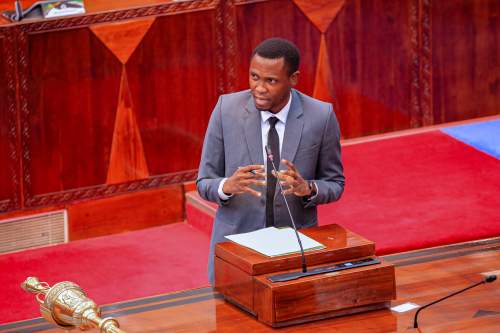
Photo: Government Communication Unit, Ministry of Finance.
The integration of property tax collection into the LUKU system is widely regarded as one of the country’s most significant tax administration reforms. By leveraging the national electricity network, the government has been able to widen the tax base, improve collection efficiency and reduce leakages.
The approach also aligns with Tanzania’s broader digital transformation agenda, which emphasizes the use of technology to enhance public financial management and improve service delivery.
Balancing efficiency and equity
While the flat-rate model has helped simplify tax administration, policymakers continue to face the challenge of balancing efficiency with equity. Critics have occasionally argued that fixed charges may not fully reflect differences in property values, while supporters maintain that the system promotes compliance by making tax obligations clear and predictable.
For the government, the priority remains ensuring that the property tax system is easy to administer, affordable for citizens and capable of generating sustainable revenues to support national development goals. As Tanzania continues to modernize its tax administration systems, property tax collection through LUKU meters is expected to remain a key instrument in strengthening local revenue mobilization and supporting public investment across the country.