
By Costantine Muganyizi
Tanzania has been challenged to seize a rare opportunity to transform its economy by unlocking growth capital for high-impact enterprises, as investors, development partners, financial institutions and entrepreneurs gathered in Dar es Salaam for the second Tanzania Impact Investment Forum (TIIF) 2026.
Held under the theme “Unlocking Growth Capital for High-Impact SMEs and Transformational Projects,” the three-day forum brought together local and international investors seeking to bridge the financing gap that continues to constrain the growth of Tanzanian businesses.
Speakers at the forum agreed that Tanzania possesses enormous entrepreneurial potential, but that many promising enterprises remain trapped in what investors describe as the “missing middle” – businesses that have moved beyond the start-up phase and are generating revenue, yet lack the capital needed to scale their operations.
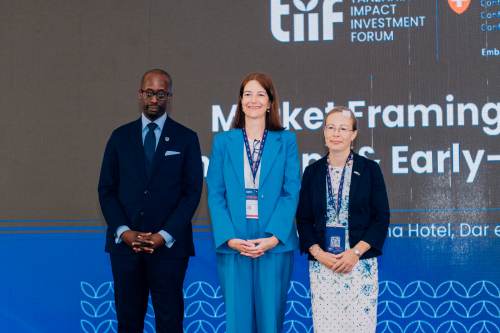
Opening the forum, Switzerland’s Ambassador to Tanzania, Nicole Providoli, said the success of the inaugural TIIF in 2025 demonstrated the growing appetite for impact investment in Tanzania. She noted that two companies that pitched at last year’s event subsequently secured investments, validating the forum’s role as a bridge between capital and opportunity.
“Tanzania is not short of potential, ideas, or determined entrepreneurs,” she said. “What remains is a gap between that potential and the capital needed to bring it to scale.”
Ms. Providoli said this year’s forum had been expanded to include 15 pitching enterprises, a dedicated Deal Room for investor engagement and investment-readiness workshops aimed at preparing businesses to attract institutional capital.
She emphasized that impact-oriented SMEs are already creating jobs, improving livelihoods and delivering essential services, but require patient and appropriately structured financing to unlock their full potential.
British High Commissioner Marianne Young echoed the call, warning that Tanzania faces a private capital financing gap estimated at between US$30 billion and US$40 billion by 2030, a shortfall that threatens progress in job creation, innovation, infrastructure development and SME growth.

Ms. Young said Tanzania’s improving investment climate, macroeconomic stability and population of more than 70 million people make it one of Africa’s most attractive destinations for impact investors.
“The question before us is how Tanzania can capitalize on this momentum to unlock greater flows of impact investment and unleash the enormous potential of its businesses,” she said.
She highlighted the United Kingdom’s growing commitment to Tanzania through British International Investment (BII), whose investments in the country have increased from approximately US$46 million to more than US$120 million over the past two years.
Stanbic Bank Tanzania Chief Executive Manzi Rwegasira argued that the challenge is no longer about proving Tanzania’s potential, but about ensuring that capital reaches businesses capable of transforming communities and sectors.
He said catalytic funding programmes such as Funguo and the Daraja Impact Fund have already demonstrated how relatively small investments can unlock significantly larger pools of commercial capital. As an example, he cited Tanzanian agritech firm MazaoHub, which leveraged a US$50,000 catalytic investment into a US$2 million pre-seed funding round.
Mr. Rwegasira, however, urged investors to place greater emphasis on impact measurement and accountability, arguing that long-term credibility would depend on demonstrating real and measurable outcomes rather than ambitious promises.
He also called for stronger collaboration among governments, development finance institutions, investors and commercial banks to address the financing needs of both SMEs and large-scale transformational projects.
The overarching message emerging from TIIF 2026 was that Tanzania stands at a pivotal moment. With capital increasingly seeking impactful investments, a young and entrepreneurial population, and growing international confidence, stakeholders were urged to move beyond discussion and convert opportunity into investment.
As delegates began negotiations, networking sessions and business pitches, the challenge was clear: transform momentum into deals, ideas into enterprises, and investment into jobs, growth and shared prosperity for millions of Tanzanians. The forum ends on June 3, with the final day dedicated to field visits aimed at providing participants with first-hand exposure to impactful enterprises and investment opportunities across the country.