
By Business Insider Reporter
Tanzania and Kenya have taken a decisive step towards deeper economic integration, committing to eliminate all non-tariff barriers by June 30, 2026 and laying the groundwork for a unified cross-border commercial system.
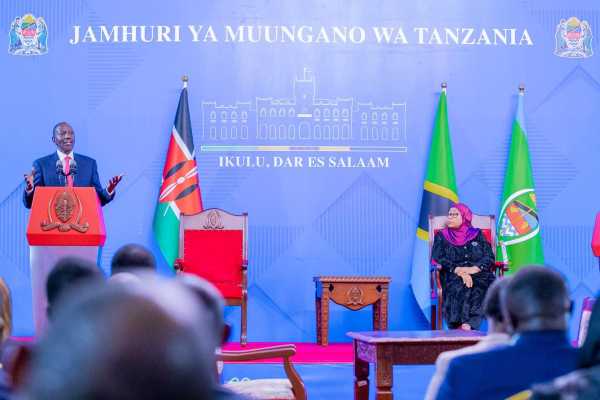
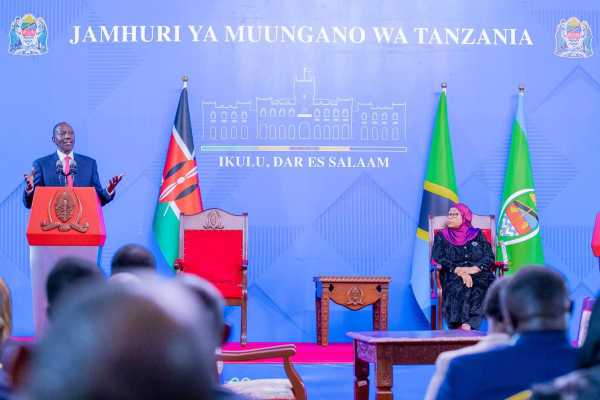
The commitments were formalised during the Tanzania–Kenya Business Forum 2026, held at the Julius Nyerere International Convention Centre, alongside a state visit by Kenyan President William Ruto, who held bilateral talks with President Samia Suluhu Hassan.
Policy shift targets trade bottlenecks
At the centre of the discussions was a firm political directive to dismantle longstanding bureaucratic barriers that have constrained trade flows between the two largest economies in the East African Community.
President Ruto disclosed that non-tariff barriers cost the two countries an estimated US$100 million in lost trade between 2024 and 2025, underscoring the urgency of reform.
Despite bilateral trade reaching US$860.3 million in 2025 – representing nearly 40 per cent of intra-EAC trade – both leaders acknowledged that current performance falls short of potential, with the US$1 billion threshold still unmet.
Private sector at the core of growth strategy
President Samia positioned the private sector as the primary engine of future growth, noting that it is expected to drive roughly 70 per cent of development implementation under Tanzania’s long-term economic vision.
She announced a series of structural reforms aimed at improving the business climate, including the digitisation of customs systems and the introduction of a 30-day dispute resolution framework under a newly established joint business council.
These measures are expected to reduce transaction costs, improve predictability, and enhance investor confidence in cross-border operations.
Business leaders call for a unified market
Leading executives at the forum reinforced the case for deeper integration beyond traditional trade facilitation.
Tanzanian industrialist Rostam Aziz called for the creation of a single commercial ecosystem spanning both countries, arguing that fragmented markets limit scale and competitiveness.
Meanwhile, Paul Russo, chief executive of KCB Group, highlighted the financial sector’s role in enabling cross-border expansion.
He revealed that the bank has extended over US$520 million in credit to businesses operating across Tanzania and Kenya in the past two and a half years.
Strategic infrastructure and energy deals
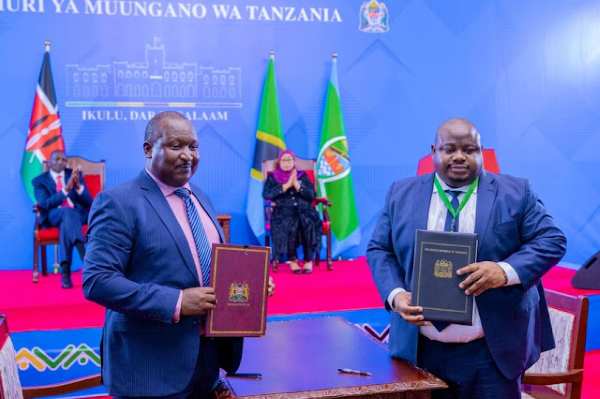
Eight Memoranda of Understanding signed during the forum signal a broadening of cooperation into key growth sectors. These include agreements on energy, agriculture, legal cooperation, maritime services, railway development, and standards harmonisation.
Flagship projects include the revival of the Voi–Taveta railway corridor, development of the Isinya–Singida power transmission line, and a proposed natural gas pipeline linking Tanzanian gas reserves to Kenya’s coastal city of Mombasa.
In telecommunications, both governments committed to advancing a “one network area” framework, which would effectively treat cross-border calls as domestic, lowering communication costs for businesses and consumers.
Towards a regional integration model
The two governments also agreed to institutionalise the business forum as an annual event, alternating between the two countries, and to establish a joint mechanism for monitoring and resolving trade barriers within a defined timeframe.
The renewed partnership reflects a broader ambition to position the Tanzania–Kenya corridor as a model for African economic integration – anchored on policy harmonisation, infrastructure connectivity, and private sector-led growth. With firm deadlines, high-level political backing, and growing business alignment, the success of these commitments will now depend on execution – particularly the ability to translate policy pledges into tangible improvements in trade efficiency and market access.