By Correspondent Benny Mwaipaja, Washington DC
Tanzania is stepping up its economic diplomacy with the United States, positioning access to long-term finance as a key lever to unlock large-scale investments across priority sectors.
Finance Minister Khamis Mussa Omar has reaffirmed that expanded cooperation with the Export-Import Bank of the United States will play a catalytic role in driving Tanzania’s economic transformation, particularly through investments in infrastructure, energy, mining, transport logistics, pharmaceuticals and agro-processing.
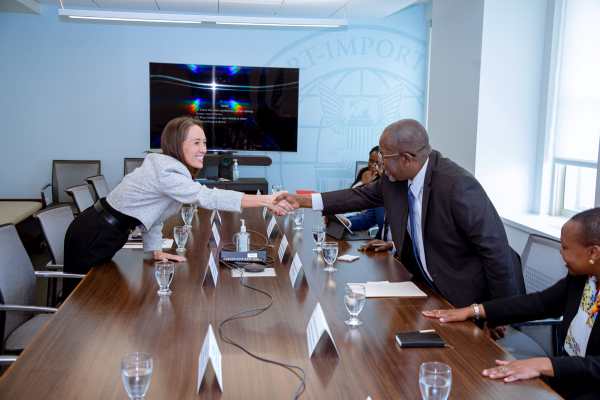
The minister made the remarks following high-level talks in Washington, DC with John Jovanovic, held on the sidelines of the World Bank and IMF Spring Meetings.
The discussions centred on strengthening bilateral financial cooperation and aligning investment flows with Tanzania’s long-term development blueprint.
At the core of the engagement is Tanzania’s Development Vision 2050, (Dira 2050) which places the private sector at the centre of growth, innovation and job creation.
Ambassador Omar noted that ongoing policy and regulatory reforms are designed to improve the business environment, attract patient capital and deepen public-private partnerships – critical ingredients for executing large-scale projects.
A major milestone in the partnership was reached in April 2023, when Tanzania signed a US$500 million Memorandum of Understanding with the US EXIM Bank.
The agreement laid the groundwork for financial and technical cooperation aimed at fast-tracking development projects across key sectors. These include strategic infrastructure, critical minerals, power generation and transmission, logistics systems, pharmaceutical manufacturing, and value addition in agriculture.
From Washington’s perspective, the partnership reflects a broader shift towards targeted, sector-driven investment in Africa. Jovanovic described Tanzania as a strategic partner, signalling growing US interest in expanding trade and investment ties in emerging markets.
Priority areas under the evolving cooperation framework include rare earth minerals, agri-value chains, technology, infrastructure development and the pharmaceutical industry.
For Tanzania, the renewed engagement comes at a time when access to affordable financing remains a critical constraint to industrial expansion. Leveraging EXIM Bank support offers a pathway to de-risk large projects while crowding in private capital – particularly in sectors with high upfront costs and long gestation periods.
The meeting also brought together senior Tanzanian officials, including Zanzibar’s Finance and Planning Minister Juma Malik Akil, Tanzania’s Ambassador to the United States Elsie Sia Kanza, and executives from local financial institutions such as TIB Development Bank and Tanzania Commercial Bank.
A growing financial partnership
The US EXIM Bank, established to support American exports and international trade, has increasingly turned its focus towards Africa as part of broader geopolitical and economic engagement.
In Tanzania, its involvement aligns with ongoing efforts to diversify financing sources beyond traditional multilateral lenders such as the World Bank and the International Monetary Fund.
For Tanzania, tapping into EXIM’s financing instruments – ranging from loan guarantees to direct lending – offers a strategic opportunity to accelerate industrialisation while reducing reliance on sovereign borrowing. As the country advances its Dira 2050 agenda, the success of such partnerships will depend not only on capital inflows but also on execution capacity, regulatory certainty and the ability to structure bankable projects that meet international financing standards.