By Business Insider Reporter
Tanzania is stepping up preparations to anchor one of East Africa’s most anticipated energy investments, as Norway’s Equinor assesses local infrastructure and service capacity ahead of the long-delayed liquefied natural gas (LNG) project in the country’s south.
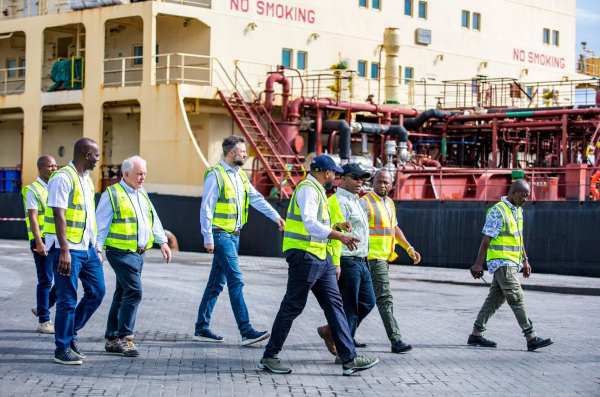
A delegation led by Equinor representative Noel Cox, alongside officials from the Tanzania Petroleum Development Corporation (TPDC), has conducted a field visit to key stakeholders expected to support the LNG value chain, including logistics providers and port authorities. The visit focused on evaluating operational readiness for the planned gas processing project spanning Lindi Region and Mtwara Region.
At the centre of the assessment was Mtwara Port, a facility increasingly viewed as a strategic logistics hub for Tanzania’s emerging gas economy. Port officials highlighted recent upgrades, including expanded cargo handling capacity, improved turnaround efficiency, and the deployment of modern digital systems to streamline operations.
The acting Port Manager, Mtunze Sudi, said the improvements have significantly enhanced the port’s ability to handle diverse cargo types at international standards – an essential requirement for large-scale energy projects such as LNG.
He added that the port is fully prepared to support project logistics once implementation begins, pledging efficient, high-quality services to facilitate timely execution.
The visit underscores renewed momentum around Tanzania’s LNG ambitions, a multi-billion-dollar project that has been under negotiation for over a decade. The development is expected to monetise vast offshore gas reserves estimated at over 57 trillion cubic feet, positioning Tanzania as a potential major LNG exporter in global markets.
Strategic context
The LNG project – led by Equinor in partnership with international oil majors and the Tanzanian government – has long been seen as a cornerstone of the country’s industrialisation strategy. It is closely tied to broader national goals under Dira 2050, which prioritises energy-led growth, export diversification, and increased private sector participation.
For Tanzania, the project offers multiple economic spillovers: foreign direct investment inflows, job creation, technology transfer, and expanded fiscal revenues. It is also expected to catalyse ancillary industries, including logistics, engineering services, and manufacturing.
Mtwara’s positioning is particularly significant. Historically underutilised compared to Port of Dar es Salaam, the southern corridor is now gaining traction as a specialised energy and export hub. Infrastructure upgrades – alongside planned industrial zones – could transform the region into a key node in regional and global energy supply chains.
Industry implications
The assessment mission reflects a broader shift towards localisation and readiness verification, as investors increasingly scrutinise host-country capacity before committing final capital decisions. For Tanzania, demonstrating operational efficiency, regulatory clarity, and infrastructure reliability will be critical in unlocking the next phase of the LNG project.
Analysts note that while progress has been made in improving port and logistics infrastructure, timely execution of supporting frameworks – including local content policies, financing structures, and contractual agreements – will determine how quickly the project moves forward. If successfully implemented, the LNG project could redefine Tanzania’s economic trajectory, elevating its status within the global energy market while reinforcing its role as a strategic investment destination in Africa.