
By Costantine Muganyizi
The US is moving to extend the African Growth and Opportunity Act (AGOA) through December 2028, giving African exporters an additional two years of duty-free access to the US market while putting pressure on countries such as Tanzania to make better use of the trade opportunity.
The extension is contained in a government funding bill passed by the US House of Representatives on September 1 after the Senate approved it in August. The legislation now awaits President Donald Trump’s signature.
The development provides relief to African governments and businesses that had faced uncertainty over AGOA’s future after the programme expired in September 2025 and was subsequently revived by Trump for only one year, through December 2026.
AGOA, introduced in 2000 under President Bill Clinton, gives eligible sub-Saharan African countries preferential access to the US market for thousands of products, with the aim of promoting trade, investment and economic development.

However, its renewal comes at a particularly important moment for Africa because the Trump administration has pursued a more protectionist trade policy centred on tariffs and reciprocal market access.
When Trump signed the one-year AGOA extension in February, US Trade Representative Jamieson Greer said Washington would work with Congress to update the programme and align it with Trump’s “America First” trade policy.
That suggests the extension should not be interpreted as a guarantee that the existing AGOA framework will continue unchanged beyond 2028.
For Tanzania, the development presents both an opportunity and a warning.
Tanzania is an AGOA beneficiary, but its utilisation of the US market remains relatively modest. Its goods exports to the United States were worth about US$101.5 million in 2024, according to UN Comtrade data.
The country therefore enters the new extension period with considerable room to increase exports, particularly by adding value to agricultural products and developing manufacturing industries capable of meeting US market standards.
Coffee, cashew products, textiles and apparel, processed foods, leather and horticultural products represent areas where Tanzania could seek greater participation in US supply chains.
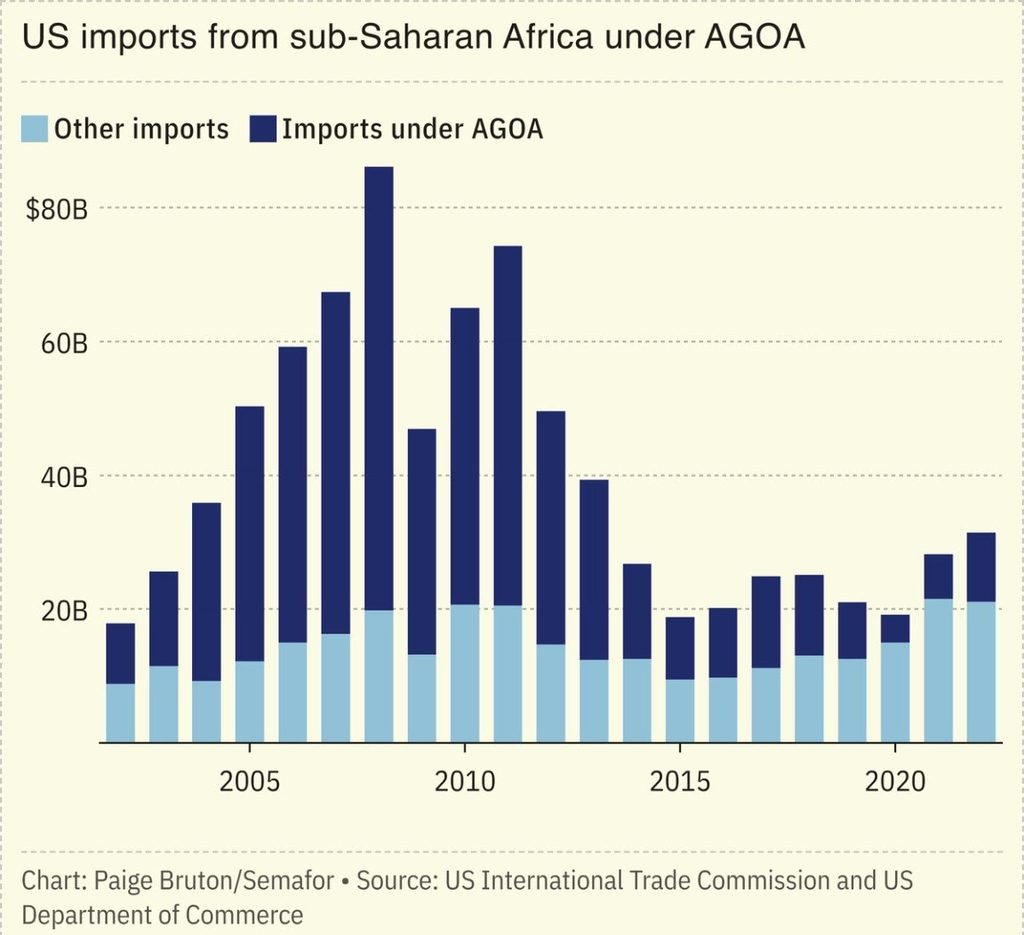
The experience of other African countries demonstrates what is possible. South Africa, Kenya, Lesotho and Madagascar have been among the strongest users of AGOA, with the programme supporting industries ranging from automobiles and components to apparel and agro-processing.
In 2024, the four countries collectively earned about US$5.07 billion from exports to the United States under AGOA, with South Africa leading with US$3.6 billion, followed by Madagascar with US$730 million, Kenya with US$500 million and Lesotho with US$237 million.
Indeed, AGOA’s benefits have been highly concentrated. More than 80 percent of duty-free non-oil exports from beneficiary countries have historically come from just five countries – South Africa, Kenya, Lesotho, Madagascar and Ethiopia.
This uneven record underscores the central challenge facing Tanzania and other smaller users: preferential access does not automatically translate into exports.
Countries must have competitive producers, adequate infrastructure, finance, quality certification, reliable logistics and strong links with international buyers.
With AGOA now potentially secured until 2028, Tanzania has another window to build those capabilities. The immediate challenge is no longer whether the US market is open. It is whether Tanzania can produce enough competitive, value-added goods to take meaningful advantage of the door that has been left open.