
By Costantine Muganyizi
Tanzania is seeking to transform its deep-sea fishing industry from a largely licence-based activity into a nationally owned and value-adding blue-economy sector capable of generating more revenue, investment, jobs and industrial activity.
The shift is expected to place greater emphasis on Tanzanian-owned fishing vessels, domestic landing and processing, port services, cold-chain infrastructure and participation in the wider fisheries value chain.
This new approach to managing and unlocking the economic potential of Tanzania’s marine wealth was revealed recently by Dr Mathew Ogalo Silas, Deputy Director General of the Deep Sea Fishing Authority (DSFA), in an exclusive interview with Business Insider in Dar es Salaam.
The fisheries management expert, with more than 20 years of experience in the sector, said Tanzania could no longer afford to rely mainly on licensing foreign vessels to access its fishing grounds while allowing much of the economic activity and value generated from those resources to accrue outside the country..
“For many years, we have depended largely on licences,” Dr Silas said. “But we do not want to move from relying on licences alone. We want to benefit more from the deep-sea fisheries.”
He said the transformation plan being developed in line with Tanzania’s long-term development ambitions seeks to increase annual economic benefits from the current level of about TSh11 billion collected through fishing licences to more than US$80 million, equivalent to over TSh200 billion, through the wider fisheries ecosystem.
“That is not just licence revenue,” he said. “We are talking about the whole ecosystem – from fishing, landing and processing to logistics, supplies and markets.”
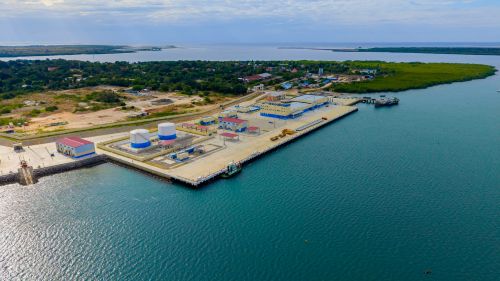
A major pillar of the strategy is the newly completed Kilwa Masoko Fishing Port in Lindi (pictured above), whose commissioning is expected to provide dedicated infrastructure for deep-sea fishing while opening up opportunities in fish landing, cold storage, processing, ship maintenance, logistics and other marine services.
Dr Silas said the first dedicated fishing port in Tanzania, built at a cost of about TSh280.6 billion, is set to be officially commissioned soon, marking a new chapter in the country’s efforts to unlock greater economic value from its deep-sea fisheries.
He added that the ultramodern facility will grearly help reverse a longstanding situation in which vessels fishing in Tanzanian waters often land their catches and obtain services in foreign ports.
“Kilwa is going to open that opportunity,” he said. “The vessels will not only come to land their fish. They will also require supplies, repairs, logistics and other services. That creates activity throughout the value chain.”
Tanzania is also targeting the development of a domestic deep-sea fishing fleet. Dr Silas said the country aims to have 22 Tanzanian-owned fishing vessels by 2037, allowing local investors to participate more directly in harvesting resources both within the exclusive economic zone (EEZ). and beyond national jurisdiction.
The strategy is being supported by investments in fisheries management and technology. The World Bank-backed Tanzania Scaling-Up Sustainable Marine Fisheries and Aquaculture Management Project (TASFAM) has total financing of US$117 million, including US$112 million from IDA and a US$5 million PROBLUE grant.
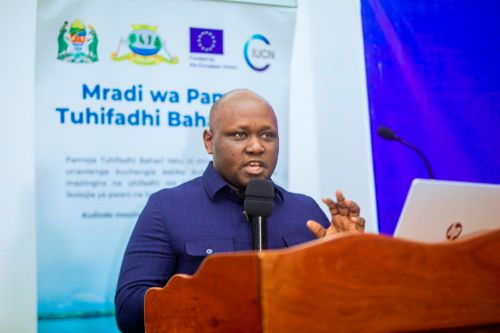
Dr Silas said its objective is to improve marine-resource management and expand economic opportunities. According to him, improved monitoring would be critical to ensuring that increased economic activity does not undermine sustainability.
“We are moving towards stronger monitoring using VMS, AIS, drones and electronic monitoring,” he said. “The objective is to make sure that the fishing taking place in our waters is legal, documented and sustainable.”
The transformation is projected to generate about 8,000 direct and 30,000 indirect jobs, while increasing Tanzanian participation in fishing, processing, logistics and related services.
“We have the fish, we have the fishing grounds, we now have the port and we are developing the capacity,” Dr Silas said. “The question is how we can use these resources to create more value for Tanzania.” The broader objective, he added, is to ensure that Tanzania’s ocean resources become a stronger pillar of the national blue economy rather than remaining primarily a source of fishing licences.