By Correspondent John Mapepele, Geneva
Tanzania and the United States have agreed to accelerate negotiations on a proposed bilateral health cooperation agreement aimed at strengthening health security, expanding universal health coverage, and boosting local pharmaceutical manufacturing, in what both sides describe as a potential model for Africa.
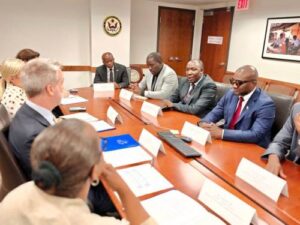
The discussions were held between Tanzania’s Minister of Health, Mohamed Omary Mchengerwa, and US Global Health official Brad Smith, a Senior Advisor in the Bureau of Global Health Security and Diplomacy at the US State Department.
The meeting marked a key step toward a proposed US–Tanzania Bilateral Global Health Cooperation Memorandum of Understanding, which both parties said should be anchored on mutual benefit, national ownership, and alignment with international commitments.
According to a joint understanding, the framework is expected to advance shared priorities including disease prevention, sustainable health financing, resilient supply chains, local pharmaceutical production, and stronger national health systems.
A “win-win” model for Africa
Both Tanzania and the United States positioned the proposed agreement as a potential blueprint for African countries seeking more predictable, results-oriented, and sustainable health partnerships.
Officials said the model would go beyond traditional donor-recipient arrangements by focusing on long-term systems strengthening and investment-driven cooperation.
The framework is expected to integrate universal health insurance reforms, expanded local manufacturing capacity, and improved emergency preparedness systems.
Support for Tanzania’s health insurance drive
Minister Mchengerwa highlighted Tanzania’s ongoing rollout of universal health insurance under the 2023 Universal Health Insurance (UHI) law, which aims to pool health risks nationally, reduce out-of-pocket spending, and expand access to essential services.
He said US technical cooperation could play a key role in strengthening the system, particularly in areas such as financing design, actuarial sustainability, claims management, fraud detection, and digital health interoperability.
Focus on local manufacturing and health security
Local production of medicines and medical supplies emerged as a central pillar of the proposed partnership, with both sides emphasizing its importance in reducing import dependence and strengthening regional health resilience.
Tanzania also underscored opportunities for US companies to invest in pharmaceutical manufacturing, diagnostics, and medical technologies under a more structured cooperation framework.
The Minister cited existing collaboration with US health technology company Abbott, which has supported local production of rapid diagnostic test kits for diseases including HIV, syphilis, and hepatitis, as an example of scalable partnership.
Building on two decades of cooperation
The proposed pact builds on more than 20 years of cooperation between Tanzania and the United States in the health sector, particularly through initiatives such as the US President’s Emergency Plan for AIDS Relief (PEPFAR).

Existing collaboration spans HIV/AIDS, tuberculosis, malaria control, laboratory strengthening, supply chain systems, and health workforce development.
Officials said the new framework would consolidate these efforts into a more predictable and long-term structure aligned with Tanzania’s national health priorities.
High-level delegations
Minister Mchengerwa was accompanied by Abdallah Saleh Possi, Tanzania’s Permanent Representative to the United Nations Office and other International Organizations in Geneva.
The US delegation included Brad Smith and Michael Behan, Public Health Advisor at the US Mission to the United Nations in Geneva. Both sides reaffirmed commitment to continue technical-level negotiations in the coming weeks.