BoT accelerates gold accumulation amid rising geopolitical uncertainty, signalling a strategic shift in reserve management and strengthening Tanzania’s position as one of Africa’s major gold economies.
By Business Insider Reporter
The Bank of Tanzania (BoT) is accelerating a significant shift in its reserve management strategy, with gold increasingly emerging as one of the country’s most important strategic reserve assets amid growing global economic uncertainty and heightened geopolitical risks.
New central bank data shows Tanzania held approximately TSh8.3 trillion worth of gold reserves as of April 30, 2026, underscoring the country’s deliberate move toward strengthening gold holdings while gradually reducing reliance on traditional foreign securities such as US Treasury bonds and other dollar-denominated assets.
According to the figures, the reserves comprise about TSh5.1 trillion in bullion gold and TSh3.1 trillion in monetary gold, making gold one of the largest components of Tanzania’s strategic reserve portfolio.
The development marks a major structural shift in the composition of Tanzania’s foreign reserves. Historically, foreign currency marketable securities – particularly US government bonds and Treasury bills – accounted for the largest share of the country’s reserve assets. However, by April 2026, those holdings had declined to around TSh7.2 trillion, placing them behind gold for the first time in recent years.
The transition reflects a broader global trend in which central banks are increasingly turning to gold as a hedge against inflation, geopolitical instability, currency volatility and growing uncertainty in international financial markets.
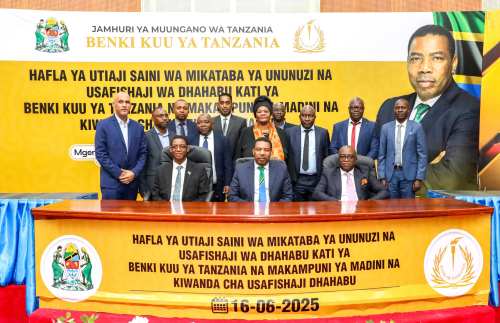
Tanzania formally began purchasing domestically sourced gold for reserve purposes in September 2024, but the pace of accumulation accelerated sharply from August 2025 as authorities intensified efforts to diversify reserve assets and strengthen long-term financial resilience.
Bullion gold now accounts for roughly 60 percent of Tanzania’s total gold reserves, highlighting the scale of the policy shift.
The move comes at a time when global central banks are reassessing reserve management strategies amid ongoing geopolitical tensions, rising debt levels in advanced economies and concerns over the long-term stability of major reserve currencies.
In its first-quarter 2026 outlook, the World Gold Council said geopolitical risks continue to play a central role in driving central bank demand for gold.
“Geopolitics remain front and centre in our outlook for gold demand in 2026,” the council noted in its latest analysis, adding that elevated inflation and persistently high gold prices are likely to sustain strong investment and official sector demand.
Several countries have recently expanded gold holdings as part of efforts to reduce exposure to external financial shocks. Some nations, including France and Germany, have also strengthened policies aimed at repatriating physical gold reserves from overseas vaults back to domestic custody.
For Tanzania, the growing emphasis on gold carries both monetary and strategic economic significance.
Gold remains one of the country’s most valuable export commodities, accounting for more than one-third of export earnings and serving as a major source of foreign exchange inflows. The sector has become increasingly important in supporting exchange rate stability, external financing and broader macroeconomic management.

The central bank’s reserve strategy also aligns with Tanzania’s wider ambitions to maximise value from its natural resources while strengthening resilience against global financial volatility.
Analysts say the accumulation of gold reserves could provide the country with greater insulation during periods of external shocks, particularly as emerging economies face increasing pressure from global interest rate fluctuations, currency instability and changing international trade dynamics. The strategy further reflects the growing importance of gold not only as a commodity export, but also as a strategic monetary asset capable of supporting long-term financial stability in an increasingly uncertain global environment.