
By Business Insider Reporter
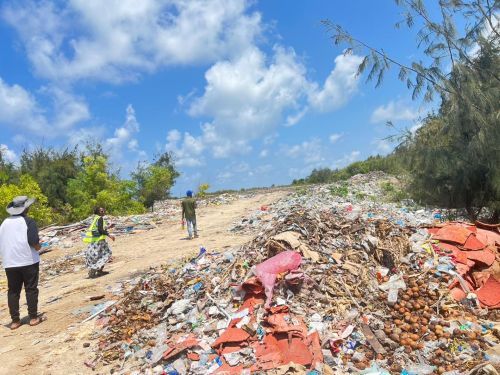
Tanzania and its regional partners have been urged to intensify action against plastic pollution and other threats to the Western Indian Ocean, as governments seek to protect fisheries, tourism and other economic activities that depend on healthy marine ecosystems.
Elizabeth Mrema UN Assistant Secretary-General and a senior official with the UN Environment Programme (UNEP), said plastic waste remains one of the major threats to ocean health and called for stronger public awareness about the consequences of dumping waste into the sea.
Speaking at a meeting of national coordinators and partners for COP12 at the Julius Nyerere International Convention Centre (JNICC) in Dar es Salaam on October 6, Mrema said protecting the ocean was essential because of its importance to food supplies and other resources on which communities depend.
“Fish swallow plastic, and that is how they die,” Mrema said, calling for greater public education on the dangers of improperly disposing of plastic bottles and other waste.
She said protecting the ocean should not be viewed solely as a government responsibility, arguing that individual behaviour ultimately affects communities and future generations.
“Citizens should understand that their actions today can affect their lives, their children and future generations,” she said.
Mrema also called for environmental information to be communicated in simple and accessible language, particularly to fishermen and coastal communities whose livelihoods are closely tied to marine resources.
Ocean as an economic asset
For Tanzania, the debate extends beyond environmental conservation. Its Indian Ocean coastline and Zanzibar archipelago support fishing, tourism, maritime trade and other activities increasingly associated with the country’s blue economy ambitions.
Minister of State in the Vice-President’s Office Hamza Hassan Juma called on members of the Nairobi Convention to strengthen cooperation and move from commitments towards practical action against climate change, marine pollution, biodiversity loss and unsustainable exploitation of marine resources.

“This heritage reminds us that the ocean is not just an environmental resource, but also a source of life, culture, identity and economic opportunities for our people,” Juma said.
He said the Nairobi Convention’s 40-year history represented four decades of regional cooperation aimed at maintaining a healthy and productive Western Indian Ocean.
The minister said the next phase should focus increasingly on measurable results that improve people’s livelihoods while producing visible improvements in the marine environment.
40 years of regional cooperation
The Nairobi Convention was adopted on June 21, 1985 and entered into force on May 30, 1996. Tanzania ratified it on March 1, 1996 and subsequently ratified the amended convention in September 2017.
Its 10 contracting parties are Tanzania, Comoros, France, Kenya, Madagascar, Mauritius, Mozambique, Seychelles, Somalia and South Africa.
Over four decades, the convention has provided a platform for regional cooperation on marine protected areas, pollution control, biodiversity conservation and scientific capacity.
Tanzania’s participation has included the establishment of the Marine Parks and Reserves Unit in 1996, followed by the declaration of the Mnazi Bay-Ruvuma Estuary Marine Park in 2000 and Tanga Coelacanth Marine Park in 2009.
But officials say emerging environmental pressures mean previous achievements will need to be matched by stronger action.
For businesses, degradation of marine ecosystems carries economic consequences. Declining fish stocks can affect fishing communities and seafood supply chains, while polluted beaches and coastal waters risk undermining tourism destinations and associated investments.
Juma also invited COP12 delegates to visit Zanzibar, highlighting the islands’ cultural and tourism attractions.
As Tanzania seeks to extract greater economic value from its coastline and marine resources, the message from the Dar es Salaam meeting was clear: the growth of the blue economy will increasingly depend on whether the natural capital supporting it can be protected.