

By Correspondent Farida Ramadhan, Cotonou
Tanzania is stepping up efforts to transform its expanding electricity generation capacity into a regional trade opportunity, opening the door to greater private-sector participation while investing in infrastructure to supply neighbouring countries and other African markets.
The government says it wants to strengthen electricity generation and distribution, attract more private investment and expand transmission networks to enable the country to sell surplus power across East Africa and beyond.
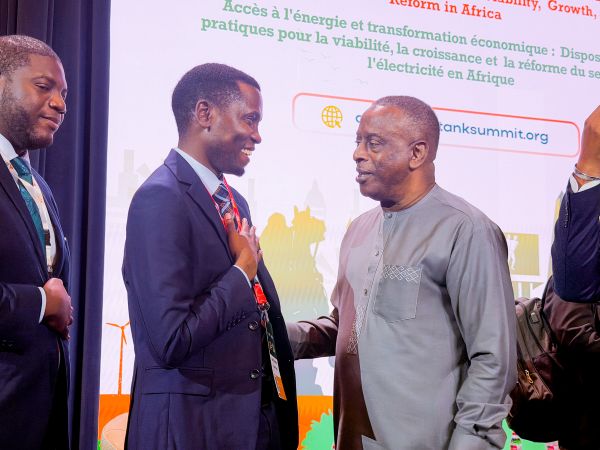
The strategy was outlined by Deputy Minister for Finance Laurent Luswetula (pictured right above), speaking on behalf of Finance Minister Khamis Mussa Omar, during a panel discussion on energy-sector development at the Africa Think Tank Summit (ATTS) in Cotonou, Benin.
Luswetula said private-sector participation in electricity generation and distribution was essential to ensuring a reliable supply for households, industries and businesses, while creating opportunities to commercialise surplus electricity.
“The Government of Tanzania has opened the door to private-sector participation in electricity generation and distribution to ensure that our people have an adequate and reliable supply of power,” he said.
Private investors expand generation capacity
Tanzania’s National Energy Policy of 2015 places emphasis on private-sector participation, a framework that has enabled several companies to enter the electricity generation and distribution market.
According to Luswetula, large private power producers currently contribute more than 350 megawatts (MW) to national generation, particularly in rural areas. Medium-sized producers contribute more than 59MW, while small-scale producers account for over 2.41MW.
The figures highlight the growing role of independent power producers in supporting the country’s electricity supply, although the government continues to dominate the transmission segment.

(Photos by the Government Communication Unit, Ministry of Finance, Cotonou, Benin)
Luswetula said electricity transmission remained largely a government responsibility, mainly through the Tanzania Electric Supply Company (TANESCO), because of the substantial investment required to develop and maintain the infrastructure.
However, he said the possibility of greater private-sector involvement in transmission could be considered through consultations and nationally agreed regulatory arrangements.
For investors, the distinction between generation and transmission is significant. While private companies have increasingly participated in producing electricity, expanding the high-voltage networks needed to move power across the country and into neighbouring markets remains a major infrastructure challenge.
Domestic financing drives strategic investment
The government is also highlighting domestic financing as a key pillar of its energy investment strategy, pointing to the Julius Nyerere Hydropower Project (JNHPP) as an example of its commitment to funding major infrastructure projects using local resources.
Luswetula said the 2,115MW hydropower project had been financed with approximately TSh7.5 trillion, equivalent to more than US$3.5 billion, from domestic resources.
“The Mwalimu Nyerere Dam is an example of how, as a country, we decided to use our own domestic resources to implement major strategic projects. More than TSh7.45 trillion was spent, but today we are seeing the benefits through increased electricity generation, which serves Tanzanians and strengthens our national energy capacity,” he said.
The project represents a major investment in Tanzania’s electricity infrastructure and is expected to strengthen the country’s ability to meet growing demand from households and productive sectors.
Domestic financing also gives the government a stronger role in determining the pace and direction of strategic infrastructure investment. However, the scale of such projects makes efficient implementation, financial discipline and the long-term sustainability of the energy sector important considerations.
Surplus power opens regional trade opportunities
Tanzania’s expanding generation capacity is creating opportunities to move beyond meeting domestic demand and establish a stronger position in the regional electricity market.
Luswetula said the country currently had electricity generation capacity exceeding 4,646MW, while domestic demand stood at more than 2,300MW.
The difference provides an opportunity to sell surplus electricity to neighbouring countries, provided adequate transmission infrastructure and regional trading arrangements are in place.
The government is therefore investing in transmission networks to enable Tanzania to participate more fully in the East African regional electricity market. It is also preparing infrastructure connections to access other African markets through transmission routes passing through Zambia.
For Tanzania, regional electricity exports could create an additional source of revenue, improve the commercial utilisation of generation assets and strengthen economic ties with neighbouring countries.
But the ability to turn surplus generation into export earnings will depend on more than available electricity. Cross-border transmission capacity, interconnection infrastructure, commercial agreements and reliable supply arrangements will be essential to developing a competitive regional power business.
The government’s focus on transmission infrastructure is therefore central to its ambition to become a significant electricity supplier in the region.
Affordable tariffs remain part of the strategy
Alongside plans to expand generation and exports, the government says it remains committed to keeping electricity affordable for households and industries.
Luswetula said industrial electricity was priced at TSh100 per kilowatt, while smaller consumers benefited from lower tariff rates.
He said the policy was intended to ensure that households and businesses could access electricity at affordable prices and benefit from power supplied through the national grid.
Affordable electricity is particularly important for manufacturers, whose operating costs are influenced by the price and reliability of energy. Competitive tariffs can support industrial production, encourage investment and improve the ability of local businesses to compete in domestic and international markets.
The government also considers Tanzania to be among the African countries with relatively low electricity costs.
From electricity security to an energy export economy
Tanzania’s energy strategy is increasingly centred on three priorities: expanding generation, attracting private investment and developing the infrastructure required to trade electricity across borders.
The contribution of independent power producers, investment in the Julius Nyerere Hydropower Project and plans to strengthen regional interconnections reflect the government’s ambition to build a more commercially active electricity sector. The next test will be whether the country can translate its growing generation capacity into reliable supply, stronger industrial activity and sustainable export revenues.