By Correspondent Benny Mwaipaja, Washington
Tanzania is leveraging high-level engagements at the IMF-World Bank Spring Meetings to accelerate trade, attract investment and strengthen its economic diplomacy with the United States, as part of a broader strategy to position itself as a regional investment hub.
Tanzania has set out an ambitious agenda at the ongoing global financial meetings in Washington DC, seeking to unlock new investment flows, expand trade opportunities and deepen bilateral cooperation with the United States.
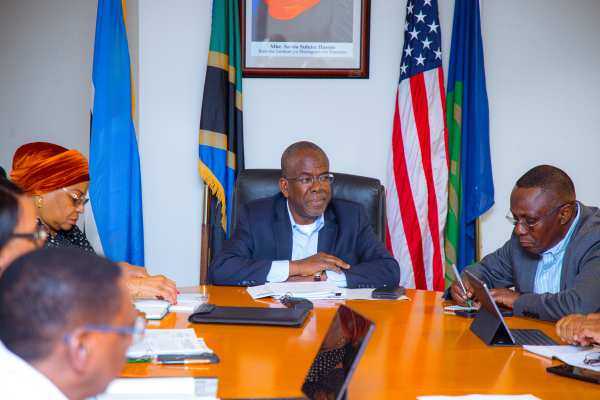
Leading the delegation, Finance Minister Khamis Mussa Omar (pictured above) underscored the country’s focus on economic diplomacy, signalling a shift from policy engagement to tangible deal-making.
The objective, he noted, is clear: convert diplomatic goodwill into bankable projects across key sectors including mining, tourism and infrastructure.
His remarks followed a briefing by Tanzania’s Ambassador to the United States, Elsie Sia Kanza, who outlined steady gains in bilateral trade and investment flows between the two countries.
Trade momentum and export expansion
Trade between Tanzania and the United States has shown strong upward momentum, rising from US$1.15 billion in 2023 to US$1.4 billion in 2024 – an increase of 22.1 percent.
Export performance has also remained resilient, with Tanzanian exports to the US growing by 18 percent in 2025 despite global trade headwinds.
A key driver of this growth has been the African Growth and Opportunity Act (AGOA), which continues to provide Tanzanian exporters with preferential access to the US market. Following its extension to December 2026, AGOA is expected to sustain export gains, particularly in textiles, which account for roughly 95 percent of Tanzania’s AGOA exports.
For Tanzanian businesses, this presents a critical window to scale production, improve quality standards and diversify export portfolios beyond traditional sectors.
Investment pipeline signals growing confidence
The meetings have also highlighted rising investor confidence in Tanzania’s economy. US companies are expanding their footprint, with global hospitality brand Marriott International planning to nearly double its hotel portfolio in Tanzania from 11 to 20 properties by 2027.
This expansion reflects growing optimism in the tourism sector, which continues to recover strongly. Visitor numbers from the United States rose significantly – from 118,108 in 2023 to around 145,000 in 2024 – reinforcing the US as a leading source market.
Meanwhile, strategic investments in extractives are gaining traction. A US$300 million project involving Panda Hill Tanzania Limited, backed by US-based investors, is expected to boost niobium production in Songwe Region while creating around 600 jobs.
The project signals Tanzania’s intent to position itself in high-value minerals critical to global supply chains.
In financial services, the entry of global payments firm Visa Inc. into the Tanzanian market marks a step forward in deepening digital financial infrastructure and supporting the country’s cashless economy ambitions.
Tourism diplomacy and soft power
Tourism has emerged as a cornerstone of Tanzania’s economic diplomacy. The continued rise in US tourist arrivals has been partly attributed to strategic branding efforts, including the film The Royal Tour, which has elevated Tanzania’s global visibility.
With more than 60 percent of hunting tourists coming from the US, the sector remains a key foreign exchange earner and a vital link in bilateral relations.
Strategic implications for Tanzania
The high-level engagements in Washington point to a broader strategic shift. Tanzania is not only strengthening its ties with a major global economy but also positioning itself as a competitive destination for investment in East Africa.
The emphasis on sectors such as mining, tourism and finance aligns with the country’s industrialisation agenda and long-term development frameworks, including its ambition to become a regional trade and logistics hub.
However, the real test will lie in execution – translating commitments into projects, improving the business environment, and ensuring that local enterprises are integrated into emerging value chains.
Looking ahead
As global capital becomes more selective, Tanzania’s proactive engagement at international forums signals a recognition that attracting investment requires both policy clarity and strategic positioning. The outcomes of the Spring Meetings could therefore shape the next phase of Tanzania’s economic trajectory – one defined not just by growth, but by its ability to leverage global partnerships for sustainable development.