
By Business Insider Reporter
The National Health Insurance Fund (NHIF) has strengthened its financial position, expanded membership, accelerated claims settlement and intensified efforts to extend health insurance coverage to vulnerable households and informal-sector workers, marking significant progress in its transformation over the past year.
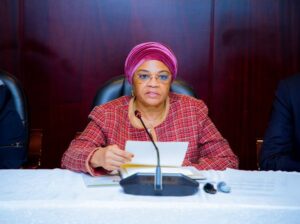
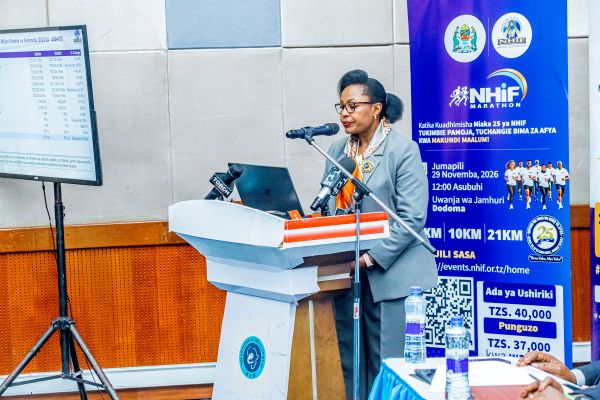
The improvements, according to NHIF Director General Dr. Irene Isaka (pictured ab.ove), reflect a series of financial, operational and technological reforms aimed at making the Fund more sustainable, responsive and accessible as Tanzania advances towards Universal Health Insurance (UHI).
Addressing editors during a working session organised by the Office of the Treasury Registrar in Dar es Salaam on Friday, Dr. Isaka outlined the Fund’s achievements, including the growth of its financial reserves to TSh1.31 trillion by the end of the 2025/26 financial year.
She said the stronger financial position had enhanced NHIF’s capacity to meet its obligations, settle claims from healthcare providers and respond to growing demand for medical services.
The financial improvement is among the most significant developments in the Fund’s recent performance, particularly as it prepares to accommodate more beneficiaries under the country’s Universal Health Insurance framework.
Improved financial performance
NHIF’s financial statements show that insurance revenue increased from TSh700.11 billion in 2023/24 to TSh773.42 billion in 2024/25, representing growth of 10.5 percent.
Over the same period, insurance service expenses declined by 10 percent, from TSh605.6 billion to TSh545.29 billion, helping to push the insurance service result up by 141.4 percent, from TSh94.51 billion to TSh228.13 billion.

Investment income also increased by 10.4 percent, reaching TSh56.3 billion in 2024/25, compared with TSh51 billion in the preceding financial year.
The Fund’s total assets grew by 22.7 percent to TSh1.063 trillion, while total reserves increased by 35.8 percent to TSh860.15 billion.
Its funding ratio improved from 0.83 to 1.40, while the current ratio rose from 2.05:1 to 2.45:1, reflecting improvements in its capacity to meet financial obligations.
The Fund also made progress in managing claims, reducing the average claims ageing period from 120 days to 50 days, against its target of 60 days.
This improvement is particularly important for healthcare providers, whose ability to maintain uninterrupted services depends partly on timely reimbursement by insurance schemes.
Membership and service expansion
NHIF has continued expanding its membership base, with the number of contributing members increasing from 1,196,205 in 2023/24 to 1,402,459 in 2024/25, an increase of 17.2 per cent.
The number of beneficiaries rose by 6.2 percent to 5,339,210, while registered employers increased from 7,486 to 7,842.
By the 2025/26 financial year, the Fund reported that its overall coverage had reached 7.1 million people, equivalent to 10.5 per cent of Tanzania’s population, compared with 2 per cent when it began operations in 2001.
The number of healthcare facilities accredited by NHIF has also reached 9,061 nationwide, comprising 7,014 dispensaries, 1,158 health centres, 464 hospitals and other specialised facilities.
Of particular significance is the Fund’s continued engagement with private healthcare providers, which account for 56.9 per cent of its claims payments, compared with approximately 43 per cent for public facilities.
Expanding protection to vulnerable households
Another major achievement highlighted in the Fund’s presentation is progress in implementing Universal Health Insurance, particularly through the provision of health insurance to vulnerable households.
The programme began verification and issuance of health insurance cards in February 2026, with the government allocating TSh41.4 billion to cover 276,000 vulnerable households comprising 1,206,319 beneficiaries across mainland Tanzania.
By the time of the reported assessment, 198,709 households had been verified and issued with cards, representing 72 percent of the target, while 542,829 beneficiaries had received cards.
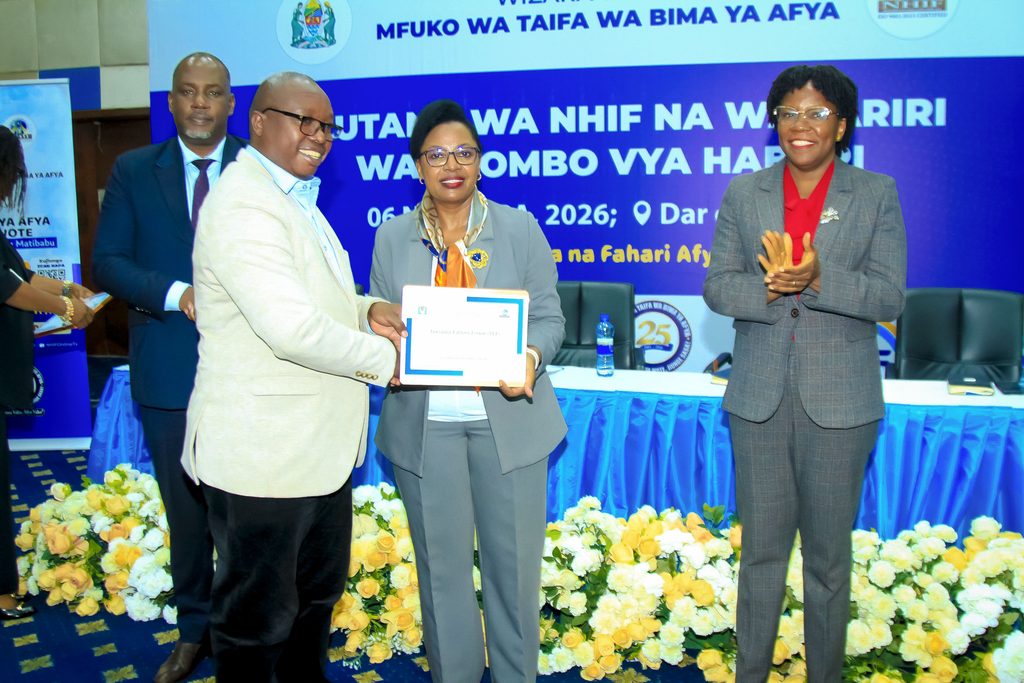
NHIF said preparations for the second phase of the vulnerable-household programme were also under way, following receipt of a list of 625,433 households and government payments amounting to TSh93.8 billion in September 2026.
New products for informal-sector workers
Recognising that a substantial proportion of Tanzanians work outside formal employment arrangements, NHIF has introduced group-based insurance packages designed to make coverage more affordable.
Under the arrangement, groups of at least 10 people can join at an annual contribution of TSh60,000 per member.
The product targets farmers, fishermen, small-scale traders, motorcycle taxi operators and food vendors, among other informal-sector workers who may find individual insurance contributions difficult to meet.
Digitalisation and stronger financial controls
Technology has become another important pillar of NHIF’s transformation.
The Fund has expanded electronic systems for membership registration, claims processing, employer contributions and communication with healthcare providers.
Its digital platforms allow members to register themselves, add dependants and access digital membership cards, while employers can submit contributions and obtain payment reference numbers online.
Integration with institutions including the National Identification Authority, Registration, Insolvency and Trusteeship Agency, National Social Security Fund and other government agencies has strengthened verification and reduced duplication of information.
Treasury Registrar calls for accountability and sustainability
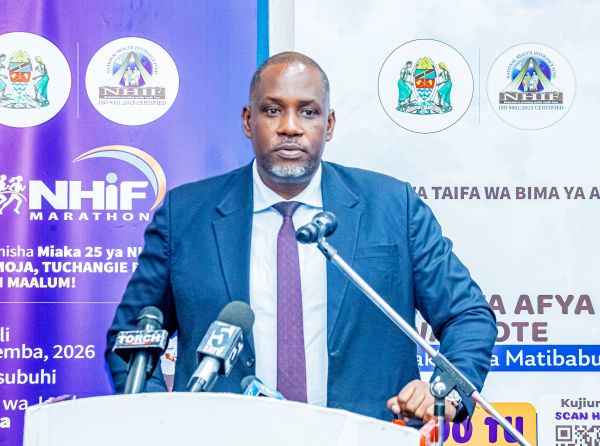
Speaking at the meeting, Treasury Registrar’s representative Sabato Kosuri (pictured below) said the Office of the Treasury Registrar had organised engagements between public institutions and media editors to strengthen accountability, transparency and public understanding of government investments.
He said the office, which supervises government assets and investments in public institutions and corporations on behalf of the government, considered good governance and accountability essential to improving institutional performance.
Kosuri said public institutions had been directed to ensure that their financial statements were accessible to Tanzanians, adding that engagement with editors provided an important platform for explaining institutional mandates, achievements and challenges while receiving independent views on areas requiring improvement.
He described NHIF as a critical institution in the healthcare sector because of its responsibility to help citizens access medical services without facing prohibitive out-of-pocket expenses.
He said health insurance was fundamentally about pooling contributions and sharing the financial risks associated with illness, thereby protecting households from the potentially devastating economic consequences of medical expenses.
Using a personal family experience, Kosuri illustrated the financial burden associated with specialised treatment, revealing that his younger brother had been receiving dialysis services at Benjamin Mkapa Hospital for approximately a month, at a family cost of about Sh1.8 million per week.
He said the experience demonstrated why health insurance should be viewed not merely as a financial product but as an important instrument for protecting families against poverty arising from expensive medical treatment.
Kosuri cautioned that NHIF’s performance should not be judged solely by membership numbers and revenue collection, but also by the quality of healthcare services, availability of medicines and medical equipment, and the Fund’s long-term financial sustainability.
He emphasised that social security institutions must balance their responsibility to serve current beneficiaries with the need to preserve resources for future generations.
“These funds must operate on the principle of serving today, tomorrow and the day after tomorrow,” he said.
He further linked NHIF’s responsibilities to the ambitions of Tanzania’s Development Vision 2050, arguing that a competitive and inclusive economy requires a healthy population and productive workforce. He said access to healthcare was essential to protecting human capital, sustaining household welfare and enabling citizens to participate effectively in economic activities.