
Government pitches renewable energy, climate-smart agriculture, resilient infrastructure and sustainable cities as investment opportunities, with the private sector expected to provide about 70 per cent of investment required under Vision 2050.
By Correspondent Scola Malinga, New York
Tanzania has invited international investors and development finance institutions to tap into the country’s growing climate and sustainable investment opportunities, arguing that efforts to tackle climate change must also drive economic transformation, job creation and improvements in people’s livelihoods.
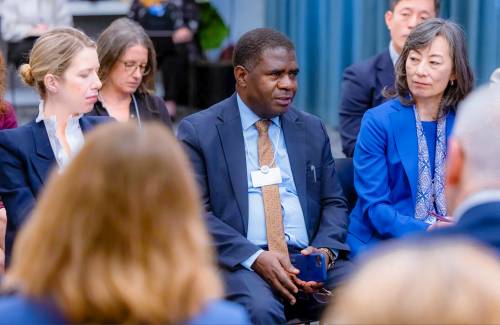
Deputy Finance Minister Mshamu Ali Munde made the call on behalf of Finance Minister Ambassador Khamis Mussa Omar following a high-level meeting of the Private Climate Finance Community at the United Nations headquarters in New York.
The meeting was part of the Sustainable Development Impact Meetings 2026 (SDIM26), organised by the World Economic Forum.
Munde said Tanzania was positioning itself to transform environmental challenges into economic opportunities through implementation of the National Development Vision 2050 (Dira 2050).
“Tanzania believes that financing to protect our planet and financing for development must go hand in hand. “For developing countries, climate action must support job creation, energy and food security, resilient infrastructure and industrial growth,” he said.
The government’s pitch places private investment at the centre of Tanzania’s long-term economic transformation.
According to Munde, the private sector is expected to account for about 70 percent of all investment required as Tanzania works towards attaining upper-middle-income status by 2050. The public sector, meanwhile, is expected to provide an enabling environment, stable policies and critical infrastructure.
Tanzania’s Dira 2050 seeks to build a US$1 trillion economy and raise average per-capita income to approximately US$7,000 a year.
Munde said Tanzania was therefore inviting the international community, banks, insurance companies and development organisations to participate in financing the country’s long-term development ambitions.
He said discussions with development partners in New York had received a positive response, with particular interest in how the private sector would participate in preparing and implementing projects supporting Dira 2050.
“A key issue that emerged was how the private sector has been involved in the preparation and implementation of projects that will take us towards the economy we are targeting,” Munde said.

He said the government was continuing to develop mechanisms for engaging private-sector stakeholders and ensuring that businesses and investors become an important part of Dira 2050 implementation.
Green investment opportunities
Tanzania is presenting several areas as priorities for sustainable and strategic investment.
Munde identified renewable energy – including wind, solar and hydropower – as one of the major opportunities available to investors.
Other areas include climate-resilient conservation agriculture, resilient transport and water infrastructure, sustainable urban development involving modern urban planning and green transport, and environmental conservation projects that protect ecosystems while generating revenue.
The government is also strengthening coordination of climate finance and seeking to create a more conducive environment for investors.
Munde said this would involve aligning public investment with public-private partnerships (PPPs) and using public resources to reduce investment risks.
The approach is intended to increase private-sector participation in projects considered important to both Tanzania’s development ambitions and its response to climate change.
Call for long-term local-currency finance
Tanzania also wants international development banks and development finance institutions to play a greater role in preparing projects and providing financing.
Munde called on the institutions to provide early-stage support for project preparation, greater access to grants and long-term financing denominated in local currency.
He said local-currency financing would help reduce the impact of foreign-exchange fluctuations on investments.
The government also stressed the importance of better coordination among institutions implementing environmental and climate-change programmes.
According to Munde, climate initiatives should involve all relevant stakeholders and be properly coordinated to prevent different institutions from developing multiple programmes targeting the same issues.
Such duplication, he said, can result in repeated work and reduce implementation efficiency.
The government’s message to investors is that climate-related investment should ultimately produce economic benefits alongside environmental gains.

Munde urged investors and development partners to engage domestic institutions at an early stage and collaborate in developing projects that create decent jobs and leave sustainable value in Tanzania.
The appeal comes as Tanzania seeks to mobilise substantially greater private investment to deliver its Dira 2050 ambitions, with climate finance positioned as one of the avenues through which capital could be channelled into renewable energy, agriculture, infrastructure, urban development and environmental conservation. For the government, the objective is to ensure that financing the response to climate change goes hand in hand with the broader task of transforming the economy and improving the livelihoods of Tanzanians.