By Business Insider Reporter
Tanzania remains among Africa’s stronger performers on gender parity, ranking 54th out of 145 economies globally in the World Economic Forum’s (WEF) 2026 Global Gender Gap Report, but the country’s relatively strong position masks persistent gaps in economic opportunity, leadership and political power.
The report, released on September 16, shows that Tanzania has closed 73.6 percent of its overall measured gender gap, placing it sixth among African economies covered by the index and fourth among SADC economies. Within the EAC bloc, it ranks behind Burundi and Rwanda but ahead of Kenya. Uganda was not included in the 2026 index because of data constraints.
Africa’s top performer is Namibia, ranked fourth globally with 84.5 percent parity, while Burundi ranks 26th, Rwanda 28th, South Africa 30th and Zimbabwe 49th .
The WEF index measures gender parity across four areas – Economic Participation and Opportunity, Educational Attainment, Health and Survival, and Political Empowerment – and Tanzania’s results vary sharply across them.
Education and health remain areas of strength
Tanzania records 95.6 percent parity in Educational Attainment and 96.3 percent in Health and Survival, indicating that the gender gaps in these areas are comparatively narrow.
The contrast is much greater in the economic and political dimensions. Tanzania records 70.1 percent parity in Economic Participation and Opportunity, while Political Empowerment stands at only 32.5 oercent.
The pattern mirrors the global picture. Worldwide, the WEF estimates that 96.9 percent of the Educational Attainment gap and 96.2 percent of the Health and Survival gap have been closed, compared with 61.7 percent for Economic Participation and Opportunity and only 22.1 percent for Political Empowerment.
The figures suggest that Tanzania has made considerable progress in creating broadly comparable outcomes for women and men in education and health, but those gains have not translated at the same pace into economic influence or political decision-making.
The economic challenge is increasingly about opportunity and leadership
The WEF’s analysis shows that economic participation is not simply about whether women enter the labour market. Leadership and progression within the economy also matter. Globally, representation among legislators, senior officials and managers remains one of the weaker areas within the economic dimension.
For Tanzania, this creates a broader development question: whether gains in education and labour-market participation can increasingly translate into women occupying senior management, business ownership and other positions where capital, investment and strategic economic decisions are made.
Political empowerment remains the widest gap
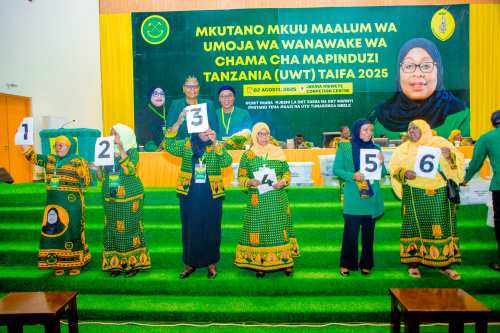
Political Empowerment is Tanzania’s weakest of the four WEF dimensions, at 32.5 percent.
Under the WEF methodology, this measure captures gaps in parliamentary and ministerial representation and the number of years women have occupied the position of head of state. It therefore goes beyond simply counting women participating in politics.
The regional picture is even weaker. Sub-Saharan Africa closed only 18.1 percent of its political empowerment gap in 2026, making it the region’s weakest-performing dimension despite improvements over the past two decades.
A health warning beneath the strong score
Tanzania’s high Health and Survival score also requires closer examination.
The WEF says healthy-life-expectancy parity has deteriorated over time in several countries, including the United Republic of Tanzania, because life expectancy has improved more rapidly for men than for women.
This illustrates why the headline parity score needs to be considered alongside the indicators that make up each subindex.
Progress, but a harder next phase
Tanzania’s overall position nevertheless places it among the stronger performers on the continent. The latest report also shows that global progress remains uneven. Among the 143 economies covered in both the 2025 and 2026 editions, about two-thirds improved their gender-parity scores, while 36 percent recorded declines.
Globally, the WEF estimates that, at the current rate of progress, full gender parity remains about 120 years away. No economy achieved full parity in the 2026 index.
For Tanzania, the report therefore presents a clear development trajectory: strong gains in education and health have established a foundation, while the more difficult next phase lies in converting those gains into greater economic opportunity, senior leadership and political influence. As Tanzania enters the implementation era of Dira 2050, the gender-gap figures provide another measure of whether the country’s human capital is being fully translated into economic participation and decision-making power.