
By Business Insider Reporter, Dodoma
Tanzania’s telecommunications sector is facing renewed scrutiny after Parliament ordered regulators to explain why major telecom operators have failed to comply with a legal requirement to list shares on the Dar es Salaam Stock Exchange (DSE), nearly eight years after the deadline expired.
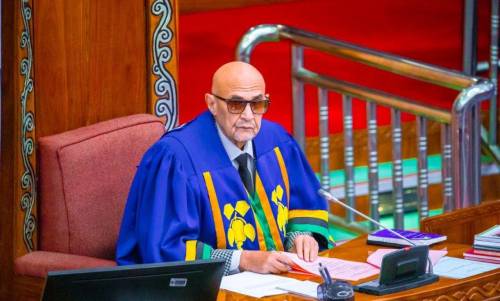
Speaker of the National Assembly Mussa Azzan Zungu (pictured below) on Monday June 15, 2026, directed the Tanzania Communications Regulatory Authority (TCRA) and the Capital Markets and Securities Authority (CMSA) to appear before the Parliamentary Budget Committee and account for the slow implementation of a law designed to broaden local ownership in the telecommunications industry and deepen Tanzania’s capital markets.
The directive follows concerns raised in the latest report by the Controller and Auditor General (CAG), which revealed that despite amendments to the Electronic and Postal Communications Act (EPOCA) in 2016 requiring non-state-owned telecom operators to float at least 25 percent of their shares to the public, only one company has fully complied with the requirement.
“Up to now, only one company, Vodacom Tanzania, has managed to comply with these legal requirements by selling shares to the public and increasing transparency and accountability,” Speaker Zungu told Parliament.
He questioned why TCRA, as the sector regulator, had failed to enforce the law and why CMSA had not ensured that the listing process was completed as required.
“The question that needs to be asked is why TCRA, as the regulator responsible for enforcing the EPOCA law, has not been able to take deliberate measures to implement this legal requirement,” he said.
The listing requirement was introduced as part of broader reforms aimed at increasing Tanzanian participation in strategic sectors, enhancing corporate transparency and expanding investment opportunities for local citizens. Policymakers also viewed public listings as a way to strengthen governance standards by subjecting companies to the disclosure requirements of the stock market.
The deadline for compliance expired on June 20, 2018. However, several major telecommunications operators remain unlisted.
Among them are Yas Tanzania, owned by Axian Telecom and Tanzanian businessman Rostam Aziz, and Halotel Tanzania, a subsidiary of Vietnam’s Viettel Group. Airtel Tanzania subsequently listed a portion of its shares on the DSE, although the government already holds an ownership stake in the company.
The issue comes at a time when Tanzania is increasingly looking inward for revenue mobilisation as shifting global economic conditions, rising financing costs and growing fiscal pressures force governments to explore alternative sources of income.
According to Speaker Zungu, failure to enforce listing requirements may be denying the country significant economic benefits.

“Honourable Members of Parliament, a significant amount of government revenue is lost due to the failure to follow or enforce our laws,” he said.
He cited examples from neighbouring countries where governments earn substantial revenues from dividends generated by investments in the telecommunications sector.
“These funds should also be generated in Tanzania so that the welfare of our citizens can improve through such revenue,” he added.
The concerns come as the government seeks to significantly increase dividend income from state-linked investments. While about TSh365 billion was collected in dividends during the 2024/25 financial year, the government is targeting approximately TSh1.2 trillion in dividend revenues in the 2026/27 fiscal year.
The push reflects a broader strategy by the government to strengthen returns from public investments and reduce reliance on borrowing while maintaining funding for development projects.
Data from the Treasury Registrar’s Office show that some of the largest dividend contributors in 2024/25 included Twiga Minerals Corporation, which contributed approximately TSh84.2 billion, followed by National Microfinance Bank (NMB) with TSh64.7 billion and Airtel Money with TSh50.67 billion.

Market analysts argue that wider participation of telecommunications companies on the stock exchange could provide multiple benefits beyond government revenues. Public listings would increase market capitalisation on the DSE, expand investment opportunities for pension funds and retail investors, and improve corporate governance through enhanced disclosure and accountability requirements.
For Tanzania’s capital markets, which have long sought larger listings to improve liquidity and attract more investors, the telecom sector represents one of the most significant untapped opportunities. The forthcoming appearance of TCRA and CMSA before the Budget Committee is therefore expected to shed light not only on regulatory enforcement challenges but also on the future of one of Tanzania’s most ambitious capital market reforms.