
By Benny Mwaipaja
Minister for Finance, Khamis Mussa Omar, has directed the Tanzania Revenue Authority (TRA) to align its revenue mobilisation strategy with the ambitions of the country’s long-term development blueprint, the Tanzania Development Vision 2050 (Dira 2050).
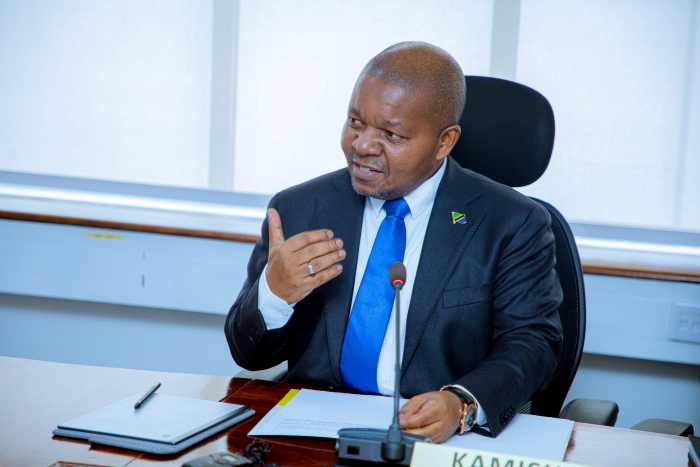
Speaking during his first official visit to the authority since his appointment by President Samia Suluhu Hassan, the minister underscored the centrality of domestic resource mobilisation in achieving Tanzania’s structural transformation agenda.
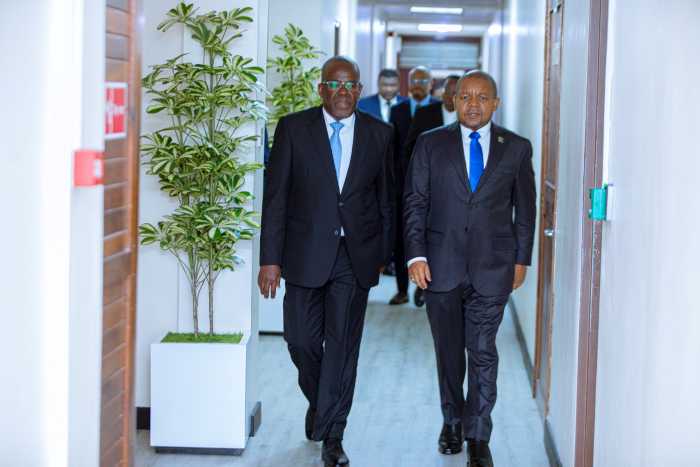
He met with the TRA Board of Directors and senior management in Dar es Salaam, where he stressed that the tax authority must position itself as a primary engine in financing the country’s next development phase.
From Dira 2025 to a more ambitious 2050 target
The outgoing national blueprint, Tanzania Development Vision 2025, had envisaged the country reaching a gross domestic product (GDP) of approximately US$90 billion by 2025.
While Tanzania has made notable strides in infrastructure, industrialisation and social services under that framework, the new Dira 2050 significantly raises the bar.
According to the minister, updated projections under the 2050 framework aim for Tanzania to attain a GDP equivalent of roughly US$1 trillion by mid-century.
To reach that level, he argued, the TRA must prepare to mobilise resources at a scale far beyond historical norms, with domestic revenues expected to finance as much as 70 percent of development expenditure.
This marks a decisive policy shift. Rather than relying heavily on concessional borrowing and external support, the government is signalling a stronger emphasis on broadening the tax base, enhancing compliance and tightening enforcement mechanisms.
The revenue challenge
Tanzania’s tax-to-GDP ratio, while improving over the past decade, remains below the levels seen in several peer economies within the East African Community and the wider SADC region. Expanding it will require not only stricter enforcement but also sustained economic growth, formalisation of informal businesses and improved digital systems.
Minister Omar commended the TRA for strengthening its relationship with taxpayers, particularly through voluntary compliance initiatives.
He urged the authority to maintain and deepen this approach, arguing that trust-based compliance is critical to long-term revenue sustainability.
A confrontational tax environment, he implied, could undermine private sector growth at a time when investment and enterprise expansion are essential.
At the same time, he delivered a firm warning on tax evasion and illicit trade practices. Among the key concerns raised were under-declaration of imports, diversion of goods falsely declared as transit cargo, and abusive transfer pricing practices by multinational companies. These leakages, he noted, distort competition, erode the tax base and ultimately slow economic development.
Customs, digitalisation and efficiency
In response, TRA Commissioner General Yusuph Juma Mwenda and Board Chairman Uledi Abass Mussa assured the minister that the authority is scaling up efforts to enhance both customs and domestic tax collection efficiency.
Key focus areas include risk-based cargo inspection, digital tracking of consignments and expanded use of electronic fiscal devices.
The minister concluded a two-day working tour of TRA offices in Dar es Salaam, during which he reviewed operations across various departments and assessed the digital platforms used to facilitate tax payments and taxpayer services.
Digitalisation is expected to play a pivotal role in the next phase of revenue reform, helping to reduce human interface, curb corruption risks and improve real-time data analysis.
Major issues framing the 2050 agenda
The fiscal push comes at a time when Tanzania faces a complex set of structural challenges that will shape the implementation of Dira 2050.
First is the demographic dynamic. With a young and rapidly growing population, the country must create millions of jobs over the coming decades.
This will require accelerated industrialisation, export diversification and expansion of value-added agriculture – all of which depend on a predictable and efficient tax environment.
Second is debt sustainability. Large-scale infrastructure investments over the past decade – from railways to ports and energy projects – have improved productive capacity but also increased public debt levels.
Strengthening domestic revenue mobilisation is therefore essential to reducing reliance on borrowing and preserving macroeconomic stability.
Third is the need to combat illicit financial flows. Transfer pricing manipulation and misinvoicing of trade transactions have long been cited as major drains on potential public revenue across Africa. Addressing these practices requires stronger audit capacity, international cooperation and sophisticated data analytics — areas where TRA will need continued institutional strengthening.

Finally, regional integration under the East African Community and the Southern African Development Community introduces both opportunity and complexity. As cross-border trade expands, customs administration must balance facilitation with enforcement to prevent revenue losses while supporting legitimate commerce.
A defining decade ahead
The minister’s directive signals that the coming decade will be pivotal. If Tanzania is to transition from lower-middle-income status to a diversified, high-productivity economy by 2050, revenue performance will be a defining metric.
For businesses, the message is clear: compliance will be more closely monitored, especially in high-risk sectors and cross-border trade. At the same time, authorities appear committed to improving service delivery and predictability in tax administration. As Vision 2025 draws to a close and Dira 2050 takes centre stage, the TRA finds itself at the heart of Tanzania’s economic transformation. The scale of ambition – from a US$90 billion economy to one targeting US$1 trillion – is unprecedented. Whether that ambition translates into reality will depend in large part on how effectively the country mobilises, manages and safeguards its domestic resources in the years ahead.