By Costantine Muganyizi
For many students in Tanzania’s most remote communities, access to qualified teachers has long been determined by geography and chance – a reality that is now poised to fade into history.
A newly launched digital learning platform is stepping in to rewrite that story, bringing lessons within reach of every learner, one virtual classroom at a time
In a move that blends technology with education equity, the RAOMA Foundation, in partnership with Vodacom Tanzania Plc, has unveiled the SOMO digital learning platform under the Twende Zetu Darasani campaign.
The platform is designed with a simple but powerful promise: a single teacher can now reach students in multiple schools across the country simultaneously. For learners in underserved and rural communities, that could mean access to lessons that were previously out of reach.
Education officials say the innovation arrives at a critical time when Tanzania is pushing to modernize learning and prepare young people for a digital future.
Representing Deputy Minister of Education Wanu Hafidh, the Director of Science, Technology and Innovation at the Ministry of Education, Science and Technology, Prof. Ladislaus Mnyone, emphasised that technology-driven education will help expand opportunity for Tanzanian children.
“As we move toward achieving our new development vision – Dira 2050 – of becoming a US$1 trillion economy, we recognise that education is the primary foundation for that success,” he said noting that digital tools can help bridge long-standing gaps in access and quality.
“Through the use of digital technology in teaching and learning, we are expanding educational opportunities, improving quality, and preparing Tanzanian children with the knowledge and skills that will drive our nation’s development,” he added.
Prof. Mnyone commended the RAOMA Foundation and Vodacom Tanzania for forging what he described as a forward-looking strategic partnership, noting in particular the decision to leverage local expertise in developing the system.
He said the homegrown innovation represents a significant transformation in Tanzania’s education sector and sets a strong precedent for locally driven digital solutions..
Behind the technology are real stories and real ambitions. At its core, SOMO seeks to support students whose schools struggle with teacher shortages, overcrowded classrooms, or limited learning resources. By connecting classrooms virtually, the system gives teachers new reach and students new hope.
Rahma Abdallah, Director of RAOMA Foundation, said the partnership reflects a shared commitment to ensuring no child is left behind because of where they live.
“We are working closely with government and development partners so that this system reaches every school and every learner who needs it,” she said.
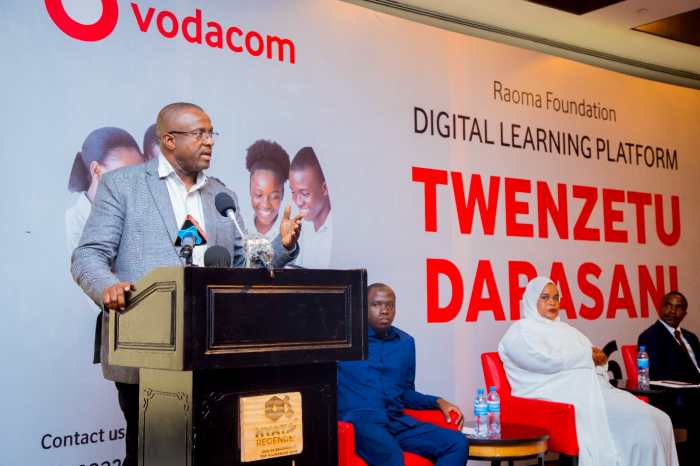
For Ali Zuheri Ali, Head of Enterprise Products & Solutions at Vodacom Tanzania, the platform is part of a broader mission to accelerate the country’s digital transformation while solving practical challenges in education.
“One of our objectives is to take Tanzania into the digital world. We have therefore introduced this digital platform that will enable one teacher to teach multiple schools or groups of students in different locations without being physically present,” Mr Al explained.
Education stakeholders believe the human impact could be significant – especially for students in hard-to-reach communities who often face the steepest barriers to quality education. As SOMO begins rolling out, its success may ultimately be measured not just in connectivity statistics, but in the stories of students who, for the first time, can clearly see – and hear – their teacher.