By Business Insider Reporter
Stanbic Bank Tanzania has deepened its corporate social investment in education with the rollout of a major school library programme in partnership with NGO Uwezo Tanzania.
The lender said in presser that the initiative in Ludewa District, Njombe Region, is designed to strengthen foundational learning in underserved communities.
The roll out of the programme will lead to establishment of 45 school libraries across the district, reaching an estimated 33,619 pre-primary and primary school pupils each year.
Stanbic Bank says the corporate philanthropy investment underscores its expanding role in supporting quality education at the base of the learning pyramid.
“The initiative will provide curriculum-aligned and extracurricular books for pre-primary and primary learners, strengthening literacy and numeracy at the most critical stage of learning,” the statement noted.
Beyond expanding access to reading materials, the partners expect the project to cultivate a stronger reading culture in rural schools, improve early-grade learning outcomes, and support national efforts to raise foundational competencies among young learners.
By focusing on early mastery of Reading, Writing and Arithmetic (RWA), the initiative directly supports the National Scientific Strategy for Building RWA Proficiency launched in January 2026 by President Dr. Samia Suluhu Hassan.
Education experts widely view these competencies as the critical foundation for lifelong learning, productivity and innovation.
Under Phase I, Stanbic Bank Tanzania is financing the procurement of age-appropriate books designed to improve classroom engagement and nurture a culture of reading both in school and at home.
The programme is being implemented through Uwezo Tanzania’s My Village (Kijiji Changu) model, which emphasizes community ownership, parental involvement and sustainable village-level learning ecosystems.
Speaking during the launch on February 18, Dickson Senzi, Senior Manager for External Affairs, Communication and Reputation at Stanbic Bank, said the initiative reflects the bank’s long-term human capital investment strategy.
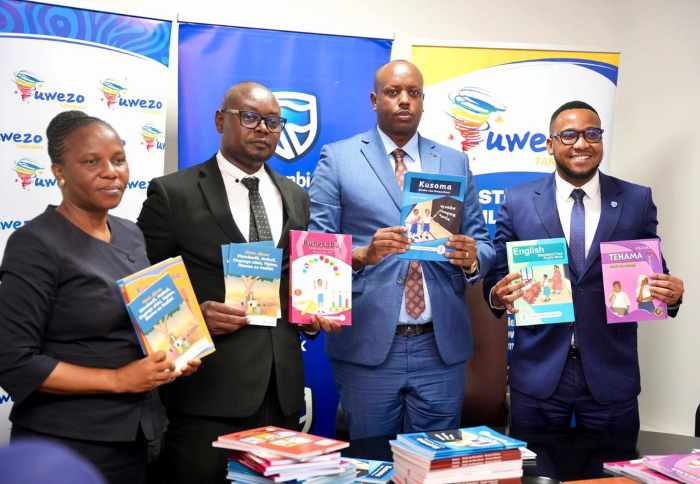
“By expanding access to quality learning resources in underserved communities, we are strengthening the foundation for a skilled, productive and innovative generation capable of driving inclusive national growth,” he noted.
The programme is being rolled out in close collaboration with the Tanzania Institute of Education, the National Library of Tanzania and the Njombe Regional Office, ensuring alignment with national education standards.
Teachers will receive literacy and numeracy support materials, while library usage will be systematically tracked to measure impact.
Beyond improving reading culture, the initiative positions Stanbic Bank’s corporate giving squarely within the ambitions of the Sixth Phase Government and the Dira 2050 national development blueprint, which prioritizes human capital development, equitable access to quality education and a knowledge-driven economy.
By investing at the earliest stages of learning, the bank is helping close foundational skills gaps that often widen inequality later in the education system. With community participation built into the model and schools encouraged to expand their own book collections, the Ludewa programme signals a scalable approach to strengthening Tanzania’s education ladder – starting where it matters most: the foundation.