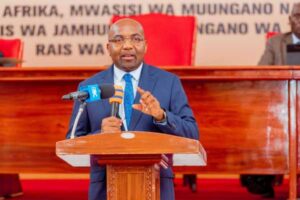

By A Correspondent, Zanzibar
University students in Zanzibar have been urged to play a leading role in protecting and promoting the Union between Tanganyika and Zanzibar, with leaders describing it as the cornerstone of national peace, stability and economic progress.
Hamad Yussuf Masauni, Minister of State in the Vice-President’s Office (Union and Environment), made the call while opening a Union symposium for higher education students held at the State University of Zanzibar (SUZA) in Unguja on February 19, 2026.
Addressing students, Masauni said young people – who make up the majority of Tanzania’s population – carry a special responsibility to preserve the legacy of unity established by the country’s founding leaders.
“Young people are the workforce and the hope of the nation,” he said. “A large proportion of Tanzanians were born after the Union. It is therefore essential that they understand its history, foundations and benefits so they can become strong ambassadors in safeguarding it.”
Renewed focus on Union education
The symposium forms part of directives issued by President Samia Suluhu Hassan in April 2024 during the launch of a publication marking 60 years of the Vice-President’s Office. The President emphasised the importance of expanding Union education to different segments of society, particularly youth.
The Union of Tanganyika and Zanzibar, founded in 1964 by Julius Nyerere and Abed Amani Karume, has now endured for more than six decades. It remains one of Africa’s longest-standing political unions and has often been cited as a model of negotiated state integration on the continent.
Masauni described patriotism as action rather than rhetoric, urging students to promote dialogue in resolving disputes, respect differing views, reject corruption, pay taxes honestly and protect national resources.
“The Government is ready to work closely with university students to ensure that the Union continues to serve as a foundation for peace, stability and development for both present and future generations,” he added.
Economic and social implications
While largely political in nature, discussions around the Union also carry economic significance. The shared governance framework enables coordinated fiscal policy, trade arrangements and joint infrastructure planning between Mainland Tanzania and Zanzibar.
Stability under the Union has been instrumental in supporting tourism growth in Zanzibar, cross-border trade and investor confidence across the United Republic.
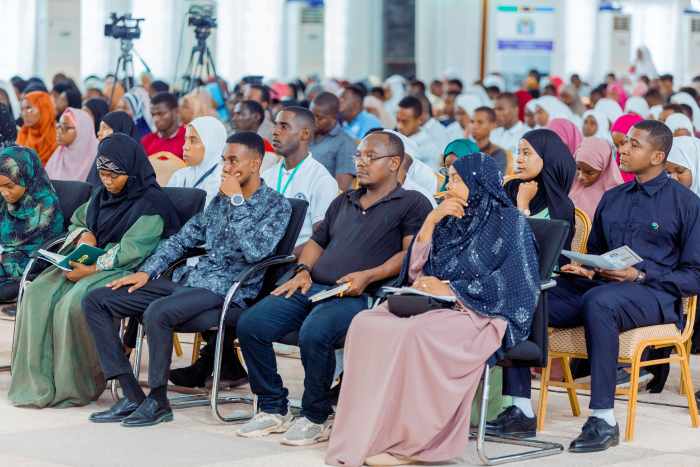
Zanzibar’s Minister for Agriculture, Irrigation, Natural Resources and Livestock, Suleiman Masoud Makame, said the symposium had deepened participants’ understanding of the Union’s unique structure and its developmental impact.
“With a broader understanding of our responsibilities as young citizens, we will use the knowledge and experience gained to advance the principles of peace, stability and unity that underpin the Union,” he said.
He noted that the forum provided space to reflect not only on achievements since 1964 but also on challenges encountered in implementation and the long-term vision for sustaining the Union.
Youth engagement at a strategic moment
The President of the SUZA Students’ Government, Juma Omar Nkwede, welcomed the initiative, describing it as timely in equipping students with historical context and institutional awareness.
The engagement of youth is seen as particularly important as Tanzania navigates evolving political and economic priorities in a rapidly changing regional environment.
For policymakers, strengthening civic education on the Union is viewed as essential to maintaining cohesion while pursuing broader national development goals. As Tanzania continues to position itself as a stable investment destination in East Africa, leaders argue that preserving the Union’s foundations of peace and cooperation remains central to sustaining economic momentum and social harmony alike.