

By Business Insider Reporter
Improving Tanzania’s investment climate is now officially framed as the most urgent structural reform required to unlock Dira 2050 and propel the country towards a trillion-dollar economy – equivalent to well over TSh 2.5 quadrillion at current exchange dynamics.
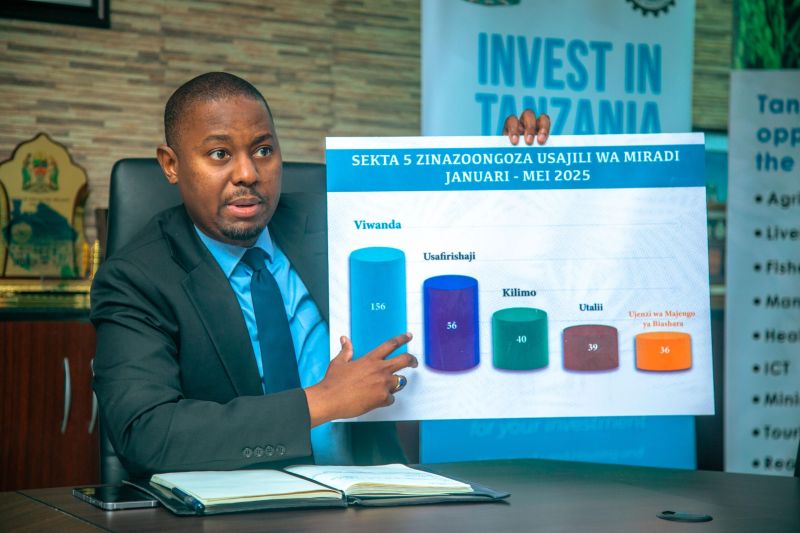
That was the overarching strategic message delivered by Kitila Mkumbo, Minister of State in the President’s Office for Planning and Investment (pictured), during the validation workshop for the proposed National Strategy for Improving the Investment Climate and Business Environment, widely known as MKUMBI II.
Speaking to development partners, investors and policymakers in Dar es Salaam, Prof. Mkumbo positioned business environment reform not as a technical policy adjustment, but as the central pillar upon which Tanzania’s 25-year development blueprint, Dira 2050, will stand or fall.
“Prosperity is born of sustained economic growth. Economic growth is driven by innovation. Innovation flourishes under competition. And competition thrives in a conducive business environment,” he argued – laying out a chain that ultimately places regulatory and institutional reform at the heart of Tanzania’s economic transformation.
From vision to implementation
Effective July 1, this year Tanzania will begin implementing Dira 2050, an ambitious national development framework that aims to transform the country into a prosperous, inclusive and self-reliant economy.
A core aspiration of the blueprint is to elevate Tanzania into the ranks of upper-middle to high-income economies, with significantly expanded industrial capacity, export competitiveness and domestic value addition.
Yet policymakers now acknowledge that such ambitions cannot be financed or delivered through public expenditure alone. Instead, the private sector must become the dominant engine of growth – and that requires a predictable, transparent and competitive business climate.
MKUMBI II is designed as the policy instrument to deliver that shift.
Learning from MKUMBI I
The new strategy builds on the earlier Blueprint for Regulatory Reforms (MKUMBI I), which guided business environment reforms over the past seven years. While MKUMBI I produced measurable progress in streamlining procedures and improving regulatory coordination, government assessments identified implementation gaps and structural bottlenecks that limited its full impact.
MKUMBI II therefore represents what Prof. Mkumbo described as both “continuity and correction”. It sustains reforms that proved effective, while addressing deeper systemic weaknesses.
The draft strategy identifies 59 core challenges affecting the investment climate and proposes 246 reform actions – signalling a move away from piecemeal adjustments towards comprehensive institutional restructuring.
Addressing structural constraints
The speech candidly acknowledged long-standing barriers that have constrained Tanzania and much of Africa’s development trajectory: overregulation, excessive bureaucracy, policy unpredictability, infrastructure gaps and corruption.
These constraints, Prof. Mkumbo suggested, have historically suppressed entrepreneurial dynamism and limited economic freedom.
For investors, the implication is clear. Tanzania’s next growth phase will depend less on new policy announcements and more on implementation discipline – ensuring regulatory predictability, reducing compliance costs and strengthening institutional accountability.
Comparisons were drawn with economies such as Dubai, Singapore, South Korea and Mauritius – jurisdictions that transformed limited natural endowments into prosperity through competitive, investor-friendly frameworks. The message was unmistakable: Tanzania intends to benchmark itself against globally competitive standards.
Harnessing the demographic dividend
Beyond regulatory reform, MKUMBI II is also framed as a mechanism for unlocking Tanzania’s demographic advantage. With a young and rapidly expanding population, the country possesses what policymakers describe as an energetic and entrepreneurial labour force capable of driving innovation and enterprise.
However, Prof. Mkumbo warned that demographic potential does not automatically translate into prosperity. Without deliberate policy alignment – particularly in investment facilitation, skills development and institutional efficiency – the demographic dividend could remain underutilised.

By aligning youthful ambition with improved investment conditions, the government aims to stimulate productive enterprise, expand decent job creation and channel innovation into wealth generation.
A strategic inflection point
The validation workshop was positioned not as a ceremonial consultation, but as a strategic inflection point. Development partners and investors were invited to provide candid, practical feedback to ensure the final strategy reflects market realities rather than purely administrative intentions.
For the business community, MKUMBI II signals a recalibration of the state–market relationship. Government is defining its role as architect of an enabling environment, while explicitly acknowledging that private capital, innovation and enterprise will determine whether Dira 2050’s ambitions are realised.
The success of the strategy will ultimately be measured by tangible outcomes: increased domestic and foreign investment, improved ease-of-doing-business metrics, expansion of formal sector employment and sustained high growth rates. As Tanzania prepares to transition into the implementation phase of Dira 2050, the message from the Planning and Investment portfolio is unequivocal: structural business environment reform is no longer peripheral policy – it is the cornerstone of the nation’s economic future.