
By Business Insider Reporter
Tanzania is sharpening its focus on private sector-led growth as it targets a US$1 trillion economy by 2050.
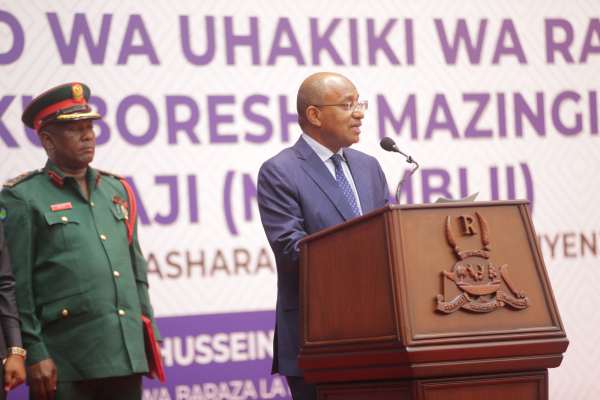
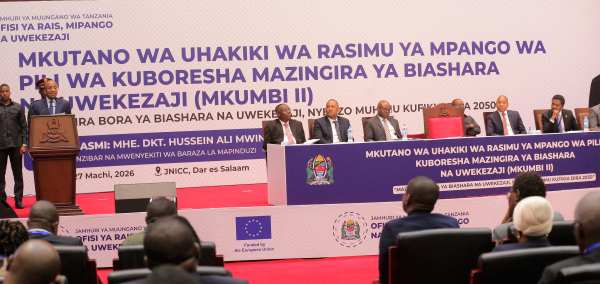
President Dr. Hussein Ali Mwinyi underscored this shift yesterday in Dar es Salaam while opening the validation workshop for the draft Second Business and Investment Environment Improvement Plan (MKUMBI II).
Addressing policymakers, business leaders and development partners at the Julius Nyerere International Convention Centre on March 27, 2026, President Mwinyi framed the draft plan as a critical execution tool to unlock investment, accelerate productivity and position the private sector at the heart of economic transformation.
The message was unmistakable: government will set the stage, but the private sector will drive growth. At the centre of this strategy is Dira 2050, the country’s new long-term blueprint to achieve high-income status within the next 25 years.
The targets are bold – expanding the economy to US$1 trillion and raising per capita income to around US$7,000 (about TSh 180 million at the current market exchange rtae) annually. But the path is equally demanding, requiring sustained economic growth of at least 10 percent per year from 2026 to 2050.
Such growth, President Mwinyi stressed, will depend on the scale and quality of investment flowing into key productive sectors. Industry, modern agriculture, the blue economy, energy, ICT and high-value services have all been identified as priority areas where private capital and innovation must lead.
“Government alone cannot deliver this transformation,” he said, reinforcing the central role of businesses as investors, employers and innovators.
That shift in thinking is also at the core of MKUMBI II itself. Speaking at the same forum, Minister of State in the President’s Office for Planning and Investment, Prof. Kitila Mkumbo, said the plan is designed to fundamentally reset the relationship between the public and private sectors.
He noted that MKUMBI II aims to remove uncertainty and build trust between government and businesses by reforming institutional frameworks and redefining the role of public institutions — from regulators to facilitators of enterprise.
“The goal is to transform public systems so that they support, rather than constrain, business activity,” he said, adding that such changes will stimulate private sector growth and generate more employment opportunities, particularly for young people.
MKUMBI II, currently in draft form, builds on reforms implemented under its predecessor, which focused on dismantling regulatory and institutional barriers that have long constrained business activity. In recent years, those efforts have begun to reshape Tanzania’s investment landscape.
In 2024 alone, the country registered 901 investment projects worth US$9.3 billion, expected to create more than 212,000 jobs. Between 2024 and 2025, the number rose to 1,828 projects valued at US$20.3 billion – a sign of improving investor confidence.
These gains have been underpinned by deliberate policy action. More than 94 laws have been reviewed, while over 628 taxes, fees and charges identified as barriers to business have been removed or reduced. Institutional overlaps have been addressed, and digital systems introduced to improve efficiency and service delivery.
Yet, as officials acknowledge, reform is now entering a more demanding phase.
MKUMBI II seeks to move beyond removing bottlenecks to actively enhancing competitiveness. The draft aligns with both Dira 2050 and the Fourth National Development Plan, with a sharper focus on efficiency, speed and adherence to international standards.
Infrastructure investment remains central to this effort. Ongoing government spending on railways, ports, roads, energy systems and ICT is aimed at lowering production costs and strengthening Tanzania’s competitiveness in regional and global markets.
For Zanzibar, improvements in the business environment are already translating into tangible gains. Growth in tourism, financial services and the blue economy highlight the potential of targeted reforms to unlock sector-specific opportunities.
Equally significant is the inclusive approach taken in developing MKUMBI II. The validation workshop marks the culmination of extensive consultations with stakeholders across the public and private sectors, ensuring that the final plan reflects real business needs and constraints.

As the country moves toward finalising the framework, attention is increasingly shifting to implementation – often the most difficult stage of reform. President Mwinyi emphasized the need for strong public-private collaboration, transparent and predictable policies, and robust monitoring systems to ensure results.
He also highlighted the importance of strengthening financial systems and expanding the use of modern technologies to support enterprise growth. Ultimately, the success of MKUMBI II will depend on its ability to catalyse investment at scale and sustain high growth over time. For Tanzania, the direction is now clear: a more competitive, investment-driven economy powered by a confident and enabled private sector.