By Correspondent Peter Haule
Finland is seeking to deepen its economic partnership with Tanzania by expanding investment and development cooperation in digital technology, telecommunications, forestry and mining, signalling a shift towards a stronger private-sector-driven relationship between the two countries.
The Nordic country wants to move beyond traditional development assistance towards a broader economic partnership that brings together private investment, technological innovation and development financing to support Tanzania’s growth ambitions.
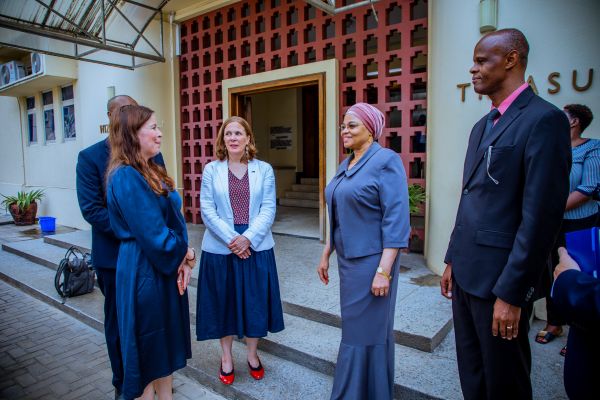
Finland’s Ambassador to Tanzania, Anna Merrifield, outlined the country’s intentions during a meeting with the Permanent Secretary in the Ministry of Finance, Dr. Natu El-Maamry Mwamba, at the ministry’s Dar es Salaam offices.
Ambassador Merrifield said Finland was keen to use its expertise in technology and innovation to support Tanzania’s development priorities, particularly as the country pursues its ambition of building a US$1 trillion economy by 2050.
“Finland has considerable experience in technology and innovation, particularly in digital services and communications, which could help Tanzania achieve its development objectives,” she said.
She argued that digital technology and telecommunications would be essential to Tanzania’s long-term economic transformation, noting that the country’s development ambitions could not be achieved without integrating technology across different sectors of the economy.
The proposed partnership is expected to connect development programmes more closely with private-sector investment, creating opportunities for Finnish companies to contribute expertise, technology and business solutions to Tanzania’s economic challenges.
Merrifield said Finland was particularly interested in supporting projects with significant social and economic benefits, including those that might not generate sufficient direct commercial returns to attract conventional private investment.
Such projects, she explained, could still deliver substantial benefits to communities and contribute to Tanzania’s wider development objectives.
The approach would allow Finnish companies to apply their technical capabilities while ensuring that investments respond to Tanzania’s priorities and generate mutual benefits.
Concessional financing opens new opportunities
The discussions also highlighted the potential of Finland’s Public Sector Investment Framework (PIF), a financing arrangement designed to support public investment projects through concessional loans backed by grants from the Finnish Government.
Dr. Mwamba welcomed the framework, saying it provided Tanzania with an opportunity to secure affordable financing for strategic public projects that might struggle to attract funding through conventional commercial arrangements.

She explained that the framework prioritises investments with substantial economic, social and environmental benefits, particularly where the commercial returns alone may not be sufficient to justify conventional financing.
One of the first projects expected to benefit is Phase Five of the National ICT Broadband Backbone (NICTBB) expansion.
The project will be implemented by the Ministry of Communications and Information Technology through the Tanzania Telecommunications Corporation (TTCL), in partnership with Finland’s Nokia.
The involvement of Nokia provides an opportunity to bring Finnish technological expertise into Tanzania’s telecommunications infrastructure, potentially strengthening the country’s capacity to expand digital connectivity and support a growing digital economy.
For Tanzania, the expansion of the national broadband backbone is strategically important. Reliable and affordable connectivity is increasingly central to the delivery of public services, financial inclusion, business operations, education and the development of digital industries.
The project also fits into the country’s wider ambition to use technology as a driver of productivity, competitiveness and economic growth.
Dr. Mwamba said the Ministry of Finance would closely monitor preparations for the project to ensure that the necessary procedures were completed on schedule.
She disclosed that the project’s documentation was undergoing review by the National Planning Commission, an important step towards its implementation.
Beyond traditional development cooperation
Finland’s proposed shift towards investment-led cooperation reflects an opportunity for Tanzania to attract more specialised technology and private-sector expertise while broadening the sources of financing available for public infrastructure.
The inclusion of forestry and mining in the proposed areas of cooperation also creates scope for collaboration beyond telecommunications, although specific investment projects in these sectors were not outlined during the meeting.

For Tanzania, the challenge will be to translate diplomatic commitments into bankable projects, effective technology transfers and measurable economic benefits.
The proposed framework could help bridge the financing gap for infrastructure and other public investments where the wider economic and social benefits are greater than the immediate financial returns. Dr. Mwamba commended the Finnish Government for its continued cooperation with Tanzania. She also recognised the contribution of former Finnish Ambassador to Tanzania, Theresa Zitting, to strengthening relations between the two countries, particularly in mobilising financing for strategic projects.