

By Business Insider Reporter
Tanzania’s latest natural gas discovery has put the Mtwara energy corridor back in focus, with the government announcing an estimated 223 billion cubic feet (Bcf) of gas at the Kasa-1X ST2 well in the Mnazi Bay area. The discovery could strengthen domestic supply and support industrial growth, power generation and access to cleaner household energy.
However, French operator Maurel & Prom (M&P) has reported a preliminary estimate of approximately 200 Bcf gross, without publicly classifying it as gas initially in place, a contingent resource or a proved reserve.
Energy Minister Juma Homera announced the government’s figure on October 27, 2026 in Dodoma, following a three-well drilling campaign by the Tanzania Petroleum Development Corporation (TPDC) and M&P.
In an October 22 technical update, M&P said Kasa-1X had confirmed a gas reservoir with encouraging characteristics. It estimated associated volumes at approximately 200 Bcf gross, equivalent to 120 Bcf net to its 60 per cent interest in the block.
The available information does not explain the difference between the government’s 223 Bcf figure and the operator’s estimate. Neither figure should be interpreted as confirmation that the entire volume is commercially recoverable.
For investors, the discovery is promising, but its economic value will depend on recoverable volumes, development costs, infrastructure and sustained production.
Three wells, two commercial purposes
The drilling campaign combined production development with exploration. According to the Petroleum Upstream Regulatory Authority, MB-5 and MS-2 are production, or infill, wells, while Kasa is the exploration well. M&P operates the Mnazi Bay block with a 60 per cent interest, while TPDC holds 40 percent.
The two production wells are already contributing to output. M&P reported that MB-5 and MS-2 were on stream, lifting current Mnazi Bay production to approximately 130 million cubic feet per day. The combined potential of existing wells was approaching 200 million cubic feet per day, while processing facilities had been tested at 150 million cubic feet per day.
For Kasa, M&P envisaged first production as early as November 2026, with expected gross potential of 50 million cubic feet per day. This was a production plan, not confirmation that the exploration well was already supplying gas when the discovery was announced.
If development proceeds successfully, Kasa could provide additional supply to Tanzania’s domestic market.
Why Mnazi Bay matters
Mnazi Bay is one of Tanzania’s two producing natural gas fields, alongside Songo Songo. Gas from the field supports power generation, industry, transport and household use, making production levels important to energy security and business operating costs.
According to TPDC, the field has been producing since 2006. Its infrastructure includes the Madimba processing plant and the Mtwara–Dar es Salaam gas pipeline, connecting production in southern Tanzania to markets along the transmission route.
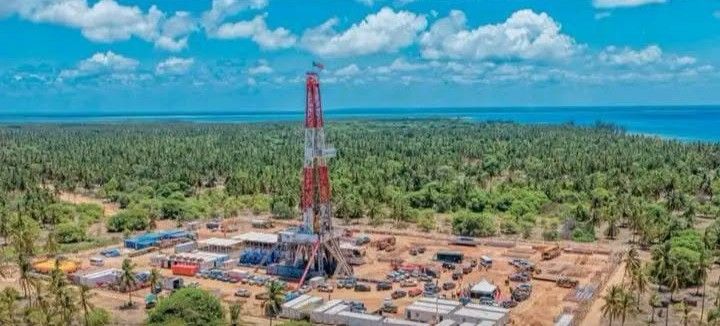
Existing infrastructure could give Kasa a development advantage over discoveries requiring entirely new processing and transportation systems. However, proximity alone does not guarantee commercial viability. Reservoir performance, connection costs and processing requirements will help determine whether the gas can be produced economically.
For manufacturers and other energy users, the key question is whether additional production can translate into reliable supply at commercially sustainable prices.
A discovery is not a proven reserve
The Kasa announcement highlights an important distinction in energy investment. Gas initially in place refers to the estimated volume underground before accounting for extraction. Recoverable resources reflect the portion that may be produced under technical and economic assumptions, while proved reserves meet established criteria for commercial recovery.
M&P’s approximately 200 Bcf estimate was not publicly classified in its October 22 update under these categories. Investors should therefore avoid treating the government’s 223 Bcf announcement as a certified measure of recoverable gas.
Further technical assessment will be needed to clarify the volumes and their commercial potential. This does not diminish the discovery’s significance, but it underscores the work required to turn exploration success into dependable supply.
A substantial national resource
TPDC estimates Tanzania’s total discovered gas resource at 57.54 trillion cubic feet of gas initially in place. This indicates the country’s geological potential but is not equivalent to recoverable reserves or gas available for immediate delivery.
In its 2026/27 budget statement, the government said Mnazi Bay averaged 110 million cubic feet per day in the period to March 2026. It expected the three-well programme to add between 45 million and 55 million cubic feet per day.
The figures relate to different reporting periods and should be read accordingly. M&P subsequently reported production of approximately 130 million cubic feet per day after MB-5 and MS-2 entered service. Ultimately, the Kasa discovery’s value will depend on whether the estimated gas can be developed commercially and delivered reliably to customers. Its proximity to existing infrastructure offers potential, but technical assessment, development progress and sustained production will determine whether the discovery becomes a lasting asset for Tanzania’s energy economy.