

By Business Insider Reporter
Tanzania’s petroleum import bill has surged to a new post-pandemic high, highlighting the growing foreign-exchange cost of the country’s dependence on imported fuel as renewed geopolitical tensions push global oil prices sharply higher.
The country spent US$3.3 billion on refined petroleum products in the year ending July 2026, up 42.3 percent from US$2.32 billion in the corresponding period a year earlier, according to the latest Bank of Tanzania (BoT) Monthly Economic Review (MER).
The increase means petroleum products alone accounted for 18.9 percent of Tanzania’s total goods import bill during the period, making fuel by far one of the country’s biggest claims on foreign exchange.
“Imports of refined white petroleum products, which accounted for 18.9 percent of the goods import bill, increased by 42.3 percent to US$3,296.8 million, reflecting elevated global oil prices and sustained domestic demand,” the central bank notes on the MER.
The latest figures also show how quickly Tanzania’s oil bill can change when international prices move. In 2025, the country’s refined petroleum import bill stood at about U$2.32 billion, compared with US$2.85 billion in 2024 and US$2.95 billion in 2023. It had reached US$3.3 billion in 2022, when the global energy market was hit by the Russia-Ukraine war.
The 2026 increase therefore brings the bill back towards the levels seen during the previous major global energy shock.
Price volatility hits Tanzania
The latest surge has coincided with an exceptionally volatile international oil market.
The BoT says the average global crude-oil price fell from US$81.7 a barrel in June to US$79.8 in July 2026, following a US-Iran agreement in June. But prices began rising again in mid-July as attacks on oil tankers resumed around the Strait of Hormuz.
Even after the July decline, the average crude price remained 28.5 percent above the US$62.10 average recorded in the fourth quarter of 2025, before the latest conflict.
The volatility intensified in September. Brent crude climbed above US$100 a barrel amid renewed concerns over Middle East supply disruptions, with the market particularly sensitive to developments around the Strait of Hormuz. On September 22, Brent was trading close to US$100 a barrel as uncertainty over a US-Iran peace deal persisted.
Earlier in September, Brent surged to US$94.65 a barrel, while later attacks on Saudi energy infrastructure pushed it above $105. For Tanzania, every sustained increase in global oil prices has implications beyond the filling station.
US$3.3 billion and counting
The BoT data show that the increase in petroleum imports was not simply a result of higher overall imports.
Tanzania’s total goods and services import bill rose 18.3 percent to US$20.81 billion in the year ending July 2026. Goods imports alone reached US$17.44 billion, up from $14.42 billion a year earlier.
But refined petroleum imports grew much faster – 42.3 percent.The central bank attributed the increase to higher international oil prices as well as sustained domestic demand.
That means the oil bill accounted for almost one-fifth of Tanzania’s goods import expenditure, underlining the exposure of the economy to movements in an international commodity over which it has little control.
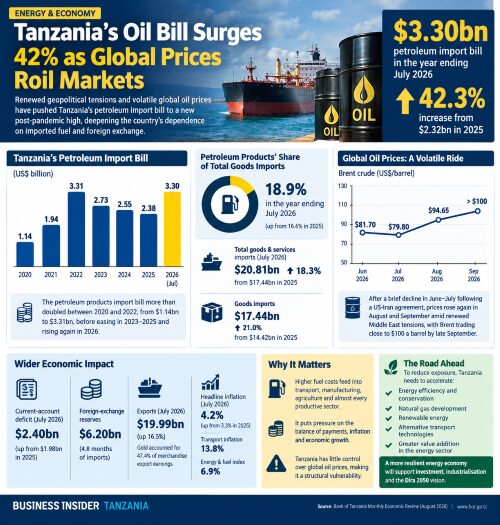
The cost is also reflected in the country’s external position. The current-account deficit widened to US$2.40 billion in the year ending July 2026, from US$1.98 billion a year earlier. The BoT said the deterioration was driven by a US$3.02 billion increase in imports, fuel and investment-related demand among the factors, although this was partly offset by stronger exports.
Foreign-exchange buffer provides cushion
Tanzania’s external position nevertheless remains relatively resilient. Foreign-exchange reserves reached US$6.2 billion at the end of July 2026, sufficient to cover about 4.8 months of projected imports, according to the BoT.
The country is also benefiting from stronger export earnings. Goods and services exports rose 16.5 percent to US$19.99 billion in the year to July, led by gold, manufactured goods and services.
Gold alone generated US$5.67 billion, accounting for 47.4 percent of merchandise export earnings. But the oil bill remains a structural vulnerability.
Beyond the pump
The impact of oil-price volatility extends through the wider economy because petroleum is an input into transport, agriculture, manufacturing, logistics and virtually every other productive activity.
The BoT reported that Tanzania’s annual headline inflation rose to 4.2 percent in July 2026, from 4.0 percent in June and 3.3 percent a year earlier. Transport inflation reached 13.8 percent, while the energy, fuel and water-bills index rose 6.9 percent.
The central bank responded partly to emerging inflation risks by raising its Central Bank Rate from 5.75 percent to 6.25 percent in July, citing, among other factors, the possibility of second-round effects from elevated energy, fertiliser and transport costs. Domestic fuel prices have since eased from their mid-year highs, offering some relief to consumers. But the international market remains vulnerable to further geopolitical shocks.