
By Business Insider Reporter, Pwani
Tanzania has reinforced its commitment to sustainable industrialisation after temporarily suspending operations at a steel manufacturing plant in the Coast Region over alleged environmental violations, signalling that regulatory compliance is becoming an increasingly important pillar of the country’s investment agenda.
Minister of State in the Vice President’s Office (Union and Environment), Engineer Hamad Yussuf Masauni, ordered the temporary closure of African Steel Group Co. Ltd in Bagamoyo after an inspection found the company had failed to comply with environmental management requirements despite receiving repeated directives from regulators.
The decision follows growing complaints from neighbouring communities over excessive air pollution, wastewater discharge and poor industrial waste management, issues that authorities say pose risks to public health and the surrounding environment.
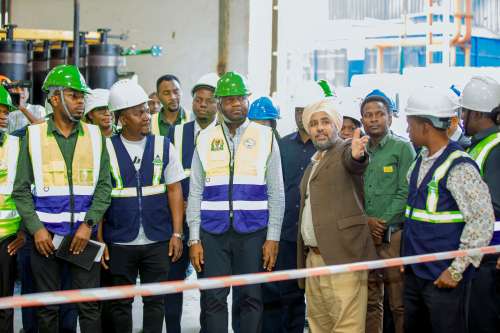
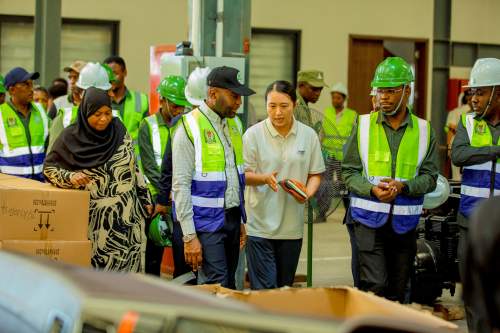
Speaking during an inspection tour of three factories in Bagamoyo on Friday, Masauni said the steel manufacturer would remain closed until it fully addresses the identified shortcomings.
Among the violations cited were excessive smoke emissions capable of affecting workers and nearby residents, the discharge of untreated wastewater into the environment, indiscriminate disposal of industrial waste and the absence of a designated storage area for scrap metal, resulting in land contamination.
“The objective of this inspection is to assess how industries are complying with environmental laws. We have discovered that some factories continue to ignore directives issued by our environmental experts despite repeated warnings,” Masauni said.
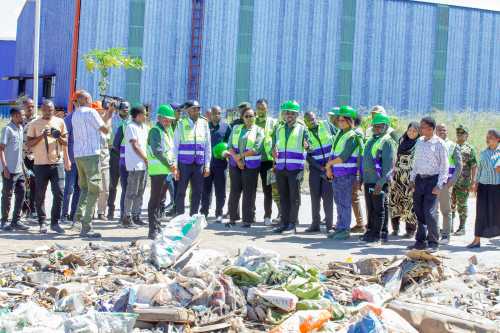
Photos: Vice President’s Office.
According to the minister, the National Environment Management Council (NEMC) had inspected the facility on four separate occasions and issued compliance notices, while also engaging with the company’s management to address operational challenges. However, the required corrective measures were not implemented.
The action underscores Tanzania’s increasingly balanced approach to industrial development – one that seeks to attract investment while enforcing environmental, social and governance (ESG) standards that are becoming central to global manufacturing competitiveness.
President Samia Suluhu Hassan’s administration has prioritised industrial expansion as a key driver of economic growth, employment creation and domestic revenue mobilisation.
Manufacturing has emerged as one of the fastest-growing sectors of the economy, supported by investments in industrial parks, transport infrastructure and energy projects.
Masauni emphasised that environmental enforcement should not be viewed as opposition to investment but rather as a safeguard for sustainable economic development.
“The Government strongly supports industrial investment because it creates jobs, expands production and contributes to tax revenues. However, neither the Vice President’s Office nor its institutions will compromise on enforcing laws designed to protect the lives and health of Tanzanians,” he said.
For investors, the incident serves as a reminder that regulatory compliance is becoming an increasingly important factor in maintaining operating licences. As international investors and financiers place greater emphasis on ESG performance, adherence to environmental standards is emerging as both a legal obligation and a business imperative.
NEMC Director General Dr. Immaculate Sware said the environmental regulator would continue strengthening oversight of industrial facilities to ensure companies operate responsibly and minimise pollution.
“We will continue enforcing environmental legislation to ensure industries fulfil their obligations and reduce environmental pollution,” she said.
Representing African Steel Group, company official Paul Damas acknowledged the Government’s directives and said the company would immediately begin implementing all required corrective measures to enable the factory to resume production.
The development comes as Tanzania intensifies efforts to position itself as a competitive manufacturing destination under its industrialisation strategy while simultaneously strengthening environmental governance. Analysts note that predictable enforcement of environmental regulations not only protects communities and ecosystems but also enhances investor confidence by creating a level playing field where compliant businesses are not disadvantaged by operators that disregard the law.