
By Business Insider Reporter
AGL Tanzania, one of the country’s leading transport and logistics companies, has successfully implemented a company-wide sustainability initiative aimed at reducing plastic waste while extending environmental awareness and safety support to the wider community.
The initiative, dubbed “Plastic-Less,” marks a significant step in the company’s efforts to promote responsible resource management by reducing dependence on single-use plastic water bottles and encouraging sustainable behavioral change among employees and community members.
Launched on June 5 to coincide with global climate action activities under the theme “Act Now for the Climate,” the programme introduced reusable water bottles for all employees and enhanced access to water refill stations across the company’s facilities. Water dispensers were installed in boardrooms alongside existing units in departments, while visitors will be served using reusable glassware that is cleaned and sanitized through dedicated facilities.
According to AGL Legal Manager Angeline Mtulia, the initiative demonstrates how practical changes supported by the right infrastructure can generate meaningful environmental and social benefits.
“Sustainability is our corporate commitment and it is a responsibility we share with our employees for our future generations,” she said, adding that the programme reflects the company’s determination to embed sustainability into everyday operations.
Unlike outright bans on plastic products, the initiative focuses on replacing disposable alternatives with reusable solutions, a strategy that the company believes will deliver measurable long-term reductions in plastic waste. To assess its effectiveness, AGL’s safety department will continuously monitor and compare plastic consumption levels before and after implementation.
The programme also incorporated environmental awareness sessions for employees. Members of The Recyclers, a recycling-focused community group, educated staff on the environmental consequences of plastic pollution and the importance of proper waste disposal. The sessions emphasized that small individual actions can collectively produce significant environmental gains.
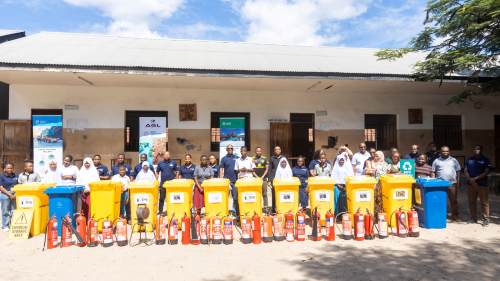
Beyond its internal operations, AGL extended the initiative into the community through a Corporate Social Responsibility programme implemented alongside its sister company, EALS, at Mabibo Secondary School in Dar es Salaam.
The companies donated 12 waste bins, 27 fire extinguishers and a manual fire alarm siren to strengthen environmental management and safety preparedness at the school. The donation builds on an existing partnership that saw the companies support the construction of sanitation facilities and an equipped library at the school in 2025.
Students received practical training on waste segregation and environmental conservation, using clearly labelled bins for food waste, plastics and general refuse. The sessions also reinforced fire safety awareness, complementing ongoing training provided by local fire authorities.
The initiative highlights a growing shift among private-sector companies from focusing solely on internal sustainability targets to actively supporting environmental stewardship within surrounding communities.
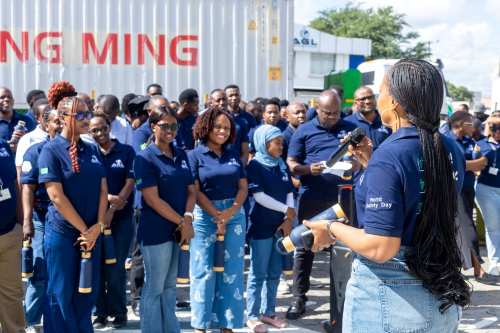
By combining operational changes, employee engagement and community outreach, AGL is positioning sustainability as both a business responsibility and a shared social commitment.
The logistics giant connects Tanzania and the wider East and Central African region to global markets through integrated freight, maritime, warehousing and supply chain solutions. It is part of the global Africa Global Logistics group, a member of the MSC family, which operates across more than 50 countries and employs over 23,000 people worldwide.
In Tanzania, AGL has a strong nationwide footprint with operations in major commercial and transport hubs including Dar es Salaam, Tanga, Mtwara, Mwanza, Kigoma, Isaka, Arusha, Namanga, Tunduma and other key border points. The company serves sectors such as mining, oil and gas, agriculture, telecommunications, humanitarian logistics, industrial projects and general trade.