By Business Insider Reporter, Dodoma
The government has signed a landmark financing agreement worth US$1.277 billion to advance construction of the Standard Gauge Railway (SGR) from Makutupora in Dodoma to Isaka, a critical stretch expected to deepen regional connectivity and accelerate the country’s long-term economic transformation.
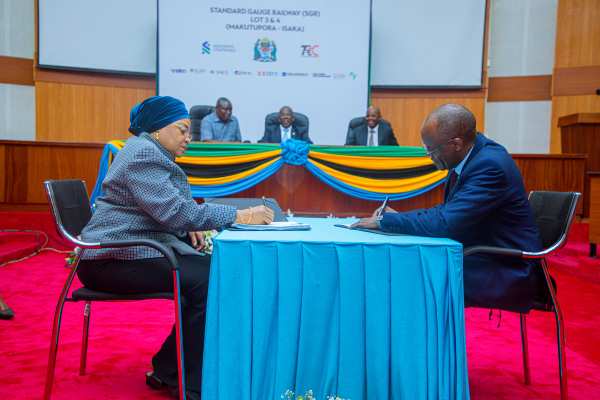
The agreement, signed in Dodoma by Permanent Secretary in the Ministry of Finance Natu El-maamry Mwamba and Herman Kasekende of Standard Chartered, forms part of a broader US$2.33 billion financing package for Lots 3 and 4 of the railway, covering the route from Makutupora in Singida Region to Isaka.
The funding is structured as a syndicated export credit facility backed by European export credit agencies – SACE, EKN, and KUKE – highlighting growing international confidence in Tanzania’s infrastructure pipeline.
Strategic corridor for trade and logistics
Finance Minister Khamis Mussa Omar described the investment as a continuation of one of the most ambitious infrastructure programmes in Tanzania’s history, aimed at linking the Port of Dar es Salaam with the Lake Zone and neighbouring countries.
“This is not just a major infrastructure investment, but a national flagship project aligned with Tanzania’s long-term development vision,” he said, noting that the railway will strengthen the country’s position as a regional trade and logistics hub.
Once completed, the SGR corridor is expected to connect inland markets in north-western Tanzania with regional economies including Rwanda, Burundi and the eastern Democratic Republic of Congo, significantly reducing transit times and logistics costs.
Economic impact already emerging
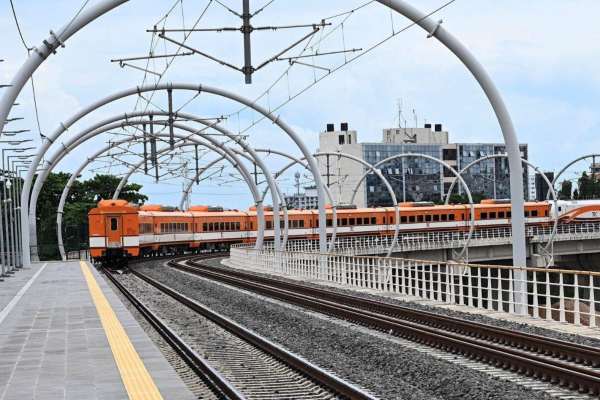
The SGR has already begun reshaping Tanzania’s transport landscape. According to Transport Minister Makame Mbarawa, passenger services between Dar es Salaam and Dodoma have carried nearly six million passengers, while freight operations have moved approximately 120,000 tonnes of cargo.
Travel time along the corridor has been reduced from around 12 hours by road to just three hours by rail – an efficiency gain with direct implications for business productivity, supply chain reliability and regional trade flows.
At full capacity, the railway is projected to handle up to five million tonnes of cargo annually, easing pressure on road infrastructure, lowering vehicle operating costs, and improving safety.
Driving down costs and carbon emissions
Beyond logistics, the electrified railway is central to Tanzania’s shift towards a more sustainable transport system. Authorities estimate that the SGR has already reduced fuel consumption by approximately 17 million litres, while cutting carbon emissions by more than 50 per cent compared to road transport.
This positions the project within the broader context of climate-resilient infrastructure and low-carbon growth – an increasingly important consideration for development finance and international partnerships.
Financing model signals shift
The Makutupora–Isaka financing reflects a broader evolution in how large-scale infrastructure projects are funded in Africa. Rather than relying solely on sovereign borrowing, Tanzania is leveraging blended finance models that combine export credit, commercial lending and development partnerships.
The involvement of European export credit agencies underscores the role of tied financing in securing technology transfer and engineering expertise, while also opening the door for further private sector participation.
Diplomatic representatives from Sweden, Italy and Poland welcomed the progress, noting that successful implementation of earlier SGR phases has strengthened confidence and paved the way for deeper cooperation.
Unlocking regional integration
The Makutupora–Isaka section is strategically significant as it extends the railway towards the Lake Victoria corridor, bringing Tanzania closer to realising its ambition of serving as a gateway for landlocked countries in East and Central Africa.
By improving connectivity between the Port of Dar es Salaam and inland markets, the SGR is expected to:
- Lower the cost of imports and exports
- Increase trade volumes across borders
- Enhance competitiveness of Tanzanian goods
- Attract industrial investment along the corridor
The railway also complements other regional infrastructure initiatives, including road networks and energy projects, reinforcing Tanzania’s role within the East African Community’s integration agenda.
A long-term development catalyst
Beyond transport, the SGR is increasingly viewed as a catalyst for broader economic transformation. Industrial clusters, logistics hubs and urban growth corridors are expected to emerge along the railway line, creating jobs and stimulating private sector activity. As Tanzania advances towards its development goals, the successful delivery of the SGR will be critical in shaping the country’s economic geography – linking production zones to markets, reducing structural inefficiencies, and positioning the economy for sustained growth.