
By Business Insider Reporter
The country’s public debt strategy is increasingly being used as a key instrument to finance long-term economic transformation, particularly large infrastructure projects aimed at lowering production costs and improving national competitiveness.
According to the latest economic data released by the Bank of Tanzania, the country’s total national debt stock reached approximately US$ 51.33 billion by January 2026, representing a 2.3 percent increase compared with the previous month.
The gradual increase reflects the government’s continued reliance on borrowing to finance strategic development projects aligned with the country’s long-term planning frameworks, including the Tanzania Development Vision 2025 and the emerging Tanzania Development Vision 2050 (Dira 2050).
These frameworks prioritise large-scale investments in infrastructure, energy, transport and industrialisation—sectors viewed as critical for sustaining economic growth and improving productivity across the economy.
External debt remains the largest component
External debt continues to account for the largest share of Tanzania’s public debt portfolio.
By the end of January 2026, external debt stood at about US$ 35.75 billion, reflecting the government’s preference for concessional financing from multilateral institutions and development partners.
Multilateral lenders – including the World Bank and the African Development Bank (AfDB) – account for about 58.2 percent of the external debt stock. These loans are generally offered at lower interest rates and longer repayment periods compared with commercial borrowing, making them attractive for financing long-term development projects.
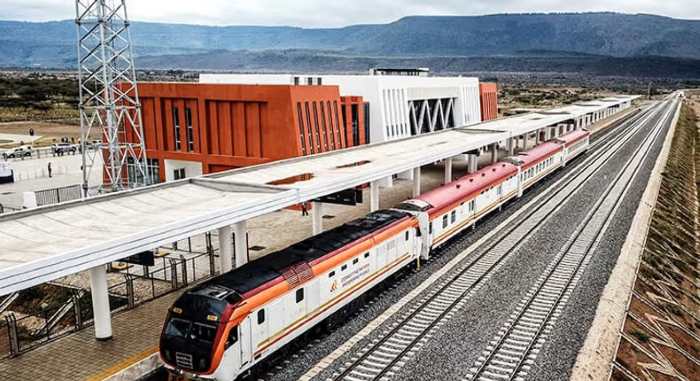
A significant portion of these funds has been directed toward infrastructure expansion. About 21.8 percent of external borrowing has been allocated to transport and telecommunications, sectors that are central to Tanzania’s strategy of becoming a regional logistics and trade hub.
Major projects financed through external resources include the construction of the Standard Gauge Railway and the development of the Julius Nyerere Hydropower Project (JNHPP).
Both projects are expected to significantly reduce transportation and energy costs for businesses while strengthening the country’s industrial base.
Another 22.7 percent of external borrowing has been directed toward balance-of-payments support and budget financing, helping the government maintain macroeconomic stability and support the Tanzanian shilling during periods of external pressure.
Domestic debt market deepens
Alongside external borrowing, Tanzania has been strengthening its domestic debt market to mobilise internal resources and reduce exposure to global financial volatility.
By January 2026, domestic debt had reached TSh 38.6 trillion, representing a 1.9 percent increase compared with the previous month.
A key feature of Tanzania’s debt management strategy has been the gradual shift toward long-term borrowing instruments. According to the central bank, about 80.4 percent of domestic debt is now held in Treasury bonds, rather than short-term Treasury bills.
This strategy helps reduce rollover risk, which arises when governments must frequently refinance short-term debt at potentially higher interest rates.
Institutional investors – particularly commercial banks and pension funds such as the National Social Security Fund – remain the primary buyers of government securities, providing a stable domestic source of financing.
Balancing borrowing and sustainability
Economists note that while Tanzania’s debt has been rising in recent years, much of the borrowing has been directed toward productive infrastructure projects expected to support long-term economic growth.
Improved transport networks, expanded electricity generation and better logistics infrastructure are seen as key drivers of industrial development, regional trade and job creation.
However, analysts also stress the importance of maintaining prudent debt management and ensuring that major investments generate sufficient economic returns to support future repayment obligations. As Tanzania moves toward its next development planning cycle, balancing infrastructure financing with fiscal sustainability is likely to remain a central challenge for policymakers.
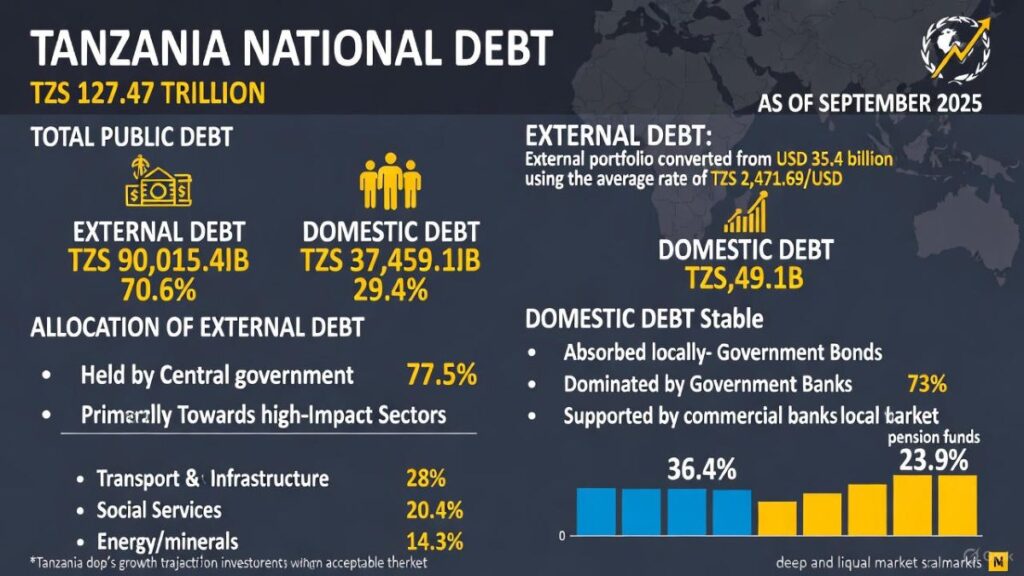
External debt by user of funds (Converted to TSh) as of November 2025
| Sector / Use of Funds | Amount (US$ Million) | Amount (TSh Bn) | % Share |
| Transport & Infrastructure | 9,910.4 | 24,508.1 | 28.0% |
| Social services (Education & Health) | 7,238.1 | 17,895.8 | 20.4% |
| Energy & Minerals | 5,058.7 | 12,506.2 | 14.3% |
| Agriculture & Water | 4,964.3 | 12,280.9 | 14.0% |
| Finance & Insurance | 1,794.7 | 4,436.6 | 5.1% |
| Industry & Trade | 1,494.9 | 3,691.7 | 4.2% |
| Others | 4,977.1 | 12,703.7 | 14.0% |
| Total | 35,438.2 | 90,015.4 | 100% |
✔ Converted using TZS 2,471.69/USD.
Detailed Breakdown – Domestic Debt (TSh)
Domestic Debt Structure by Creditor Category
| Creditor Category | Share (%) | Amount (TSh Bn) |
| Commercial Banks | 36.4% | 13,626.1 |
| Pension Funds | 23.9% | 8,946.7 |
| Other Financial Institutions | 39.7% | 14,886.3 |
| Total Domestic Debt | 100% | 37,459.1 |
Domestic Debt by Instrument Type
| Instrument Type | Share (%) | Amount (TSh Bn) |
| Government Bonds | 73% | 27,349.1 |
| Treasury Bills | 27% | 10,110.0 |
| Total | 100% | 37,459.1 |