By A Correspondent
The Office of the Treasury Registrar (OTR) has opened doors for Rand Merchant Bank (RMB) to explore financing and investment opportunities across Tanzania’s public enterprise portfolio, in a move aimed at unlocking capital for strategic projects and strengthening the financial capacity of public entities.
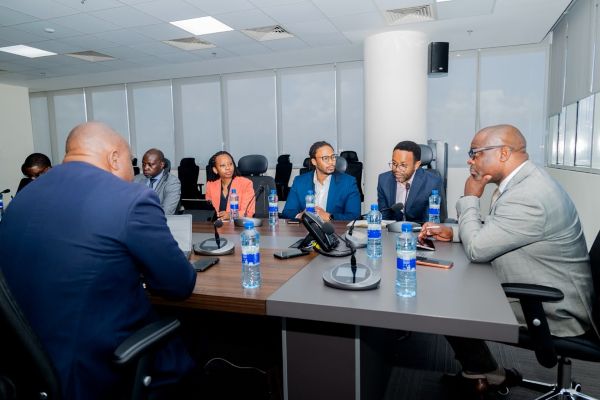
The invitation was extended on Tuesday by Treasury Registrar Nehemiah Mchechu during a meeting with a delegation from FirstRand Bank Limited, which operates principally through RMB, led by John Njuguna, Lead Banker for the East Africa Institutional Clients Segment, at the OTR offices in Dar es Salaam.
FirstRand Bank Limited, dual-listed on the Johannesburg Stock Exchange and the Namibia Stock Exchange, is among Africa’s largest financial institutions, with a market capitalisation exceeding US$30 billion.
Through RMB, the bank has extensive experience in structuring and providing financing solutions to governments, state-owned enterprises, financial institutions and corporates across East Africa, including Tanzania.
The discussions explored potential financing and investment opportunities in infrastructure, renewable energy, agriculture, transport, telecommunications, mining, pharmaceuticals and other productive sectors, with a focus on how RMB’s financial expertise could support investment, expansion and business growth among public entities.
Mr. Mchechu said OTR was ready to facilitate the bank’s engagement with public enterprises to identify viable projects and explore financing solutions suited to their individual needs.
OTR manages a portfolio of 308 public entities, comprising 252 majority-owned public sector companies and 56 companies in which the Government holds minority interests.
The portfolio has a combined investment value of TSh92.3 trillion, representing a significant base of public investments with potential to contribute further to economic growth.
Mr. Mchechu said the Government was encouraging public enterprises to become more financially independent by making better use of their balance sheets and accessing alternative sources of capital rather than relying heavily on budgetary support.
Such financing options include commercial bank loans, bond issuance and raising capital through the stock market, depending on the financial position, business model and funding requirements of individual enterprises.
He encouraged RMB to examine the opportunities within the portfolio and develop proposals that could be assessed jointly with OTR and the respective institutions.
Responding, Mr. Njuguna said RMB was interested in deepening its engagement with Tanzania’s public enterprises, building on its experience in supporting infrastructure and corporate financing transactions across African markets.
He noted that Tanzania’s infrastructure development priorities and its strategic position in regional trade and transport connectivity presented opportunities for the bank to contribute through financing and investment solutions.
Elaborating on the bank’s capabilities, RMB’s Head of Infrastructure Sector Solutions for Broader Africa, Sindisiwe Mosoeu, outlined financing approaches that could be considered for projects undertaken by public enterprises.
These include project finance, public-private partnerships (PPPs), export credit agency-backed facilities and renewable energy financing.
She explained that the choice of financing structure would depend on the nature of each project, its commercial viability, expected revenue streams and capacity to attract external funding.
RMB also highlighted its experience in financing renewable energy projects, particularly in solar, wind and hydropower, across African markets.
Such experience could provide opportunities for public entities seeking to develop energy projects and diversify their sources of financing.
Beyond project-level funding, the discussions also explored financing solutions tailored to the cash-flow requirements of individual enterprises, longer-term funding arrangements and opportunities to access international capital markets.
RMB Structurer for Broader Africa Global Markets, Sinethemba Mvandamba, said the bank’s role extended beyond providing financing within African markets to helping clients connect with international sources of capital.
He explained that RMB sought to support clients in accessing opportunities in international markets, broadening the range of financing options available to businesses and institutions across the continent.
The delegation also expressed interest in opportunities in agriculture, including financing arrangements to support the procurement of essential agricultural inputs and strengthen the wider agricultural value chain.
A key consideration raised during the discussions was the need to match financing instruments with the economic life and revenue-generating capacity of projects. This is important in managing repayment obligations and avoiding refinancing risks that can arise when short-term funding is used for projects that require long-term financing.