By Business Insider Reporter
The Government has reaffirmed its commitment to transforming Tanzania’s cashew subsector into a resilient, high-value engine of growth – one that boosts farmer incomes, deepens industrialisation and strengthens export earnings.
Delivering a message from President Dr. Samia Suluhu Hassan during a working tour of Mtwara Region on December 11, Minister for Agriculture, Daniel Chongolo, said the Sixth Phase Government will continue easing the burden on cashew farmers by guaranteeing timely and affordable access to agricultural inputs, improving markets and strengthening the entire value chain.
“The Government will continue to ease the burden on cashew farmers by ensuring reliable access to agricultural inputs,” Mr Chongolo noted when delivering the President’s message on Thursday.
Strong performance, higher ambitions for 2025/26
The cashew subsector is a key pillar of Tanzania’s agriculture, supporting millions of livelihoods across major producing regions, namely Mteara, Lindi, Ruvyma, Pwani, Morogoro and Tanga, and ranking the country among Africa’s leading producers.

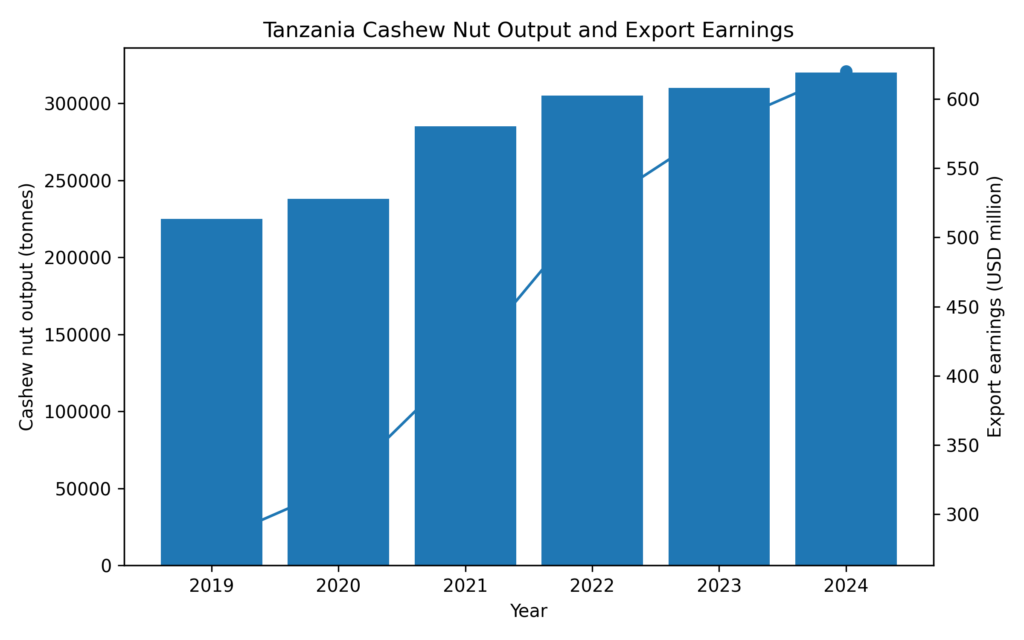
Output has grown strongly in recent seasons, rising from 189,114 tonnes in 2022/23 to 305,014 tonnes in 2023/24, before reaching a record 528,260 tonnes in 2024/25. Building on this momentum, the Government has set ambitious 2025/26 targets aimed at boosting productivity, increasing marketed volumes and expanding local processing to raise farmer incomes and export earnings.
Production in the 2025/26 season is projected to reach about 700,000 tonnes, with the Government targeting one million tonnes by 2030 to strengthen export growth, rural incomes and national development.
According to TRA and Bank of Tanzania projections, cashew exports are expected to earn about US$527.6 million in 2025, nearly double the previous year. In 2024, the crop earned US$225.6 million, up from US$206.4 million in 2023, when it ranked ninth among Tanzania’s top foreign exchange earners.
Mtwara Port, value addition and farmer prosperity
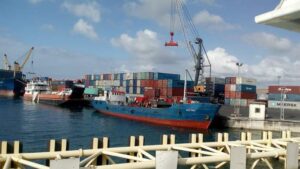
To ensure the southern regions fully benefit from the crop, Minister Chongolo directed that all raw cashew exports be routed through the Port of Mtwara. The move is designed to cut logistics costs, stimulate regional trade services and anchor industrial growth around the port.
The Minister also instructed the Cashew Board of Tanzania to continue safeguarding the primary market, particularly by curbing unregulated traders – commonly known as kangomba – whose activities undermine price transparency and farmer earnings.
During a visit to the Maranje Industrial Park, the Minister reiterated the Government’s resolve to expand domestic processing capacity. New and planned factories are expected to significantly increase value addition, create jobs and retain more wealth locally.
He emphasised that each facility should include a modern laboratory to test moisture levels and quality, ensuring Tanzanian cashews meet stringent international standards, especially for discerning markets such as China and Vietnam.
Science, technology and reforms at the core
At the TARI–Naliendele Agricultural Research Centre, Minister Chongolo called for accelerated modernization of cashew research to improve seed quality and combat pests and diseases.
He cited the adoption of advanced technologies – including drones for precise application of sulphur-based pesticides – as a practical example of science-driven productivity gains.
These interventions align with broader sector reforms aimed at strengthening institutions, improving input distribution, enhancing extension services and promoting private investment across the value chain.
Driving national development
Beyond exports, the cashew industry plays a pivotal role in national development – raising rural incomes, supporting food security, generating employment and anchoring agro-industrialisation under Tanzania’s long-term development vision. By tightening regulation, promoting value addition and investing in research and infrastructure, the Government aims to ensure the sector plays its full role in inclusive growth and improved livelihoods.