
Initiative strengthens intra-EAC trade, supports women and youth entrepreneurs, and deepens East Africa’s economic integration
By Business Insider Reporter
In a landmark step towards promoting regional integration and inclusive trade across East Africa, the East African Business Council (EABC) has launched a Trade Information Booth on both sides of the Taveta–Holili One Stop Border Post (OSBP).
The initiative – implemented in partnership with the Tanzania Chamber of Commerce, Industry and Agriculture (TCCIA) and supported by AGRA – aims to simplify access to cross-border market information, trade procedures, and the EAC Simplified Trade Regime (STR) for small-scale traders, particularly women and youth.
The newly established Trade Information Booth is designed as a one-stop centre for small traders engaged in cross-border commerce between Tanzania and Kenya.
Equipped with digital tools such as educational videos, internet-enabled devices, and direct links to Non-Tariff Barriers (NTB) reporting platforms, the booth will play a critical role in facilitating transparent, efficient, and compliant trading within the East African Community (EAC).
The platform also integrates a WhatsApp-based B2B market information service, enabling traders to connect, share real-time updates, and report challenges such as harassment or bureaucratic delays.
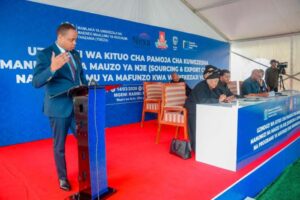
Speaking during the launch at the border, Mr Gift Gabriel, Trade in Goods Officer representing EABC’s Acting Executive Director, Mr Adrian Raphael Njau, said the initiative is part of the broader “Promoting Intra-EAC Agri-Food Cross-Border Trade” project, which focuses on addressing non-tariff barriers and empowering women and youth in cross-border agri-food trade.
“By simplifying trade procedures and strengthening market linkages, this initiative will enable small traders—especially women and youth—to participate more fully in regional value chains,” Mr Gabriel said.

Advancing east Africa’s integration agenda
The Taveta–Holili OSBP, linking northern Tanzania and southern Kenya, has long been a critical gateway for trade in agricultural goods, especially cereals and horticultural produce.
However, traders have often faced challenges such as inconsistent border procedures, limited access to information, and burdensome inspection fees.
Speaking on behalf of Tanzania’s Ministry of Foreign Affairs and East African Cooperation, Mr Amedeus Arbogast Mzee underscored that the initiative reinforces the principles of the EAC Treaty, which prioritises balanced development, gender equity, and youth empowerment.
“The Trade Information Booth reflects the EAC’s commitment to a people-centred, market-driven integration process – one that promotes inclusion and equitable growth,” he said.
Representing Kenya’s Ministry of EAC, ASALs and Regional Development, Ms Mary Maisory emphasised that the booth provides practical support for traders to benefit from the Simplified Trade Regime, which allows small-scale traders to move goods valued below US$ 2,000 across borders duty-free under streamlined documentation.
“This is a real step toward enabling micro-entrepreneurs to trade formally, confidently, and profitably,” Ms Maisory noted.
Public and Private sectors in collaboration
Officials from both countries’ revenue authorities also expressed commitment to supporting small-scale traders. Mr Leonard Mapunda from the Tanzania Revenue Authority (TRA) at Holili said the agency is keen to simplify border processes to help informal traders formalise their operations.
“Formalisation creates pathways for growth. It enables traders to access finance, scale operations, and contribute meaningfully to our economies,” he said.
From the Kenyan side, Mr Hudson Makhanu of the Kenya Revenue Authority (KRA) announced that a help desk for small cross-border traders will become operational at Taveta in November 2025, complementing the new Trade Information Booth.
Empowering women and youth entrepreneurs
More than 70 women and youth cross-border traders attended the launch, which also featured a Public–Private Dialogue (PPD) on Non-Tariff Barriers and trade facilitation. Participants raised concerns about complex procedures and high fees for plant health inspection and certification, which continue to hinder smooth trade in agricultural goods.
In response, EABC rolled out a series of capacity-building sessions focusing on:
Financial literacy to enhance access to credit and business sustainability.
Business management training for cross-border cooperatives to improve governance and accountability.
Gender-sensitive practices to equip border officials with skills to prevent harassment and support inclusive trade facilitation.
As part of the event, EABC, TCCIA, and AGRA introduced a “Business Capital Award” competition for young women traders. Ten women from both Taveta (Kenya) and Holili (Tanzania) received USD 200 each for demonstrating successful cross-border trade under the Simplified Trade Regime.
EABC also extended USD 500 grants to the Matunda Women Group (Holili) and Taveta Cross Border Traders SACCO to help integrate young traders into formal cooperatives and enable access to microloans.

Regional integration beyond policy
This initiative highlights the growing synergy between the private sector and policy institutions in advancing East Africa’s integration agenda.
By bringing market information closer to the border and addressing real challenges faced by traders, EABC and its partners are translating policy goals into practical solutions that directly impact livelihoods.
The Trade Information Booth serves as a tangible example of regional integration in action—facilitating movement, connecting entrepreneurs, and breaking down the information barriers that have long limited small traders’ participation in formal trade systems.
As East Africa works toward deeper economic integration under the EAC Common Market and Customs Union, initiatives like this mark a critical shift from dialogue to implementation—bridging the gap between policy frameworks and grassroots enterprise. “The EABC’s vision of a borderless East Africa for business and investment is not a distant dream,” said Mr Gabriel. “It is becoming a lived reality for the small trader who can now cross the border with confidence, clarity, and opportunity.”