By Mwanamkasi Jumbe, Dodoma
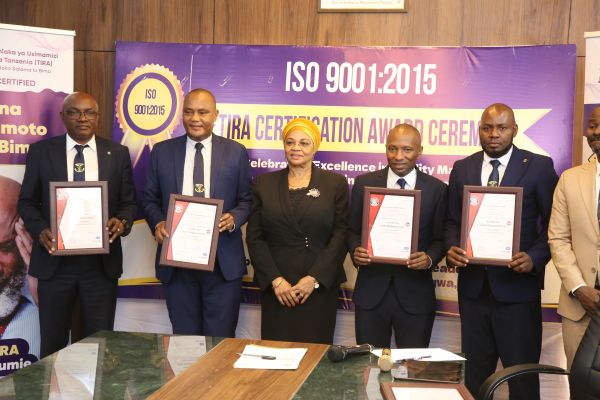
The Tanzania Insurance Regulatory Authority (TIRA) has secured the internationally recognised ISO 9001:2015 Quality Management System certification for four of its offices, marking a significant step in its efforts to improve regulatory efficiency, service delivery and accountability in the insurance industry.
The certification, awarded by the Tanzania Bureau of Standards (TBS), covers TIRA’s headquarters in Dodoma, its Dar es Salaam and Zanzibar offices, and the Eastern Zone office.
The achievement follows an improvement programme that TIRA began in 2018, focusing on strengthening institutional infrastructure, human resources and internal processes to bring its operations in line with internationally recognised quality management standards.
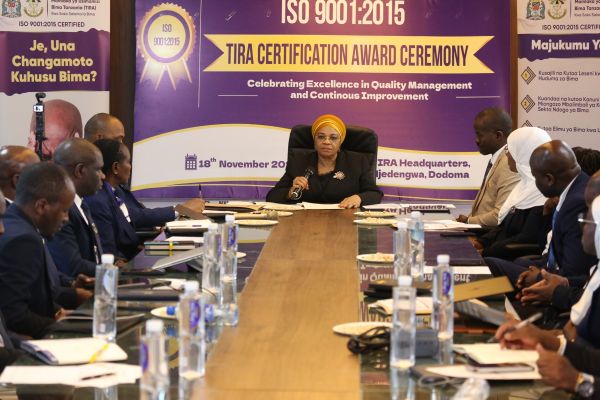
The Permanent Secretary in the Ministry of Finance, Dr Natu Mwamba, said the certification was an important institutional milestone, recognising TIRA’s efforts to strengthen operational systems, accountability and service quality.
She commended the authority’s management for the progress made in improving the insurance market, managing financial resources and investing in its working environment, including the construction of its headquarters.
She also cited TIRA’s ability to contribute dividends to the Government as evidence of institutional progress and financial accountability.
Dr. Mwamba said the achievements, alongside the insurance market performance report launched in October 2026, demonstrated the importance of effective institutional management in supporting the development of the sector.
She noted that the insurance industry contributed 2.11 per cent to Tanzania’s Gross Domestic Product (GDP) in 2025, expressing hope that the contribution would increase in subsequent years.
The Permanent Secretary said improved regulatory systems were essential to building public confidence in insurance services and strengthening the industry’s contribution to the wider economy.
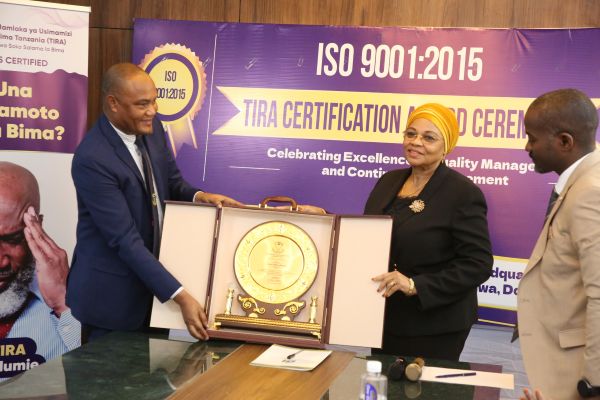
She linked the certification to the country’s Development Vision 2050, which places emphasis on institutional reforms, efficient public services and stronger systems of accountability.
“Every citizen and stakeholder receiving services from TIRA should be able to recognise the difference through the quality, professionalism, transparency and efficiency of those services,” she said.
Dr. Mwamba also challenged insurance companies to strengthen their own quality management systems and consider obtaining ISO certification as part of efforts to improve competitiveness and customer confidence.
She said the Ministry of Finance would continue supporting TIRA in providing the resources and institutional oversight needed to sustain the certification.
Speaking at the certificate handover ceremony, Commissioner of Insurance Dr. Baghayo Saqware and head of TIRA said the certification reflected years of institutional investment and a commitment to making the authority’s services more efficient and responsive to stakeholders.
He said TIRA had set out in 2018 to improve its buildings, staffing capacity and service delivery procedures, with the objective of achieving internationally recognised standards.
“Since 2018, we have been implementing our plans by improving the infrastructure, ensuring we have the required staff and strengthening the processes through which we deliver services. This year, 2026, we have achieved that objective and obtained the quality certification,” Dr. Saqware said.
He said the authority intended to extend the certification to all its 13 regional offices, emphasising that quality improvement was an ongoing institutional commitment rather than a one-off achievement.
“We are guided by the philosophy that excellence has no limits. Whatever we can accomplish in one day, we want to do in a few hours. We will continue improving our services and ensure that all our 13 offices across the country eventually meet the certification requirements,” he said.
For Tanzania’s insurance industry, the development carries significance beyond TIRA’s internal administration. As the regulator responsible for licensing and supervising insurance businesses, protecting policyholders and developing the market, the authority’s operational efficiency has a direct bearing on public confidence and the industry’s ability to expand.
Representing TBS Director General Dr Ashura Katunzi, the Director of Quality Management at TBS, Engineer Abdallah A. Kileo, said ISO 9001:2015 provided an internationally recognised framework for institutions to strengthen their management systems, improve work processes, manage risks and ensure that services meet customer and stakeholder expectations.
He said the standard was particularly important for TIRA because of the nature of its regulatory responsibilities, which require consistency, transparency and reliability.
“These services require a high level of trust, attention to detail, stability of processes and compliance with both domestic and international requirements. Therefore, this certificate is not simply proof that a quality management system exists; it is also an opportunity to strengthen confidence among customers and stakeholders, reduce operational shortcomings and increase TIRA’s contribution to national development,” Engineer Kileo said.
He stressed that the real value of certification would be measured by improvements in everyday service delivery, rather than the certificate itself.
He urged TIRA to ensure that customers received services on time, complaints were properly addressed and performance was regularly assessed to identify areas requiring improvement.
TBS, he added, would continue conducting surveillance audits at TIRA to establish whether the authority maintained the requirements of ISO 9001:2015.
For TIRA, however, the next challenge will be extending the quality management framework beyond the four certified offices and ensuring that improvements are reflected in the experience of insurance customers throughout the country. The certification is therefore an important step towards strengthening the regulatory environment, but its lasting value will depend on how consistently the authority applies the standards in its daily operations.